- Empty cart.
- Continue Shopping
Battery free light switches in Australia for retrofit use
- Posted on
 Strong Digital
- 0
- Categories: Uncategorized
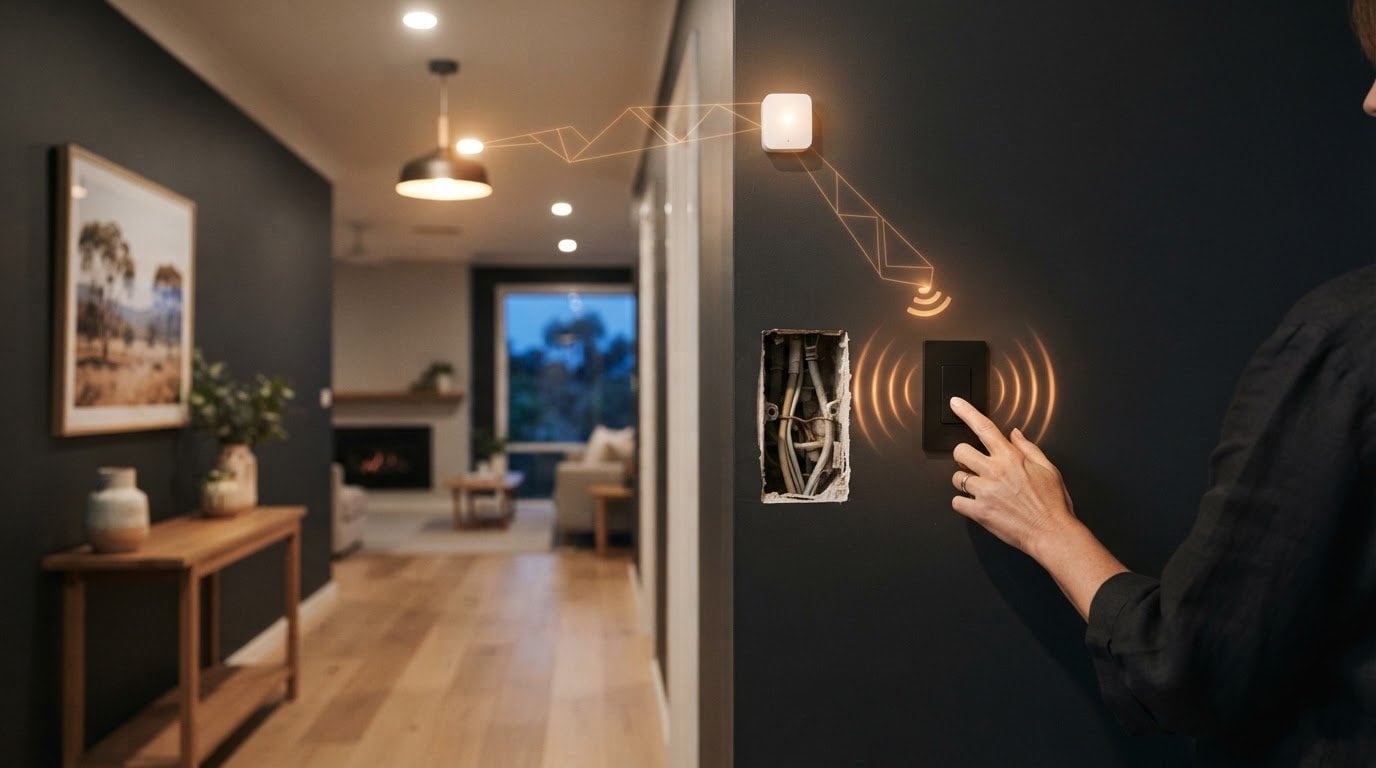
A light switch can work without a battery or a new cable. A battery free light switch in Australia can use the energy from a press to send a wireless command to a receiver, adding a control point during a retrofit. It works differently from a battery-powered remote or a hardwired switch.
It’s reasonable to want a simple upgrade that suits your home without extra wiring work. This guide explains how battery-free wireless switches work, what affects their fit with Australian switch plates, and how they compare with battery-powered and hardwired options. It also covers fixed electrical work: a licensed electrician is required to install or replace a smart light switch in Australia.
Key Takeaways
- Understand how a press-powered switch sends a wireless command without relying on a replaceable battery.
- Assess switch plate fit by looking beyond appearance to mounting and receiver compatibility.
- See how wireless accessory switches can add another control point for two-way operation in a retrofit.
- Compare battery-powered, battery-free and hardwired options by their power source, upkeep and installation needs.
- Explore the types of wireless switching options available in Australia and where each can suit a lighting setup.
Benefits of battery-free wireless light switches
A battery-free wireless switch sends a command to a receiver without needing a battery or a cable to the control. In an Australian retrofit, it can add a control point without extending wiring between switches.
Multiway switching without extra wiring
Multiway switching lets separate controls operate the same light, with a wireless accessory sending a command to its receiver. This can help when a hallway or large room needs another control point but running cable between locations would mean extra building work.
For example, a hallway light can respond to controls at either end. The wireless accessory sends its command to the receiver operating the light. The receiver and accessory must be compatible, and the signal needs a suitable path between them.
Wireless and battery-free mechanisms
A kinetic switch turns the energy from a press into a wireless signal, so it needs no replaceable battery. The receiver interprets the signal and controls the connected light or circuit.
This removes battery changes from the accessory’s upkeep. The receiver still needs an appropriate power connection, and its electrical compatibility matters. Smart switches for fixed installation in Australian homes are typically rated for 230-240 volts AC.
How much do battery-free light switches cost in Australia? Prices vary by setup. A receiver-only option differs from a set with wireless controls, so the total depends on the components the lighting arrangement requires.
What brands sell energy-harvesting light switches in Australia? Specialist wireless-control brands offer energy-harvesting switches. Compare the switch and receiver as a matched system, since a brand name alone doesn’t mean separate components will communicate.
Wireless accessories and range: Signal performance depends on the path between the wall control and receiver. Walls and receiver placement can affect communication, so a control in the same room has a different signal path from one separated by several walls. Consider positioning as part of the retrofit.
Wireless switch receivers: The receiver responds to the command and controls the relevant light or circuit. It differs from the wall accessory, which sends the command but doesn’t carry the lighting circuit’s mains load. A receiver installed elsewhere still needs a suitable connection and space.
Wireless control doesn’t make every part of a lighting setup wireless. In Australia, a licensed electrician is required to install or replace a smart light switch. This distinction matters when adding an accessory control rather than changing equipment connected to household wiring.
Compatibility with Australian switch plates
A wireless accessory can sit beside an existing Australian switch plate, but appearance alone doesn’t prove compatibility. Fit depends on the accessory’s mounting, the receiver’s electrical requirements and the switch’s intended role.
Plate fit and mounting
Start by distinguishing the wall accessory from the receiver. The accessory sends a command; the receiver connects to the lighting circuit. An accessory can offer flexible placement, while the receiver still needs suitable space and connections.
For example, a slim wireless switch may be mounted near an existing plate, but its shape, fixing method and finish must suit the wall and surrounding controls. Don’t assume it replaces a standard switch mechanism just because it looks similar. Check whether it’s designed as an added remote or a fixed switch.
Multiple-gang plates need extra thought. A two-switch plate controls separate circuits from one location, while a wireless accessory might control a receiver elsewhere. Match the number and function of the controls to avoid confusing a new wireless command with an existing wired circuit.
Neutral-wire and wiring compatibility
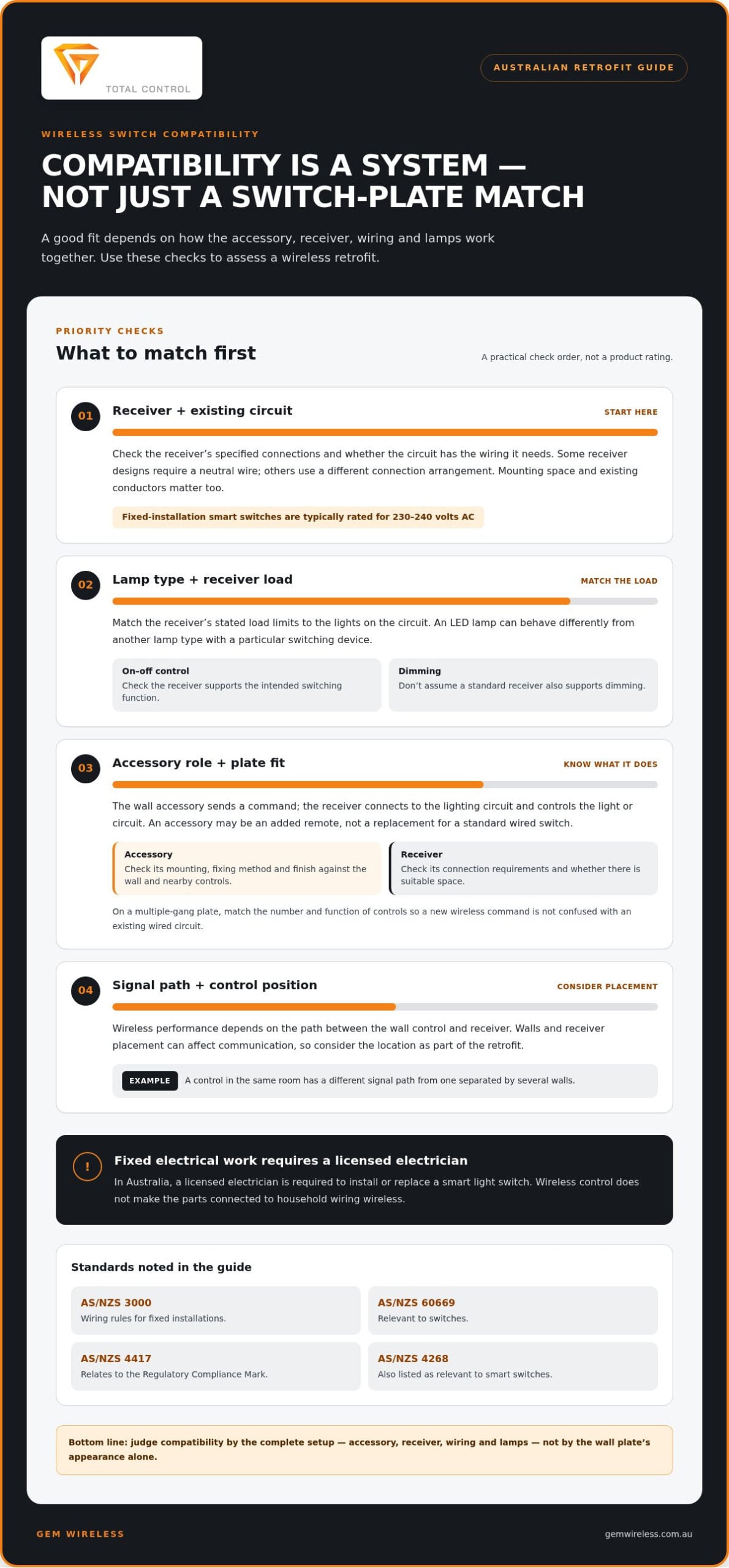
Some receiver designs require a neutral wire, while others use a different connection arrangement. The right match depends on the receiver’s wiring diagram and the existing circuit, not simply the age or style of the switch plate.
Australian smart switches for fixed installation are typically rated for 230-240 volts AC. Fixed installations must meet AS/NZS 3000 wiring rules. AS/NZS 3000:2018 is an industry source for wiring requirements, while AS/NZS 60669 is relevant to switches. A licensed electrician is required to install or replace a smart light switch.
Before choosing a receiver, identify whether it will sit behind the plate or elsewhere in the circuit. Mounting space, existing conductors and the receiver’s specified connections all affect suitability. A neat plate fit can’t make incompatible wiring suitable.
Compatible lamp types
Lamp compatibility depends on the receiver’s rated load and the lighting technology. An LED lamp, for example, can behave differently from another lamp type with a particular switching device. Match the receiver’s stated load limits to the lights on that circuit.
Consider whether one receiver will control a single lamp, several fittings or a dimmable setup. On-off switching and dimming are different functions, so don’t assume a standard receiver supports both. The lamp, receiver and control method need to work as one system.
AS/NZS 4417 relates to the Regulatory Compliance Mark, and AS/NZS 4268 is also listed as relevant to smart switches. These standards and the circuit details help frame product selection. For an Australian retrofit, compatibility means matching the accessory, receiver, wiring and lamps, rather than judging the wall plate alone.
Wireless accessory switches for retrofits and two-way control
A wireless accessory switch adds another control point by sending a command to a receiver. In a retrofit, it can support two-way or multiway control without running switch cable between locations.
How do you install and pair a battery-free light switch? A licensed electrician must install or replace a smart light switch in Australia. Pair the accessory and receiver using the manufacturer’s instructions, which set out the sequence and compatible components.
Imagine a bedroom with one switch near the door and another beside the bed. A wireless accessory at the bedside can send a command to the receiver controlling the light. This can avoid adding cable between the two control locations while keeping the existing switch in place.
For dual-control switching, the receiver needs to recognise commands from both control points. Multi-control setups work the same way, with each compatible accessory sending a command to the relevant receiver. A two-channel arrangement can control separate functions, such as two lighting circuits, if the receiver and controls support that configuration.
Battery-free accessories harvest energy from the press itself. Battery-powered wall controls use a replaceable or rechargeable battery to send their signal. Both work wirelessly, but their upkeep differs: kinetic designs avoid battery changes, while battery-powered controls need battery power over time.
Choose between them by considering placement, access and the system you’re extending. A control in a frequently used spot may be easier to maintain if it needs no battery replacement. A battery-powered remote may suit a location where its size or mounting style better fits the room. Either way, the receiver must support the control.
App, voice and remote control are separate methods, not automatic features of every wireless switch. An app or voice assistant needs a compatible smart system and receiver. A handheld remote needs a receiver designed to respond to it. Match the control method to the equipment rather than assuming a battery-free switch connects directly to Wi-Fi.
For Wi-Fi smart switches, the network can affect app-based control. Some devices require a 2.4GHz network, and may fail to connect if the router doesn’t advertise one. That requirement applies to Wi-Fi devices, not to every wireless accessory switch, which may communicate directly with its receiver.
Plan the control path: wall accessory, wireless signal, compatible receiver, then light circuit. Adding a bedside switch, for example, is different from replacing the fixed switch at the doorway. This distinction helps identify which parts are accessories and which involve mains wiring.
Differences between battery-powered and hardwired switches
Battery-powered, battery-free and hardwired switches differ in how they get power and communicate. For an Australian retrofit, the key decision is whether you’re adding a wireless control or changing the fixed switch connected to the lighting circuit.
A battery-powered wireless wall control uses a battery to send a command to a compatible receiver. It can add a control point without a cable running from that wall position to the receiver. For example, a renter or homeowner might put a remote beside the bed and replace its battery when needed.
A battery-free wireless control uses energy from a press to send its command. It avoids battery replacement, but still needs a compatible receiver to act on the signal. Both wireless options rely on communication between the control and receiver. A Wi-Fi switch also depends on its network, and some models may fail to connect if the router doesn’t advertise a required 2.4GHz network.
A hardwired switch connects directly to the lighting circuit. It doesn’t rely on a wireless signal from a separate accessory to operate the light. However, adding or moving a fixed switch can involve changes to mains wiring. A wireless accessory can add a control location without extending switch cable, though the receiver may still connect to the circuit.
In Australia, smart switches for fixed installation are typically rated for 230-240 volts AC. Fixed installations must meet AS/NZS 3000 wiring rules, and a licensed electrician is required to install or replace a smart light switch. These requirements matter when comparing a wall-mounted accessory with equipment connected to household wiring.
Use the control’s role to narrow the options:
- Battery-powered wireless control: sends commands to a compatible receiver and needs battery upkeep.
- Battery-free wireless control: harvests energy from a press and avoids battery changes.
- Hardwired switch: connects to the lighting circuit and can require fixed electrical work when installed or replaced.
In a hallway, a wireless accessory may add control at a second entry without running cable between locations. Replacing a switch depends on the wiring, receiver arrangement and circuit. These are different jobs, even if both result in a wall control operating the same light.
Choose according to the change you need. If you want another control point, compare wireless controls and their receiver compatibility. If you want to replace a fixed switch, consider the circuit and electrical installation requirements. A battery-powered remote requires different upkeep from a battery-free accessory, while a hardwired switch uses a different connection method.
Which battery-free wireless light switches are available in Australia?
Australian buyers can compare energy-harvesting wall controls, receiver-only options and wireless switch sets. Each category suits different retrofit needs. A battery free light switch in Australia generally needs a compatible receiver to control the light, so compare the control and receiver as a system.
An energy-harvesting accessory uses the energy from a press to send a wireless command, adding a wall control without a battery inside the accessory. The receiver responds to that command, so compatibility matters more than appearance. Check the control’s intended role: some are designed as additional remotes, not replacements for fixed switches.
Receiver-only options may suit a setup where a compatible wireless control is already available or sourced separately. That price applies to the receiver-only option, not necessarily a complete control setup. The wall accessory and receiver perform separate jobs, so make sure the configuration includes both.
It may suit a layout that needs separate controls for different functions, provided the receiver supports the arrangement. For example, two controls could serve separate lighting circuits. The channel arrangement and receiver compatibility determine whether the setup fits.
Match the product type to the retrofit task:
- Adding one control point: pair a wireless accessory with a receiver that operates the relevant light.
- Controlling separate functions: compare a two-channel configuration with the circuits and controls required.
- Using an existing receiver: select an accessory designed to communicate with that receiver.
- Replacing a fixed switch: distinguish mains-connected equipment from a wireless wall accessory.
Compare complete configurations, not just listed prices. A receiver-only option differs from a set that includes two switches. Check which components are included and whether they suit the lighting arrangement. Consider the signal path between the accessory and receiver too, since walls and receiver placement can affect communication.
For a battery-free light switch in Australia, the right option depends on whether the project needs a receiver, an accessory or a coordinated set. Smart switches for fixed installation are typically rated for 230-240 volts AC. A licensed electrician is required to install or replace a smart light switch in Australia. Keeping the accessory and fixed electrical equipment distinct makes it easier to compare suitable options.
Gem Wireless: Switch Module Kits
Gem Wireless offers Switch Module Kits for adding wireless control to existing switches and lights without rewiring. They’re a practical option when you want to update a lighting setup while keeping its existing controls.
The range also includes Mains Powered Switches, Long Range Switches and Switching Modules. These options address different control needs, from mains-powered switching to components for a retrofit. Consider how your lights and controls are arranged, then explore the option that best matches your project.
For a wireless control solution that works with existing switches and lights, contact Gem Wireless to discuss your setup.
Plan your next lighting upgrade
Let your lighting goal guide the next decision. A battery free light switch in Australia can be part of a broader retrofit plan, especially when you’re adding control points or changing how existing lights operate. Consider which rooms need a different setup and how each control should work day to day.
Gem Wireless offers Switch Module Kits, Mains Powered Switches and Long Range Switches. These provide different ways to approach wireless switching, depending on the system you’re planning. Match the type of control you want with the switching solution that suits your setup.
Explore the available options and take the next step at your own pace. Contact Gem Wireless about switch options to discuss a suitable direction for your lighting project.
Frequently Asked Questions
What is a battery-free light switch and how does it work?
A battery-free light switch generates energy when pressed and uses it to send a wireless command. A compatible receiver responds by controlling the connected light. For example, an added wall control can send a command without needing its own battery. The receiver is a separate part of the setup, so its power source and connection to the lighting circuit still matter.
Are battery-free light switches compatible with Australian wiring and 230-240V systems?
They can suit an Australian setup when the receiver matches the circuit and installation requirements. Smart switches for fixed installation are typically rated for 230-240 volts AC, but a wireless accessory may serve a different role from a mains-connected switch. The receiver’s wiring needs, including whether a neutral connection is required, affect compatibility. A licensed electrician is required to install or replace a smart light switch in Australia.
Do battery-free switches work with LED lights, dimmers, and smart home systems?
They work with LED lights when the receiver is compatible with the lamp and circuit. Dimming also requires a receiver designed for dimming and a dimmable lamp; an on-off receiver won’t provide that function. Smart home control depends on the wider system supporting the receiver and chosen control method. For Wi-Fi devices, check network requirements, as some need a 2.4GHz network to connect.
What is the wireless range and reliability of battery-free switches?
Range depends on the switch, receiver placement and obstacles between them. Walls and building materials can weaken a wireless signal, so a layout that works in an open room may behave differently across several rooms. Test the control from its intended position after pairing. If the signal is unreliable, moving the receiver or control may improve the path without changing the switch’s battery-free operation.
What are the advantages and disadvantages compared with wired and battery-powered switches?
A battery-free control avoids battery changes and can add a control point without running switch cable to that location. It relies on a compatible receiver and wireless signal. A battery-powered remote offers flexible placement but needs battery upkeep. A wired switch connects directly to the circuit, and its installation or replacement involves fixed electrical work. Choose according to whether you’re adding a control or changing the circuit’s switch.
How do you install and pair a battery-free light switch?
A licensed electrician is required to install or replace a smart light switch in Australia. Pair the accessory and receiver using the manufacturer’s instructions and compatible components.
Australian electricalbattery free light switchhome retrofitkinetic switchlighting controlssmart home Australiaswitch plateswireless light switches