- Empty cart.
- Continue Shopping
Farm building lighting control for sensors, dimming and wiring
- Posted on
 Strong Digital
- 0
- Categories: Uncategorized
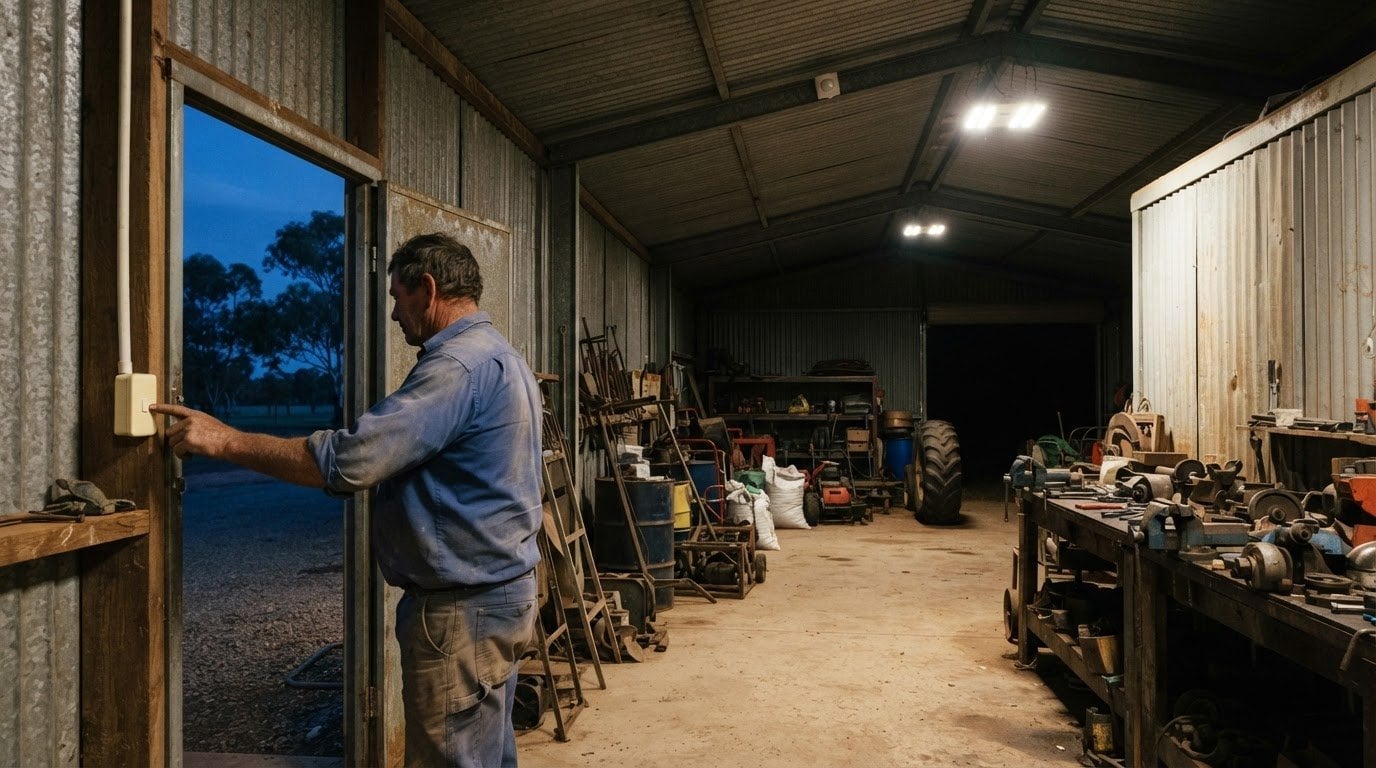
A farm building lighting control plan needs to match the space, the way it’s used and how its lights are connected. In applicable Australian buildings, motion-controlled lights must switch off when a space has been unoccupied for more than 15 minutes under NCC 2022 Specification 40. Sensor placement, delays and zones all affect how reliably that control works.
It’s easy to focus on the sensor and overlook the wiring behind it. But choosing wired or wireless control also affects how a lighting system is organised and adapted. This guide explains how to plan sensor coverage, set delays, divide areas into zones and choose between dimming and stepped control. It compares wired and wireless approaches to help you decide what suits a farm building. The aim is to provide a practical framework for choosing controls around the work taking place, from everyday movement to tasks that need steady, adjustable light.
Key Takeaways
- Plan sensor coverage around how people and vehicles move, then group lights by the tasks and areas they serve.
- Choose dimming or stepped control to match how much light each activity needs and how daylight changes across the space.
- Understand how networked and luminaire-level controls coordinate sensors and lights before deciding how much central control you need.
- Compare wired and wireless options in the context of existing switches and lights, building layout and the flexibility you want.
Motion sensor placement, delays and zoning
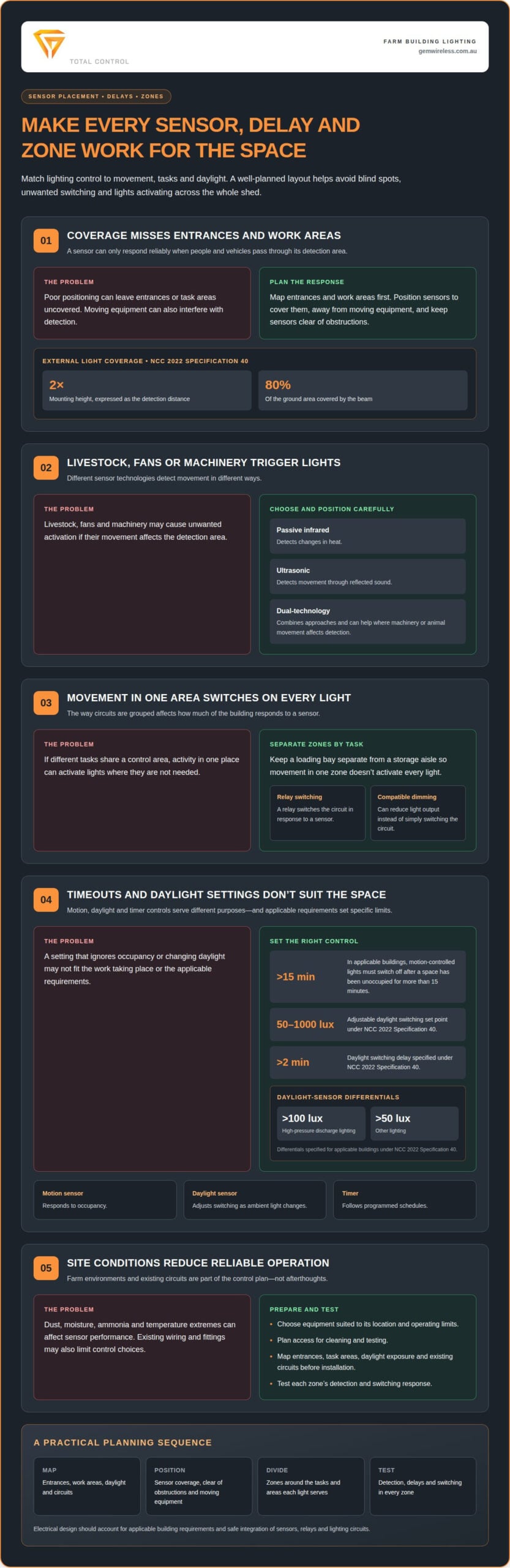
A farm building lighting control plan starts with movement patterns. Passive infrared sensors detect changes in heat, while ultrasonic sensors detect movement through reflected sound. Dual-technology sensors combine approaches, which can help where machinery or animal movement affects detection. Position sensors to cover entrances and work areas, away from moving equipment. For external lights, NCC 2022 Specification 40 sets detection coverage at a distance equal to twice the mounting height or 80% of the ground area covered by the beam.
Set timeouts to suit tasks and applicable requirements. Under NCC 2022 Specification 40, motion-controlled lights in applicable buildings must switch off after a space has been unoccupied for more than 15 minutes. A relay switches the circuit in response to a sensor. Compatible dimming controls can reduce light output instead. Separate a loading bay from a storage aisle, so movement in one area doesn’t activate every light.
Motion, daylight sensors and timers serve different purposes. Motion sensors respond to occupancy; daylight sensors adjust switching as ambient light changes; timers follow programmed schedules. NCC 2022 Specification 40 sets an adjustable daylight switching set point between 50 and 1000 lux, with a delay of more than 2 minutes. Dimming can maintain useful light levels as daylight shifts, provided the lights and controls support it.
For applicable buildings, NCC 2022 Specification 40 sets daylight-sensor differentials at more than 100 lux for high-pressure discharge lighting and more than 50 lux for other lighting. Electrical design should account for applicable building requirements and safe integration of sensors, relays and lighting circuits. Plan control layout and wiring as part of the system, not as an afterthought.
There’s no single price for farm lighting controls and installation in Australia. Costs depend on the number of zones, sensor types, wiring changes, relay requirements and whether existing lights support dimming. A single switched area has different control needs from a multi-zone shed.
For reliable farm building lighting control, consider the building’s conditions. Dust, moisture, ammonia and temperature extremes can affect sensor performance, so choose equipment suited to its location and operating limits. Keep sensors clear of obstructions and account for livestock, fans and machinery that could trigger unwanted activation. Plan access for cleaning and testing. Before installation, map entrances, task areas, daylight exposure and existing circuits, then test each zone’s detection and switching response.
Dynamic lighting dimming and stepped control
Dimming adjusts light output across a range, while stepped control switches between preset levels. In a packing area, automatic dimming can respond to daylight and maintain useful illumination while reducing electric light output. Stepped control suits familiar task settings, such as full output during loading and a lower level between tasks. The right option depends on the activity, light fittings and control gear selected.
Many LED and fluorescent systems use 0-10 V analogue dimming. It needs a pair of low-voltage control wires alongside line-voltage supply wires, so check compatibility between the controller and light driver. In a 1-10 V dimmable fluorescent system, 1 V is minimum and 0 V is off. Match the control signal to the lamp and driver. In a retrofit, this choice affects whether existing wiring can be reused.
Automatic daylight dimming uses a photosensor to measure ambient light and adjust artificial lighting as conditions change. Under NCC 2022 Specification 40, daylight-responsive dimmed or stepped controls in Australia must reduce power consumption to less than 50% of full power. Savings depend on operating hours, available daylight and control settings. Outdoor lighting can also use dimming or preset steps where full intensity isn’t needed throughout operation.
During commissioning, set a useful lower output, then test transitions as daylight changes and work areas become occupied. For agricultural projects, treat rebates or incentives as programme-specific: eligibility depends on location, equipment and the terms that apply. Include any incentive in projected savings only when the project meets those criteria. Residential and farm applications may have different requirements. If wireless switching forms part of the wider plan, wireless lighting controls can be considered alongside dimming options.
Evidence can help frame expected performance, though results remain project-dependent. A Western Michigan University study reported that daylight harvesting with continuously dimming equipment controlled by a photosensor can save 30 to 40% of lighting energy. That finding supports evaluating continuous adjustment where daylight varies, while site conditions and operating patterns still matter.
Equipment availability is broad: More than 99% of fixtures on the DesignLights Consortium SSL (LED) Qualified Products List are capable of dimming. Confirm that the selected fixture’s driver and control method are compatible, then verify performance in the installed space. This keeps fixture capability distinct from guaranteed savings and helps ensure the chosen dimming approach works with the control strategy.
Networked lighting controls and luminaire-level lighting controls
Networked controls connect sensors, controllers and lights so settings can be coordinated across a building. Two-way communication lets the system respond to occupancy or daylight changes and adjust luminaire output. Luminaire-level lighting controls place occupancy and daylight sensing at each networked fitting. That can support local movement responses, while a central controller helps manage commercial environments with different work areas.
Digital Addressable Lighting Interface, or DALI, is specified in IEC 62386. DALI-2 can combine dimming signals and network control, supporting precise intensity adjustments and collection of fixture lifetime and maintenance data. In a shed, this could mean keeping an active loading area bright while reducing output in an unoccupied aisle. More detailed control adds coordination, so its value depends on the building’s size and whether energy savings justify the extra cost.
For agricultural spaces, recommended horizontal illuminance levels vary by task. Livestock buildings are listed at 50 lux; loading and unloading areas, sick pens, calving stalls, feed preparation areas and dairy areas are listed at 200 lux. These are recommendations, not universal settings, and each environment needs consideration. Uniformity matters too: the recommended minimum Emin/Eave ratio is greater than 0.4 for livestock buildings and loading areas, and greater than 0.6 for the listed task areas.
Lighting schedules and control settings should reflect animal needs, daily work and the task area. The available agricultural recommendations give illuminance levels, not a single schedule for poultry, dairy and livestock buildings. For dairy housing, Lojer says lighting at 200 lux for 16 hours a day, with a CRI of 80, can help increase milk production by 6%; this is a reported finding, not a universal outcome. Use separate zones and programmed schedules to align light levels with activities, then consider animal routines and required task visibility when setting transitions.
Agricultural figures are recommendations; consider each unique environment. Glare value <25 for loading/unloading, sick pens, calving stalls, feed preparation/dairy areas; targets: 1-2 foot-candles at farm fence lines/perimeters, 2-3 at driveways/access points, 5 at building entries/loading bays.
Wired and wireless control systems
Wired controls connect switches and sensors physically to lighting circuits. They suit new builds or planned upgrades where cable routes can be included in the design. Fixed connections can provide straightforward operation in a poultry house with separate lighting zones, but changing control locations may require wiring changes. Map sensor positions, switching points and zones before settling on a wired layout.
Wireless controls send commands without a dedicated control cable between each device. Bluetooth Mesh operates in the 2.4 GHz frequency band, allowing compatible devices to communicate across a network. This can suit an existing shed where adding control wiring would disrupt the building. Wireless doesn’t mean there are no electrical connections: lights and control devices still need suitable power. Building materials, distance and equipment placement can affect communication, so consider the layout when planning coverage.
Australian farm sheds, barns and poultry houses can use manual switches, occupancy sensors, daylight-responsive controls, timers, dimming or wireless switching. The right fit depends on the task, existing lights, sensing needs and whether zones need independent operation. For example, a barn used occasionally may need only a manual switch, while a poultry house may benefit from scheduled control and separate areas. A mixed system can combine wired lighting circuits with wireless switching where flexible control is useful.
Choose based on the building and the way it operates, not on the assumption that one method always saves more energy. Wired control may suit stable layouts and planned installation; wireless control can enhance flexibility when extending or changing existing switching. Both can support efficient operation when control settings match occupancy and work patterns. Compare the need for new cable routes against wireless coverage and device power requirements. Explore wireless lighting control options for a retrofit where adding control wiring is impractical.
Gem Wireless
Gem Wireless provides wireless lighting and switching controls for farm buildings. Its Switch Module Kits work with conventional switch mechanisms and compatible existing lights, adding switching control without rewiring. The system is plug-and-play, with no pairing or programming required. Other options include Mains Powered Switches, Long Range Switches and Switching Modules.
The right control approach depends on the building layout, existing lighting and how you want different areas to operate. Gem Wireless products can support a practical retrofit when running new control wiring is a concern. They provide switching control, so plan separately if the lighting also needs dimming.
For a farm building lighting project, contact Gem Wireless to discuss which switching control options may suit your setup.
Shape your next control decision
Turn your building’s daily routine into a clear control brief. Identify which areas need independent switching, where wireless control could simplify changes and whether the lights need dimming. This keeps the decision grounded in how the shed operates, rather than adding features without a clear purpose.
For switching changes, Gem Wireless offers Switch Module Kits, Mains Powered Switches and Long Range Switches. These options can support a wireless approach using compatible existing lighting and switching arrangements. The right configuration depends on the system and the control outcome you want. A considered farm building lighting control plan starts with the work being done and the areas that need to respond.
Talk through your lighting control requirements with Gem Wireless. Contact Gem Wireless about lighting controls and take the next step towards a setup that fits your operation.
Frequently Asked Questions
What lighting levels are recommended for different farm buildings and tasks in Australia?
Recommended horizontal illuminance is 50 lux for livestock buildings and 200 lux for loading and unloading areas, sick pens, calving stalls, feed preparation areas and dairy areas. Treat these as starting points, not identical settings for every farm. For example, a feed-preparation space may need different lighting distribution from an open livestock shed, even where the recommended level matches. Consider each area’s tasks and conditions.
How much do farm lighting controls and installation cost in Australia?
There’s no single price for farm lighting controls in Australia. Costs depend on the number of zones, sensor types, wiring changes, relay requirements and whether existing lights support dimming.
dimmingfarm lightinglighting controllighting zonesmotion sensorssensor placementwired controlswireless controls