- Empty cart.
- Continue Shopping
Garage conversion lighting without rewiring for your room
- Posted on
 Strong Digital
- 0
- Categories: Uncategorized
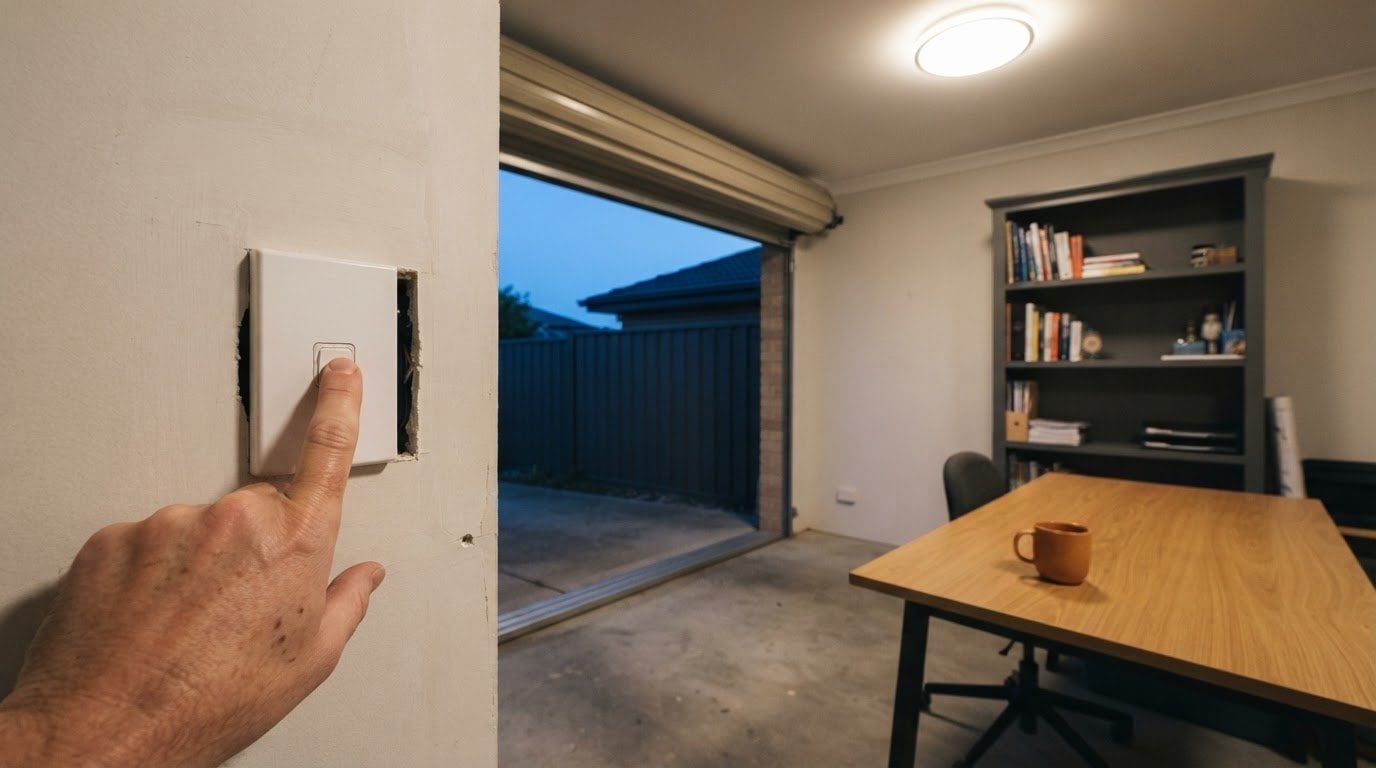
New wiring isn’t always the first move: garage conversion lighting without rewiring can work when existing electrical points and controls suit the room’s new use. But hardwired lighting must be installed by a licensed electrician and comply with AS/NZS 3000. The existing lighting circuit may also need reworking if it can’t support the converted space.
A garage conversion can gain practical, flexible lighting without rewiring. The right approach depends on the room’s new use, the light it needs and whether existing electrical points are suitable. This guide compares lighting options for a lounge, home office or workshop, including LED panels, flush-mount fittings, sensor lights and dimmable lighting, and explains how wireless switching can add control without running new switch wires.
Key Takeaways
- Reusing existing electrical points may avoid full rewiring, but hardwired lighting must meet AS/NZS 3000 and be installed by a licensed electrician.
- Match the fitting and light quality to the room’s purpose, whether it’s a home office, lounge or workshop.
- Compare LED panels, flush-mount lights, sensor fittings and dimmable options by how you’ll use the space.
- Weigh plug-in, battery-powered and solar lights against the room’s everyday lighting needs before choosing a solution.
1. What are the electrical and compliance requirements?
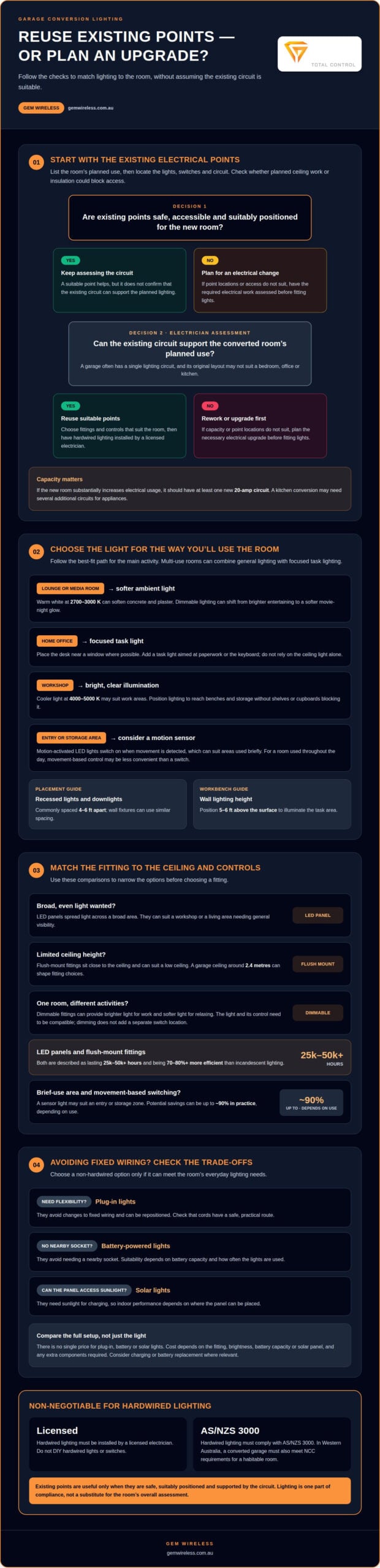
Reusing existing electrical points can make a garage conversion lighting upgrade possible without running new cables. Start by identifying the existing lights, switches and circuit, then map them against the room’s new use. A garage often has a single lighting circuit, and its original layout may not suit a bedroom, office or kitchen.
Can you DIY hardwired lights or switches in Australia? No. Hardwired lighting in a garage conversion must be installed by a licensed electrician and comply with AS/NZS 3000. In Queensland, garage lighting work must also comply with AS/NZS 3000. A converted garage in Western Australia must meet the National Construction Code (NCC) requirements for a habitable room.
Capacity matters as much as fitting placement. If the new room substantially increases electrical usage, it should have at least one new 20-amp circuit. A kitchen conversion may need several additional circuits for appliances. An electrician can assess the existing circuit and determine whether it can support the planned lighting or needs reworking before installation.
To improve lighting without rewiring, follow these steps:
- List the room’s use and lighting needs, such as general light for a lounge or task light for an office desk.
- Locate the existing electrical points and switches, including any blocked by planned ceiling or insulation work.
- Match suitable fittings and controls to those points, then have a licensed electrician assess the circuit and installation.
- If capacity or point locations don’t suit, plan the necessary electrical upgrade before fitting lights.
Existing points only help if they’re safe, suitably positioned and supported by the circuit. A garage ceiling around 2.4 metres high can shape fitting choices, while new insulation and ceiling linings may affect access to existing wiring. In Western Australia, conversion approval and broader habitable-room requirements also matter. Lighting is one part of compliance, not a substitute for the room’s overall assessment.
2. Choosing fittings for the room’s new use
Choose fittings for the activities the converted room will support. A lounge often benefits from softer ambient light, while a workshop needs clear illumination over benches and storage. In a multi-use room, combine general lighting with focused task lighting rather than relying on one ceiling fitting. Planning garage conversion lighting without rewiring starts with matching each light to its purpose.
Colour temperature helps set the mood. Warm white light at 2700–3000 K can soften concrete and plaster in a lounge or entertainment room. A workshop may suit cooler light at 4000–5000 K, which can feel clinical in a relaxation space. For detailed tasks, choose lighting that provides clear, focused illumination.
Plan placement around furniture and activity zones before choosing where fittings will go. Recessed ceiling lights and downlights are commonly spaced 4–6 ft apart; wall fixtures can use similar spacing. At a workbench, position wall lighting 5–6 ft above the surface to illuminate the task area. Keep fittings clear of shelves or cupboards that could block their light.
A home office needs focused light without relying on the ceiling alone. Place the desk near a window where possible, using natural light to reduce eye strain during long screen sessions. Then consider a task light aimed at paperwork or the keyboard. A lounge or media room has different demands: dimmable LED strips can shift the atmosphere from bright entertaining to a softer movie-night glow.
Before choosing a fitting, consider its connection to existing electrical points and how its light will reach the room. A flush-mount fitting can suit a low ceiling, while a directional wall light can highlight a reading chair or workbench. For garage conversion lighting without rewiring, match the fitting’s purpose, position and colour temperature to the room, then add task or mood lighting if one central ceiling light leaves shadows.
3. Comparing garage-conversion lighting options
LED panels and flush-mount fittings suit different ceiling layouts. Panels spread light across a broad area, while flush fittings sit close to the ceiling. This can help in a converted garage with limited ceiling height. Both types are described as lasting 25k–50k+ hours and being 70–80%+ more efficient than incandescent lighting.
Motion-activated LED lights switch on when movement is detected, making them useful in areas used briefly, such as an entry or storage zone. They can potentially save up to ~90% in practice, depending on use. For a room used throughout the day, a sensor may be less convenient than a switch because it controls light according to movement.
Dimmable fittings provide flexibility during a renovation: one fitting can give brighter light for work and softer light for relaxing. Dimming can be useful in a multi-purpose room, provided the light and its control are compatible. It changes brightness, but does not by itself add a separate switch location.
Plug-in lights avoid changes to fixed wiring and can be repositioned, but their cords need a safe, practical route. Battery-powered lights avoid the need for a nearby socket, though their suitability depends on battery capacity and how often they are used. Solar lights need access to sunlight for charging, so indoor performance depends on where the panel can be placed.
How much do plug-in, battery and solar garage lights cost in Australia? There is no single price for each type. Cost depends on the fitting, brightness, battery capacity or solar panel, and any extra components required. Compare the full setup, not just the light, and consider charging or battery replacement where relevant.
For a living area, broad LED lighting paired with dimming can balance everyday visibility and a relaxed atmosphere. A workshop may be better served by bright, even panels, while a passage can suit a sensor light. Compare options based on ceiling height, existing electrical points and how the room will be used. This helps narrow the choices before selecting fittings.
4. Are plug-in, battery-powered or solar lights suitable for a converted garage?
Plug-in, battery and solar lights can add illumination without extending fixed wiring, but their suitability depends on daily use. A plug-in lamp can work beside a home-office desk or reading chair if a suitable power point is nearby. It is less practical as the only light in a lounge where people move around or need even illumination.
Plan the cord route before positioning a plug-in fitting. Keep it away from walkways and doorways, and avoid placing it where furniture or storage could crush it. A desk lamp plugged in beside the desk is easier to manage than a lead stretched across the room. Portable fittings also make it easier to adjust lighting when the layout changes.
Battery-powered lights suit targeted tasks, such as lighting a cupboard, shelf or occasional-use corner. In a room used every evening, charging or replacing batteries may become inconvenient. Position the fitting so its beam reaches the task area, and keep it accessible for recharging. Use battery lighting as a supplement if it cannot provide consistent coverage across the whole room.
Solar lights need a panel that receives enough sunlight to charge. That can be difficult when the light is inside a garage conversion, away from direct daylight. They work best when the panel can sit outdoors in sunlight and connect to the light without an awkward route. For an internal room with limited daylight, do not rely on solar lighting as the main source.
Choose by matching the power source to the space: plug-in for a nearby socket, battery for a small or occasional task, and solar where the panel gets sunlight. Check that the light reaches the area you use, then consider how often it needs charging or repositioning. If you want to control compatible mains-powered lighting without adding switch wiring, explore wireless lighting control options.
Gem Wireless
Gem Wireless provides wireless control solutions for lighting and switching, allowing existing switches and lights to be used without rewiring. This can suit a garage conversion where the fittings already work for the room but you want more flexible control. Its plug-and-play system requires no pairing or programming.
Gem Wireless sells Switch Module Kits, Mains Powered Switches, Long Range Switches and Switching Modules for residential and commercial use. The Switch Module Kits include a wireless transmitter and controller, and work with conventional switch mechanisms. They can provide a way to add wireless control without replacing every switch or fitting. Choose the product according to your existing setup and how you want to operate the lights.
For a simpler way to manage compatible lighting, contact Gem Wireless to discuss your setup.
Plan the lighting around how you’ll use the room
Before choosing fittings, picture an ordinary day in the converted space. Consider where you will work, relax or move between tasks, and how you want to control the lights in each area. This practical check can help you choose a setup that feels natural, without adding controls you are unlikely to use.
Garage conversion lighting without rewiring can also involve adapting how existing lights are switched, not just choosing new fittings. Gem Wireless offers wireless control solutions designed to work with existing switches and lights. If you’re weighing up ways to make your lighting easier to manage, contact Gem Wireless to discuss your lighting.
A considered setup can help your converted room feel ready for its next purpose. Take the next step when you’re ready to explore your options.
Frequently Asked Questions
What are the electrical and compliance requirements?
Hardwired lights must comply with AS/NZS 3000 and be installed by a licensed electrician. Before choosing fittings, consider how the converted room will be used: a desk, lounge area or appliance zone can place different demands on the existing electrical layout. If the proposed setup increases electrical use, circuit capacity may need attention. Treat lighting compliance as one part of planning a safe, functional habitable room.
What colour temperature and dimming suit a converted garage?
For a lounge or entertainment space, warm white light at 2700–3000 K can create a softer feel. A work area may suit 4000–5000 K, while task lighting can use 5000–6500 K LED panels. Dimming helps a shared room adapt, such as shifting from focused daytime work to relaxed evening use. Confirm the selected fitting and dimmer are compatible before installation.
What is the best lighting for a garage conversion in Australia?
The best lighting choice depends on the room’s main purpose and the position of its existing electrical points. In a home office, combine general ceiling light with a task lamp aimed at the desk. In a lounge, use broad ambient lighting and a dimmable source for a softer evening setting, checking that the fitting and control are compatible. For a workshop, plan even illumination over benches instead of relying on one central fitting.
What lighting options work in a garage conversion without rewiring in Australia?
Options include fittings that use existing electrical points, plug-in lamps, battery lights and solar lights where a panel can receive sunlight. A plug-in desk lamp can add task lighting near a power point, while battery lighting can suit a cupboard or occasional-use area. For control without new switch wiring, Gem Wireless switching products work with existing switches and lights. Choose according to how the room will be used and where the lighting needs to go.
How many lumens and what colour temperature are recommended for garage conversion lighting?
There isn’t one suitable lumen figure for every converted garage. The amount of light needed depends on the room’s size, ceiling fittings, surface colours and tasks, such as screen work or detailed repairs. For colour temperature, warm white at 2700–3000 K can suit a lounge, while 4000–5000 K may suit a workshop. Use task lighting to brighten work areas without over-lighting the whole room.
What Australian electrical rules apply to adding lights or outlets in a garage conversion?
For hardwired lighting, AS/NZS 3000 applies, and a licensed electrician must install the lights. Don’t assume that a rule for lighting also answers what applies to adding power outlets. Outlet work needs a separate assessment of the existing circuit, intended electrical load and applicable requirements. This distinction matters if a conversion adds appliances or work equipment alongside new lights.
electrical safetygarage conversionshome officehome renovationLED lightslightingwireless switchesworkshop lighting