- Empty cart.
- Continue Shopping
Decentralised Lighting Control: How Distributed Systems Work
- Posted on
 Strong Digital
- 0
- Categories: Uncategorized
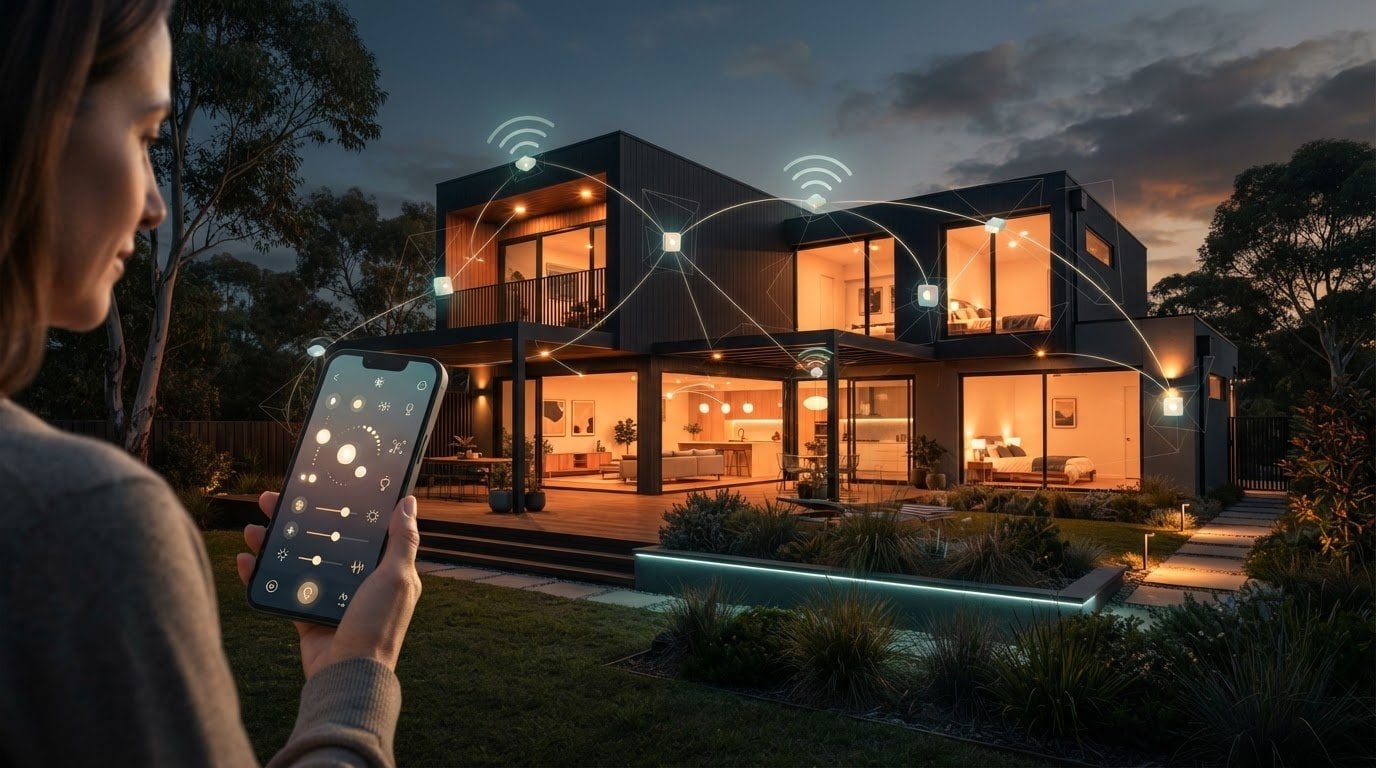
The smartest lighting system may not be the one with the biggest central controller. Decentralised lighting control places decision-making across devices or areas, while a centralised system relies more heavily on a main controller. The label alone, though, won’t tell you how a system behaves or whether it suits your building.
If terms like “distributed”, “wireless” and “centralised” make comparisons harder, you’re not alone. It’s also reasonable to ask whether an upgrade means new wiring and what happens if a controller or network connection fails. Start by separating two questions: where control decisions happen and how devices communicate. Wireless is one possible connection method, not a synonym for decentralised control.
This guide explains the architectures in plain language, compares centralised, decentralised and hybrid approaches, and outlines what to assess before choosing. You’ll also learn what to check for a practical retrofit, including compatibility, wiring needs and fallback behaviour. That way, you can focus on the arrangement that fits your building rather than choosing by label alone.
Key Takeaways
- Decentralised lighting control describes where decisions happen, not whether the system uses wired or wireless connections.
- Trace how a switch input reaches each light to understand how control works across rooms and zones.
- Compare centralised, decentralised and hybrid designs by considering expansion, configuration and what may happen if a component fails.
- Before a retrofit, note your circuits, existing switches, preferred control zones and desired outcomes, then check compatibility and installation requirements.
- Assess wireless switching hardware, including Gem Wireless kits, as a possible retrofit option, and confirm its suitability for your system before choosing.
What decentralised lighting control means for a building
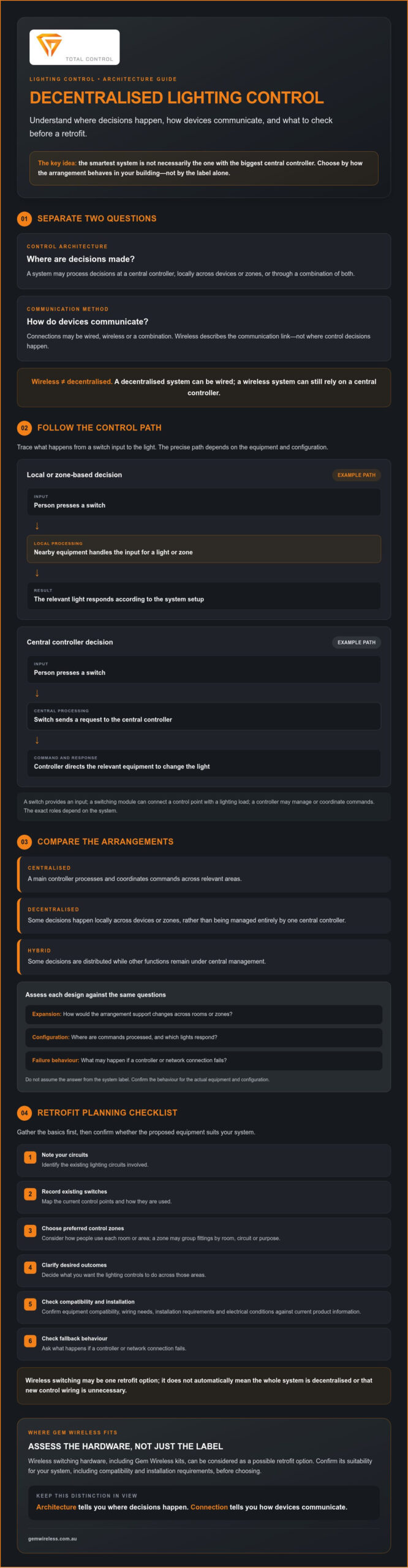
In a decentralised lighting control system, some decisions happen locally, across devices or zones, rather than being managed entirely by one central controller. The exact arrangement depends on the equipment and its configuration. A useful working definition is: Decentralised lighting control distributes decisions across local devices or zones, with behaviour determined by the system design.
This describes where decisions happen, not how devices connect. A system may use wired communication, wireless communication or a combination of both. For a broader overview of the components and control methods involved, see this guide to a lighting control system.
Picture a room with a wall switch and a ceiling light. In a locally controlled arrangement, the switch or another nearby control device may send an input to equipment serving that light or zone. The light responds according to the system setup. In another design, the switch sends a request to a central controller, which processes the command and instructs the light to respond.
Where does control happen in a decentralised system?
Local control points can include switches or other devices that provide input. A zone is a group of lights treated as a unit, such as the fittings assigned to one room. Depending on the system, local equipment may handle a command for a device or zone, while a central controller may manage commands across multiple areas. Don’t assume every local device can act independently: its capabilities and responses depend on the equipment and configuration.
To compare system descriptions, ask which device receives the input, where the decision is processed and which lights or zones respond. A system might distribute some decisions while keeping other functions under central management. The label alone won’t reveal that balance.
Is decentralised control the same as wireless lighting?
No. “Decentralised” describes the control architecture; “wireless” describes how devices communicate. A decentralised system can use wired connections, and a wireless system can still rely on a central controller to process commands. The two terms answer different questions, so check both when reviewing a proposed design.
This distinction matters during planning, especially if you’re considering a retrofit. Wireless switching may offer a way to add or change control without assuming that the whole system is decentralised or that new control wiring is unnecessary. Check the equipment’s compatibility, installation requirements and electrical conditions against current product information. Then assess how control is organised across your rooms and zones.
How decentralised lighting control works across rooms and zones
A control action follows a path: someone presses a switch, a signal reaches the equipment assigned to the relevant light or zone, and that equipment changes the lighting state. The path depends on the design. In a wired system, the input may travel through a physical control connection. In a wireless system, it travels over a wireless link. Either way, the lighting load needs suitable equipment to respond.
Control architecture determines where decisions are made; communication links carry inputs and commands between the devices involved. For more context on how components and programming fit into centralised and distributed lighting control, see this overview from Consulting-Specifying Engineer.
What roles do switches, modules and controllers play?
A switch gives a person a way to request a lighting change. Depending on its design, a switching module can connect a control point with a lighting load. A controller, where included, manages or coordinates commands. Some systems keep certain functions at local devices or zones; others route commands through a central controller. The equipment and configuration determine the actual sequence.
For example, pressing a switch might send an input to a nearby module, which controls the connected light. In another setup, the switch may send a request to a central controller, which then directs the relevant module. The paths can look similar to the person using the switch, but differ in how the system processes the command.
How do zones and local control affect daily use?
Zones should reflect how people use a space. A meeting room might be one zone, while an open-plan area could have separate zones for workstations and shared spaces. A zone may group fittings by room, circuit or purpose, depending on the design. Clear labels and consistent switch behaviour help occupants understand which lights will respond without needing to know the system’s internal architecture.
Before settling on a layout, confirm how zones will be configured and checked, and whether the equipment is compatible with the existing lights and controls. Commissioning requirements vary by system. Ask how the final setup will be documented so future users can identify each control and its effect.
Plan for interruptions, too. Ask what happens if a device loses power, a central controller stops responding or a wireless communication link is unavailable. Which controls may still work? Which lights could be affected? Don’t assume a system will behave in a particular way: the answer depends on its equipment, configuration and power arrangements.
If wireless switching is part of your retrofit planning, you can review Gem Wireless switching hardware as one possible option. Check product documentation and confirm compatibility and installation requirements for your setup before choosing.
Decentralised vs centralised lighting control: which trade-offs matter?
Neither architecture wins by default. Decentralised lighting control can place some decisions near the lights or zones they affect; a centralised design can coordinate commands through a main controller. A hybrid combines elements of both. The right comparison depends on the building, equipment and how people need to use and maintain the system.
| Consideration | Centralised | Decentralised | Hybrid |
|---|---|---|---|
| Control location | Commands are managed through a central controller. | Some decisions are handled locally by devices or zones. | Local control and central coordination share functions. |
| Expansion | New areas may need to connect to the central system and fit its capacity. | Local additions may be possible, depending on compatibility and system design. | Expansion depends on which functions are central and which are local. |
| Fault implications | A controller issue may affect functions that depend on it. | A local device issue may be limited to its connected area, but this isn’t guaranteed. | The effect depends on how responsibilities and fallback behaviour are configured. |
| Configuration and maintenance | Central management may provide one place to configure supported functions. | More local devices may mean more points to understand or maintain. | Teams need to know which tasks sit at each level. |
These are trade-offs, not promises. A decentralised design isn’t automatically simpler, cheaper or more reliable. A central controller can simplify oversight in one project while creating a dependency in another. Distributed devices may limit the reach of some faults, but only if the equipment and setup support that outcome.
When might centralised, decentralised or hybrid control suit a project?
For a small retrofit, local control may suit the need if the selected equipment supports it and works with the existing installation. A larger site may need coordinated management across multiple areas, but that doesn’t automatically call for one architecture. Compare future expansion, maintenance access, compatibility and the controls occupants expect to use. Research into autonomous lighting control systems also illustrates how project goals can extend beyond basic switching, though any approach still needs to fit the building.
What happens if a controller or communication link fails?
There’s no universal answer. Behaviour depends on the architecture, the affected device and any configured fallback. Ask what local controls retain during a network interruption, which zones depend on a central controller and how the system behaves if a component loses power. Get answers for the proposed equipment and configuration rather than relying on broad claims of uninterrupted operation.
How to assess decentralised lighting control before a retrofit
A good retrofit starts with the building, not a product label. Before choosing decentralised lighting control, gather enough detail to check whether the proposed equipment suits your existing lights, switches and circuits. This also gives a suitably qualified electrical professional a clearer brief to assess.
What should you check before choosing a control system?
Work through this checklist before comparing options:
- Set your lighting goals. Note what you want people to be able to do, such as controlling a room separately or adding a convenient switch location.
- Record what’s installed. List the fitting types, existing switches, known circuit arrangements and any control points you want to add. Don’t open electrical equipment to identify components.
- Sketch your preferred zones. Mark which fittings should respond together and where occupants need straightforward, predictable controls.
- Check compatibility. Compare the existing lights and switches with current manufacturer documentation. Confirm required components, operating conditions and any limitations before selecting hardware.
- Arrange a professional assessment. Have electrical conditions, installation requirements and any planned changes assessed by a suitably qualified professional.
Keep the notes together. A simple room-by-room plan can help expose unclear points early, such as a switch that needs to control a different group of lights or a zone that may need to expand later. For extra retrofit context, consult the existing no-rewire lighting control guide, while treating “no rewire” as an option to verify for your specific installation, not an assumed outcome.
How can wireless switching fit a retrofit plan?
Wireless switching can provide another way to add a control point where running new control cabling may be undesirable. It doesn’t mean every installation avoids wiring work: existing circuits, equipment compatibility and electrical conditions still matter. Nor does wireless alone tell you whether control decisions are centralised or distributed.
As you compare options, use the wireless switching modules guide to understand the general role of a module, and the wireless light switch kit guide for broader kit-selection considerations. Check current product documentation for compatibility and installation requirements, and have any electrical work assessed professionally.
Gem Wireless sells wireless switching hardware and kits for residential and commercial lighting. Its products are described as compatible with existing switches and lights and designed to enable control upgrades without rewiring. Suitability still depends on your setup. Explore Gem Wireless switching kits as one option to assess against your retrofit requirements.
Where Gem Wireless fits into decentralised lighting control planning
Once you’ve mapped your control goals, zones and existing setup, assess hardware against the project rather than choosing by label. Gem Wireless sells wireless switching hardware and kits for residential and commercial lighting, including switch module kits, mains powered switches, long range switches and switching modules. These are product categories to consider, not a guarantee that a particular item will suit your installation.
Wireless describes how devices communicate. It doesn’t confirm where control decisions happen. Don’t assume a wireless product creates a decentralised lighting control system. Check the product documentation for its control behaviour and how it fits the architecture you’re planning.
Could wireless switching hardware suit your control upgrade?
It may be worth assessing if your aim is to add or change lighting control while limiting changes to control cabling. Gem Wireless describes its hardware as compatible with existing switches and lights and designed to enable upgrades without rewiring. Suitability still depends on the specific product, existing equipment and electrical conditions.
Before selecting a kit or module, confirm which lights it is intended to control, what components are required and whether it works with the switches and fittings already in place. Check current product information rather than relying on a general compatibility statement. Gem Wireless sells hardware, not electrical installation services. Have installation requirements and any electrical work assessed by a suitably qualified professional.
What is a sensible next step for Australian projects?
Take a short project brief to your installer or electrical professional. Include your preferred control outcomes, a record of existing switches and circuits, the zones you want, and questions about behaviour if a device or communication link fails. This gives them a practical starting point for checking compatibility and discussing a suitable arrangement.
Then compare the relevant hardware with that assessment. Gem Wireless products are available for direct purchase or through stockists across Australia. Browse the product categories and check the documentation for details relevant to your setup. If the hardware appears suitable, explore Gem Wireless switching solutions or ask a stockist about options to assess for your project.
Choose a lighting control approach that fits your building
The practical starting point is to separate architecture from connection method. Decentralised lighting control describes where decisions happen; wired or wireless describes how devices communicate. Compare centralised, decentralised and hybrid designs by considering your control needs, future changes and what happens if a device or connection fails.
Before a retrofit, document your switches, circuits, desired zones and the experience you want for occupants. Then confirm equipment compatibility, installation requirements and electrical conditions with a suitably qualified professional. Wireless hardware may suit some upgrade plans, but it doesn’t automatically define the system architecture or remove every wiring requirement.
Gem Wireless sells wireless switching hardware and kits for residential and commercial lighting. You can purchase directly or explore its stockist network serving Australia. Review the available options against your project needs, then explore Gem Wireless switching solutions.
A clear plan makes the next step easier. With the right questions answered, you can move towards a control setup that makes sense for your building.
Frequently Asked Questions
What is decentralised lighting control?
Decentralised lighting control distributes some control decisions across local devices or zones, rather than managing every command through one central controller. For example, equipment serving a room may process a switch input for lights in that zone. The exact arrangement depends on the selected equipment and its configuration. To compare systems, ask where commands are processed, which lights each control affects and what happens if a component stops responding.
Is decentralised lighting control the same as wireless lighting control?
No. Decentralised describes where control decisions happen; wireless describes how devices communicate. A decentralised system can use wired connections, while wireless devices can still rely on a central controller to process commands. Treat these as separate choices when assessing a design. Ask suppliers to explain both the control architecture and communication method, then check how each affects compatibility, installation requirements and the controls people will use day to day.
Is decentralised lighting control better than centralised control?
Not in every building. A centralised design may suit projects that need commands coordinated through one controller. A decentralised or hybrid arrangement may suit projects that benefit from some decisions being handled locally, if the equipment supports it. Compare expansion, configuration, maintenance and fault behaviour against your needs. Don’t assume decentralised means simpler, cheaper or more reliable. The actual outcome depends on equipment, system design and setup.
Can decentralised lighting control work without rewiring?
Sometimes, but it depends on the existing lights, switches, circuits and chosen hardware. Wireless switching may add control options without new control cabling, but it doesn’t automatically remove every wiring requirement. Gem Wireless describes its wireless switching hardware and kits as designed to enable upgrades without rewiring and compatible with existing switches and lights. Check current product documentation and have compatibility, electrical conditions and installation requirements assessed before choosing a solution.
What happens if a decentralised lighting controller fails?
It depends on the system. A fault may affect a local device or zone, or it may disrupt functions that rely on a central controller or communication link. Don’t assume lights will keep working or that a failure will stay local. Ask which controls remain available during a fault, how the system responds if a device loses power, and what fallback behaviour the equipment and configuration support.
Can decentralised lighting control be used in commercial buildings?
Yes. Decentralised, centralised and hybrid approaches can all be considered for commercial buildings, depending on the lighting layout and how staff need to control different areas. Start by mapping rooms, circuits, zones and user requirements. Then assess coordination, future expansion, maintenance access and behaviour during communication or equipment faults. Gem Wireless sells wireless switching hardware and kits for both residential and commercial lighting, but suitability depends on the project and product compatibility.
Do I need an installer for wireless lighting control?
It depends on the equipment and work involved. Before buying, check product documentation for installation requirements and compatibility with your existing switches, lights and electrical conditions. Have electrical work and any uncertain requirements assessed by a suitably qualified professional. Gem Wireless sells switching hardware and kits, not electrical installation services. Prepare a list of your circuits, desired control zones and intended outcomes to help a professional assess the setup.
building automationdecentralised lighting controldistributed control systemsenergy efficiencylighting retrofitsmart lightingwireless switches