- Empty cart.
- Continue Shopping
Modernising Australian Heritage Homes with Wireless Light Switches: A Preservation Guide
- Posted on
 Strong Digital
- 0
- Categories: Uncategorized
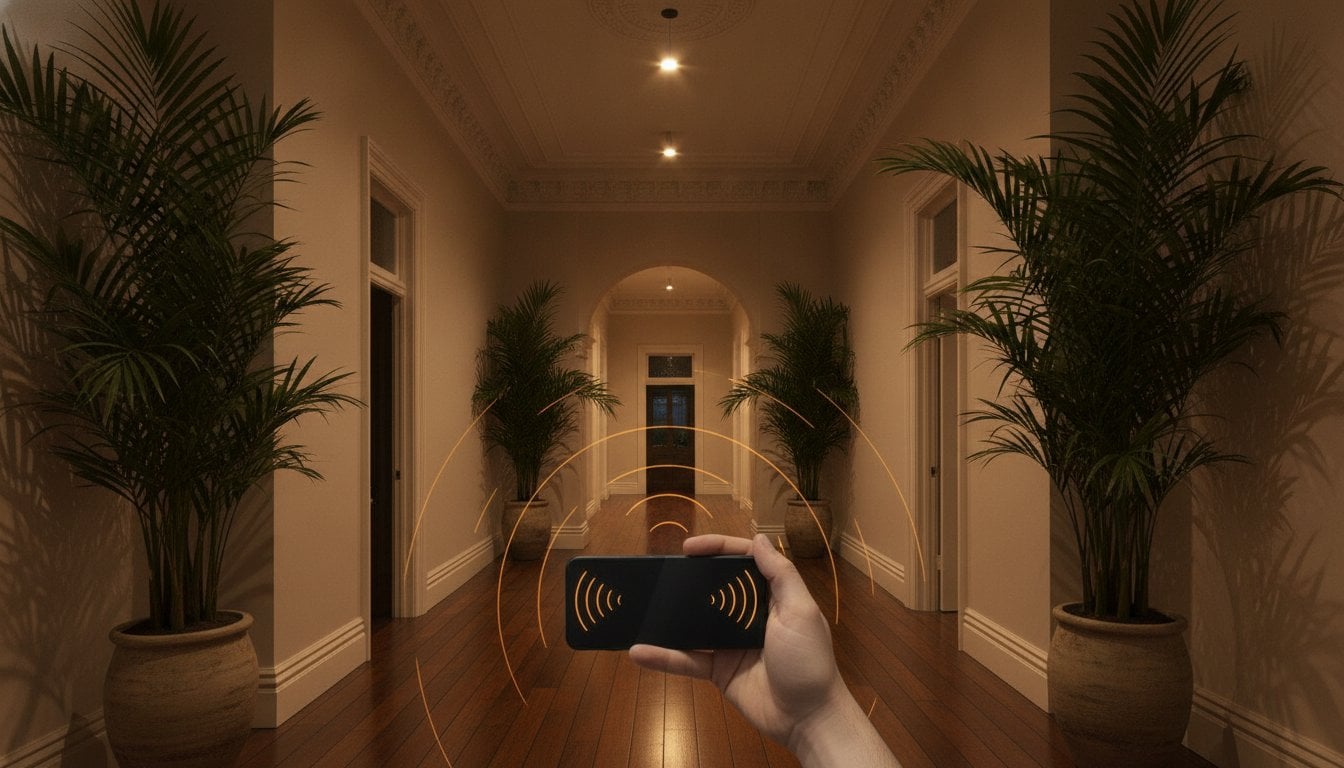
What if the greatest threat to your Victorian terrace or Federation bungalow isn’t age, but the very renovation intended to save it? Every owner of a period property knows the anxiety of watching a contractor approach original lath and plaster with a drill. Traditional electrical upgrades often require invasive chasing into double-brick walls or disturbing hazardous asbestos in old wall cavities. Integrating a wireless light switch for heritage homes changes this dynamic. It allows you to introduce modern convenience without compromising the structural or historical integrity of your property.
We understand you want a home that feels smart but looks timeless. This guide explains how to add sophisticated lighting control to your property without the high cost of a full rewire or the risk of damaging irreplaceable features. You’ll learn about no-rewire module kits and long-range switching solutions that penetrate thick masonry while remaining compliant with current Australian standards. We will show you how to achieve a modern lighting setup that feels invisible and protects your home’s fabric for the next generation.
Key Takeaways
- Protect your property’s original lath and plaster by using RF signals instead of chasing into walls, eliminating the risk of disturbing hazardous materials like asbestos.
- Learn why a wireless light switch for heritage homes is a superior alternative to traditional rewiring, saving you significant costs on plastering, painting, and professional cleaning.
- Discover how to use Switch Module Kits to bypass the need for a neutral wire at the switch plate, making modern lighting possible in even the most challenging period structures.
- Identify dead zones in thick double-brick walls and learn how long-range switches provide reliable control where standard Wi-Fi signals often fail.
The Challenge of Modernising Australian Heritage Home Electrics
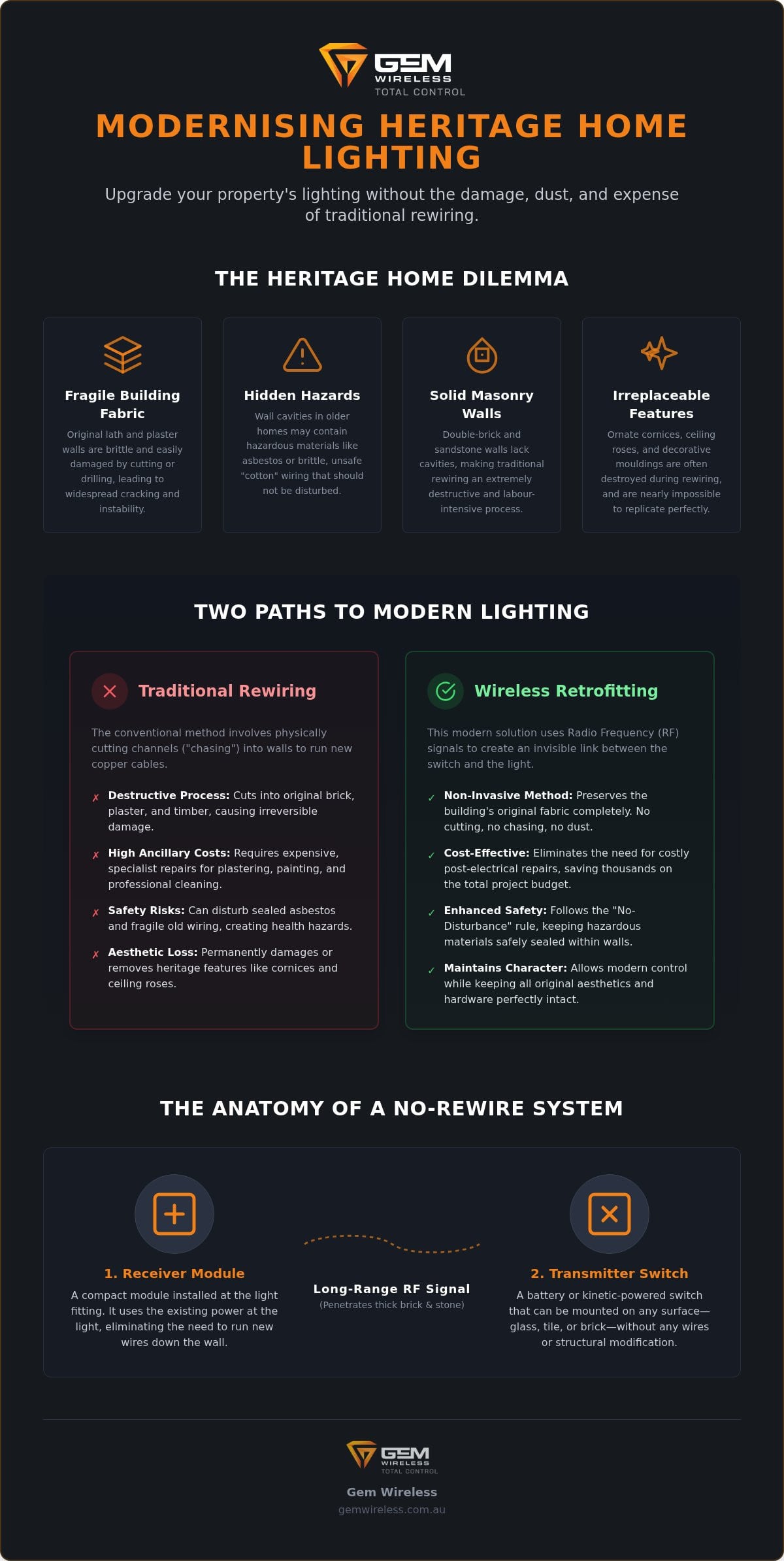
Updating a classic Australian home often feels like a battle between modern needs and historical integrity. If you live in a Federation villa or a mid-century bungalow, you’ve likely faced the dilemma of adding new lighting points. Traditional rewiring requires “chasing”, which involves cutting deep, dusty channels into walls to bury copper cables. This process is a logistical nightmare for double-brick or sandstone structures where the walls are solid and unforgiving. It isn’t just the electrical labour that’s expensive. The real cost lies in the specialist plastering repairs and painting needed to hide the structural scars left behind.
Preserving the Fabric of Period Architecture
Heritage features like ornate cornices and delicate ceiling roses are often the first victims of a standard rewire. Once a contractor cuts into brittle lath and plaster, the surrounding area often becomes unstable and cracks. Matching a 100-year-old plaster finish is nearly impossible for most modern tradespeople, leading to visible patches that ruin the room’s aesthetic. This is where the philosophy of historic preservation becomes a practical reality. Instead of performing invasive surgery on your home, a wireless light switch for heritage homes acts as a non-invasive tool. It allows you to place controls exactly where you need them without touching a single original brick or decorative moulding. You get the convenience of modern switching while keeping the original craftsmanship of your home perfectly intact.
Safety and Regulatory Considerations
Safety is a primary concern when you start disturbing old wall cavities. Many Australian homes built or renovated between the 1940s and late 1980s contain asbestos in wall linings, backing boards, or insulation. Boring holes for new switches can release hazardous fibres into your living space, requiring expensive professional remediation. Additionally, heritage properties often still house antiquated “cotton” or Tough Rubber Sheathed (TRS) wiring. These systems are brittle and dangerous to move. Adding even one new hardwired point can trigger a mandatory and expensive switchboard upgrade to meet current AS/NZS 3000:2018 standards. By opting for a wireless light switch for heritage homes, you follow the “No-Disturbance” rule. You keep hazardous materials sealed safely behind the walls and bypass the need to move fragile old cables. It is a pragmatic way to ensure your home remains safe, compliant, and beautiful.
How Wireless Switching Modules Protect Original Building Fabric
Traditional lighting depends on physical copper connections. In a period home, this usually means a “switch drop” where a cable runs from the ceiling, down through the wall cavity, to the switch plate. If your walls are solid double-brick or sandstone, there is no cavity. An electrician must grind a channel into the masonry. Using a wireless light switch for heritage homes replaces this destructive physical link with Radio Frequency (RF) signals. The connection is invisible. It is immediate. Most importantly, it is entirely non-destructive.
Modern long-range RF is designed specifically for difficult environments. While standard Wi-Fi often struggles to pass through 450mm of solid brick, specialised switching modules use lower frequency bands that penetrate dense Australian hardwood and stone with ease. This technology ensures that your lighting remains reliable without the need for invasive structural work.
The Anatomy of a No-Rewire Setup
A wireless system consists of two primary components that work in tandem to protect your building’s fabric. The receiver is a compact module designed to sit at the “load” or the light fitting itself. It’s small enough to be tucked away inside a decorative ceiling rose or a brass light gallery. This placement is strategic. It uses the existing power already at the light point, removing the need to run any new vertical wiring down your walls.
The transmitter is the switch itself. These units are often battery-powered or use kinetic energy from the press of the button to send a signal. Because they require no wires, they can be mounted anywhere. Modern systems provide incredible signal reliability, far exceeding the performance of old-school infrared remotes. They offer a stable, dedicated mesh that ensures your lights respond instantly every time. You can explore these Switching Modules to see how they integrate into a standard electrical setup.
Maintaining the Heritage Aesthetic
Preserving a home’s character often means keeping the original hardware. You don’t have to settle for cheap plastic buttons that look out of place in a Victorian hallway. Wireless modules can be wired into existing brass, porcelain, or timber toggle switches. This allows you to keep the tactile feel of the 19th century while enjoying 21st-century reliability. It’s a perfect compromise for those who value authenticity but need modern functionality.
You can even mount these switches on surfaces that were previously impossible to wire, such as mirrors, glass partitions, or delicate hand-painted wallpaper. Creating multi-way switching at the top and bottom of a staircase becomes a five-minute task rather than a two-day construction project. A wireless light switch for heritage homes ensures that your modernisation remains completely invisible to the eye, protecting the aesthetic you’ve worked hard to preserve.
Traditional Rewiring vs. Wireless Retrofitting: A Comparison
Choosing between traditional rewiring and a modern wireless retrofit is a decision between disruption and efficiency. Traditional methods require an electrician to spend hours, or even days, chasing channels into masonry and drilling through timber joists. In contrast, pairing a wireless light switch for heritage homes with its receiver takes mere minutes. This speed translates directly into lower labour costs. While an electrician in Australia typically charges between $80 and $130 per hour, you want those hours spent on high-value installation rather than destructive wall preparation.
The true cost of traditional wiring is often hidden in the “make-good” phase. Once the cables are in, you are left with a trail of damage that requires secondary trades and additional budget. These hidden costs frequently include:
- Professional plasterers to patch lath and plaster or solid masonry.
- Specialist painters to colour-match aged finishes and original lime washes.
- Industrial cleaning to remove fine masonry dust from heritage carpets and curtains.
- Scaffolding hire for safe access to high-ceilinged Victorian or Edwardian properties.
A wireless setup avoids these expenses entirely. There is no visible trunking or ugly surface-mounted conduit to ruin the room’s profile. The result is an “invisible” upgrade that respects your budget and your home’s aesthetic.
Structural Impact and Heritage Value
Traditional rewiring involves significant vibration from heavy power tools. For brittle lath and plaster ceilings, this vibration can lead to immediate cracking or even structural failure. A wireless light switch for heritage homes uses peel-and-stick or simple screw-mount transmitters that create zero structural stress. This non-invasive approach maintains your property’s “clean” heritage title. You avoid the modern scarring that often devalues historic properties in the eyes of future collectors or preservationists who value original, undisturbed surfaces.
Flexibility for Future Owners
Room uses change as families grow. A space used as a formal dining room today might become a home office tomorrow. Wireless systems offer the unique ability to reconfigure light groups without opening a single wall. You can move a switch from one side of a room to the other in seconds. This scalability is ideal for large Federation estates where you might start with a single room and expand the system as your renovation progresses. If a future owner wants to revert to a completely original look, they can remove the modern additions without leaving a single hole in the original timberwork. This same flexibility also makes wireless switching an excellent choice for multigenerational households, as a wireless light switch for elderly Australians living in the home provides accessible, easy-to-use controls without any structural disruption.
Planning Your Heritage Lighting Upgrade: A Step-by-Step Guide
Successful implementation begins with a clear roadmap. Unlike a standard renovation where you might just “hope for the best”, a heritage project requires precise planning to avoid unnecessary structural contact. The first step is a comprehensive audit of your current lighting points. You need to identify “dead zones” where thick 450mm double-brick walls or reinforced flooring might dampen a standard signal. Once you’ve mapped the layout, select the appropriate wireless light switch for heritage homes based on the specific electrical load. Whether you are controlling modern LEDs, legacy halogens, or even a ceiling fan, matching the module to the device ensures long-term stability and flicker-free operation.
After selecting your hardware, decide on your interface. You can opt for modern wireless remotes for convenience or integrate the technology into your property’s original brass and timber switches. This choice allows you to maintain the aesthetic continuity established in previous sections while upgrading the internal logic of the system. Finally, engage a licensed electrician for the commissioning phase. While you can handle the placement of the battery-powered switches, Australian law requires a professional to install the mains-powered receiver modules. Hiring a professional ensures your work complies with AS/NZS 3000:2018 standards and protects your home insurance policy.
Audit and Assessment Phase
Testing signal strength before you commit to a permanent mounting position is critical. Modern receivers are small enough to be tucked into ceiling cavities or floor voids, keeping them completely out of sight. The line of sight myth suggests that wireless signals must have an unobstructed path to the receiver, whereas modern RF switching comfortably penetrates multiple layers of double brick and timber. This allows for total flexibility in where you place your controls, ensuring the technology remains a helpful, invisible partner in your home.
Installation and Integration
Your licensed sparky will handle the “mains side” of the installation, ensuring the module is safely wired into your existing lighting circuit. This is the moment to configure advanced features, such as pairing multiple switches to a single module. This setup is perfect for long hallways where you want a switch at either end without running new copper through the walls. Final testing should focus on response times. A high-quality wireless light switch for heritage homes should provide a reliable, instant response with zero perceptible lag. To get started with your project, you can browse our full range of Switch Module Kits designed for Australian homes.
Integrating Gem Wireless Solutions into Period Properties
Gem Wireless designs solutions specifically for the structural challenges of Australian period architecture. While many generic smart brands require a neutral wire at the switch plate, our Switch Module Kits are engineered to work with existing wiring. This removes the need for invasive wall chasing or cable upgrades in homes where the original wiring is fragile. It is a pragmatic solution for owners who want 21st-century control without the 19th-century structural headache. You can modernise your lighting while keeping the hazardous materials like asbestos safely sealed behind your walls.
The “thick wall” problem is a reality for many Federation and Edwardian homes. Standard wireless signals often fail when faced with 450mm of solid double brick or reinforced masonry. Gem Long Range Switches solve this by using high-penetration RF technology that ensures a stable connection across multiple rooms and levels. Whether you are upgrading a single room or an entire estate, the signal remains reliable and immediate. This technology ensures that your wireless light switch for heritage homes performs consistently, regardless of your property’s construction materials.
The Gem Wireless Component Range
Our hardware is designed to remain invisible. Compact Switching Modules are small enough to fit directly behind your original heritage plates, allowing you to maintain your home’s aesthetic. For locations where battery maintenance is not ideal, our Mains Powered Switches offer a permanent, maintenance-free alternative. These components allow you to create a sophisticated lighting network that feels like a natural part of the house. For a detailed breakdown of which setup suits your specific property, refer to our Wireless Light Switch Kit Guide for Australian Homes 2026.
Why Australian Homeowners Trust Gem
We understand the nuances of the local market. All Gem products are fully compliant with AS/NZS 3000 standards, giving you peace of mind regarding safety and insurance. Our systems are proven to perform in high-interference environments, providing a “fit and forget” experience that respects your time and your home’s history. You can find our range through national wholesale and retail stockists across the country, ensuring easy access to hardware when you need it.
Modernising your lighting doesn’t have to be a destructive process. By choosing a wireless light switch for heritage homes, you are investing in the long-term preservation of your property’s fabric. You get the convenience of modern living with none of the structural risk. Ready to start? Browse our full range of wireless kits today to find the perfect match for your period home.
Future-Proofing Your Heritage Home Without Compromise
You now have a clear roadmap for updating your property without the destructive legacy of traditional rewiring. Integrating a wireless light switch for heritage homes allows you to protect original building fabric while bypassing the high costs of masonry chasing and the risks of disturbing hazardous materials. These systems provide a sophisticated lighting setup that respects the history of your home; ensuring every original cornice and ceiling rose remains undisturbed. You don’t have to choose between modern convenience and historical integrity anymore.
Gem Wireless solutions are built on no-rewire technology that keeps your original walls intact. Our systems are fully compliant with Australian Electrical Standards and are trusted by heritage renovators across Australia for their reliability in thick-walled structures. It is a pragmatic, cost-effective way to bring your period property into the 21st century without the construction stress. View our range of Heritage-Friendly Wireless Switching Kits and start your non-invasive renovation today. Your home’s historical character is its greatest asset, and you now have the technology to preserve it for generations to come.
Frequently Asked Questions
Do wireless light switches work through thick double brick walls?
Yes, high-quality wireless systems are designed to penetrate dense materials. While standard Wi-Fi often drops out behind masonry, our long-range technology comfortably passes through 450mm double-brick walls. This makes a wireless light switch for heritage homes a reliable choice for older Australian properties built with solid stone or brick. You won’t need to worry about signal lag or dead zones, as the RF frequency is specifically tuned to overcome these structural barriers.
Can I use my existing antique brass switches with Gem Wireless modules?
You can absolutely integrate modern switching modules with your existing antique brass or porcelain hardware. The compact receiver sits at the light fitting, while a small transmitter module can be wired into the back of your original heritage switch plate. This allows you to keep the tactile feel and historical look of your home while enjoying the benefits of no-rewire technology. It’s the ideal way to modernise without sacrificing your property’s unique period character.
Is an electrician required to install a wireless light switch in Australia?
Yes, a licensed electrician must perform the installation of the mains-powered receiver module. In Australia, any work involving 240V wiring must comply with AS/NZS 3000 standards to ensure safety and maintain your home insurance coverage. While you can safely mount the battery-powered switch plates yourself, the mains side of the kit requires professional commissioning. This ensures your new setup is legally compliant and operates safely within your home’s existing electrical framework.
How long do the batteries last in a wireless light switch?
Batteries in modern wireless transmitters typically last between five and ten years under normal residential use. The technology uses ultra-low-power radio signals that only activate for a fraction of a second when the button is pressed. Some advanced switching modules even use kinetic energy, meaning the physical force of your finger press generates enough power to send the signal. This eliminates the need for batteries entirely, providing a truly maintenance-free solution for your lighting control needs.
Are wireless switches safe to use in homes with old wiring?
Wireless solutions are exceptionally safe for homes with antiquated wiring systems. Adding a traditional hardwired point often requires disturbing brittle cotton-covered or TRS cables, which can lead to insulation failure or fire risks. By using a wireless light switch for heritage homes, you avoid touching these fragile circuits altogether. The technology allows you to expand your lighting layout without putting additional physical stress on the historical wiring hidden within your walls or ceiling cavities.
Can I control my ceiling fan with a wireless light switch kit?
You can control ceiling fans using specific wireless module kits designed for motor loads. It’s important to select a module that is rated for the inductive load of a fan rather than just a standard light globe. These modules allow you to turn the fan on or off and, in some configurations, adjust speed settings without running new cables through your ceiling. This is a practical way to add comfort to bedrooms without damaging ornate plasterwork.
What happens to the wireless switch if there is a power outage?
Your wireless system will retain all its pairing and configuration settings during a power outage. The modules use non-volatile memory, so the switch and receiver will recognise each other immediately once the power returns. Most receivers are programmed to stay in the off position when power is restored, preventing lights from turning on unexpectedly in the middle of the night. You won’t need to reprogram the system or call an electrician after a standard blackout.
Can I add a two-way switch to my hallway without running new wires?
Adding two-way or multi-way switching to a hallway is one of the most common uses for this technology. You simply install one receiver at the light fitting and pair it with two or more wireless transmitters. This allows you to control the same light from both ends of a corridor or the top and bottom of a staircase. It eliminates the need for complex traveller wires and avoids any invasive drilling into your home’s original timber or masonry. The same no-wire approach is particularly valuable as a wireless light switch solution for elderly Australians who need accessible controls at multiple points along a hallway to reduce the risk of falls in the dark.
Australian renovationelectrical solutionsheritage homeshome renovationperiod propertysmart lightingwireless switches