- Empty cart.
- Continue Shopping
Automating Outdoor Water Features: The 2026 Australian Guide to Effortless Control
- Posted on
 Strong Digital
- 0
- Categories: Uncategorized
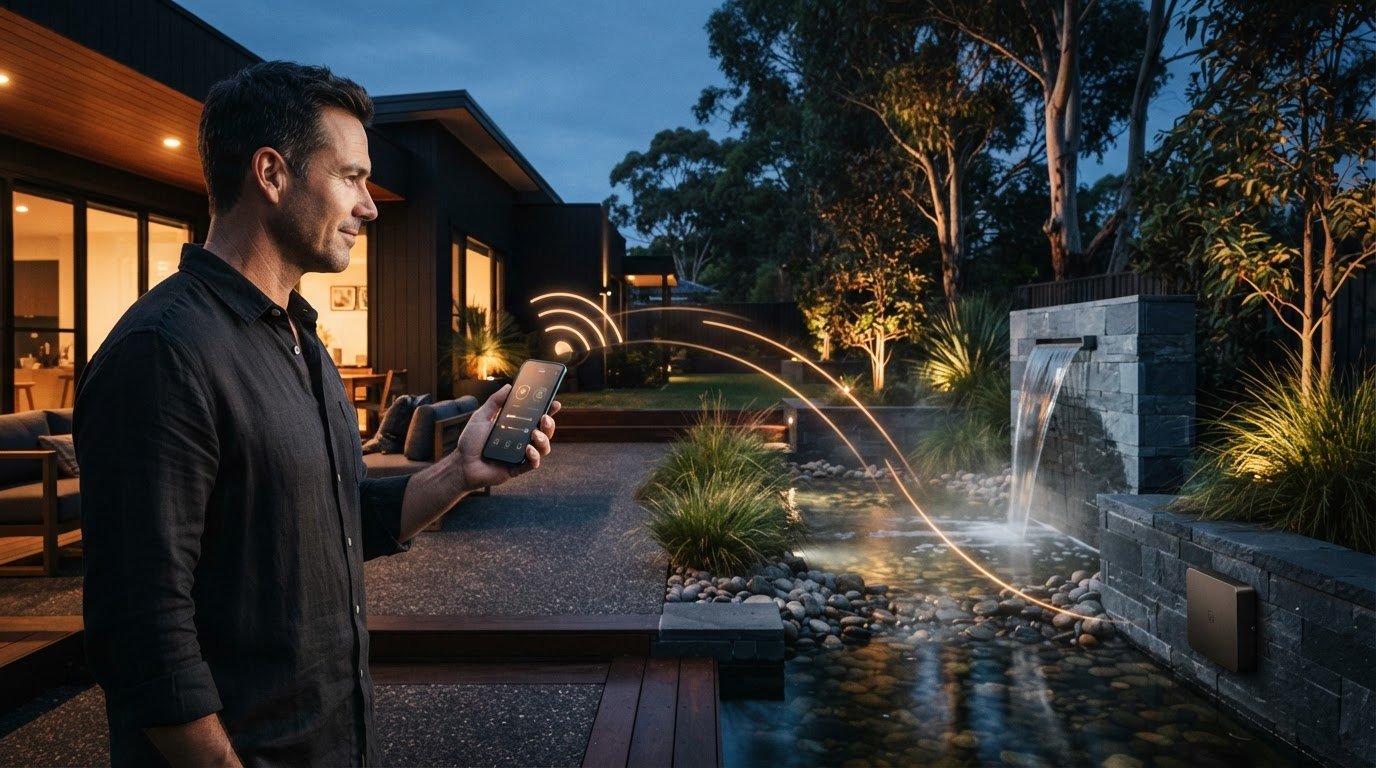
Did you know that running a standard 100W pond pump 24/7 can add over A$300 to your annual power bill? It’s a steep price for a bit of ambience, especially when manual switches are so easy to forget. We know that the idea of automating outdoor water features often brings to mind expensive trenching and messy rewiring that ruins your established landscaping. You deserve a sophisticated garden interface that works reliably without the frustration of Wi-Fi signals dropping out in the far corners of your backyard.
We agree that garden upgrades should be empowering, not exhausting. This guide shows you how to transform your fountains and ponds into automated masterpieces using long-range wireless technology that requires zero new cabling. You’ll learn how to slash energy costs by scheduling pumps during the latest midday Solar Sharer windows and discover the switch module kits that make retrofitting a breeze. We’ll walk you through the practical steps to achieve a sleek, modern garden with total, effortless control.
Key Takeaways
- Discover how automating outdoor water features can slash your running costs by over A$230 per year while creating a resort-style atmosphere at home.
- Learn why Radio Frequency (RF) is the most reliable choice for Australian backyards, outperforming Wi-Fi in range and signal stability across large properties.
- Explore “no-rewire” technology that allows you to upgrade your garden fountains and ponds without the mess or expense of traditional trenching.
- Understand the simple process of installing long-range wireless receiver modules to gain total control over your pumps and lighting.
- Find out how to sync your water features with midday solar peaks to take advantage of free electricity windows and lower your energy bills.
Why Automating Outdoor Water Features is a Game Changer
Automating outdoor water features involves integrating smart timers, sensors, or remote switches to manage your garden’s pumps and lighting. It moves your backyard away from manual, forgotten toggles toward a system that works on your terms. While many home automation systems stop at the back door, extending this control to your pond or fountain provides a level of convenience that truly modernises your property. It’s about removing the friction of garden maintenance so you can focus on the enjoyment of the space.
Scheduled water flow and lighting ensure the centrepiece of your landscape is active when you’re there to enjoy it. You no longer have to wander through the garden in the dark to find a hidden power point. Instead, the system anticipates your needs, creating a resort-style retreat the moment you arrive home. This seamless integration makes your outdoor area feel like a natural extension of your living room.
Consistent, scheduled operation is also healthier for your equipment. Submersible pumps thrive on regular cycles that prevent the build-up of debris and keep the impeller moving freely. Erratic manual use often leads to pumps being left off for too long, which allows algae to settle and can cause motor stress when eventually restarted. By automating outdoor water features, you ensure the longevity of your hardware through steady, reliable performance.
The Aesthetic Advantage of Scheduled Lighting
Syncing your water feature lights with the local sunset creates a beautiful transition from day to night. You can easily create specific “scenes” for different occasions. You might want a vibrant, fully lit setting for weekend barbecues but prefer a subtle, dimmed glow for quiet evening relaxation. Automation allows you to highlight the architectural centre of your garden without ever stepping outside to flip a cold, wet switch.
Cost Savings and Energy Management
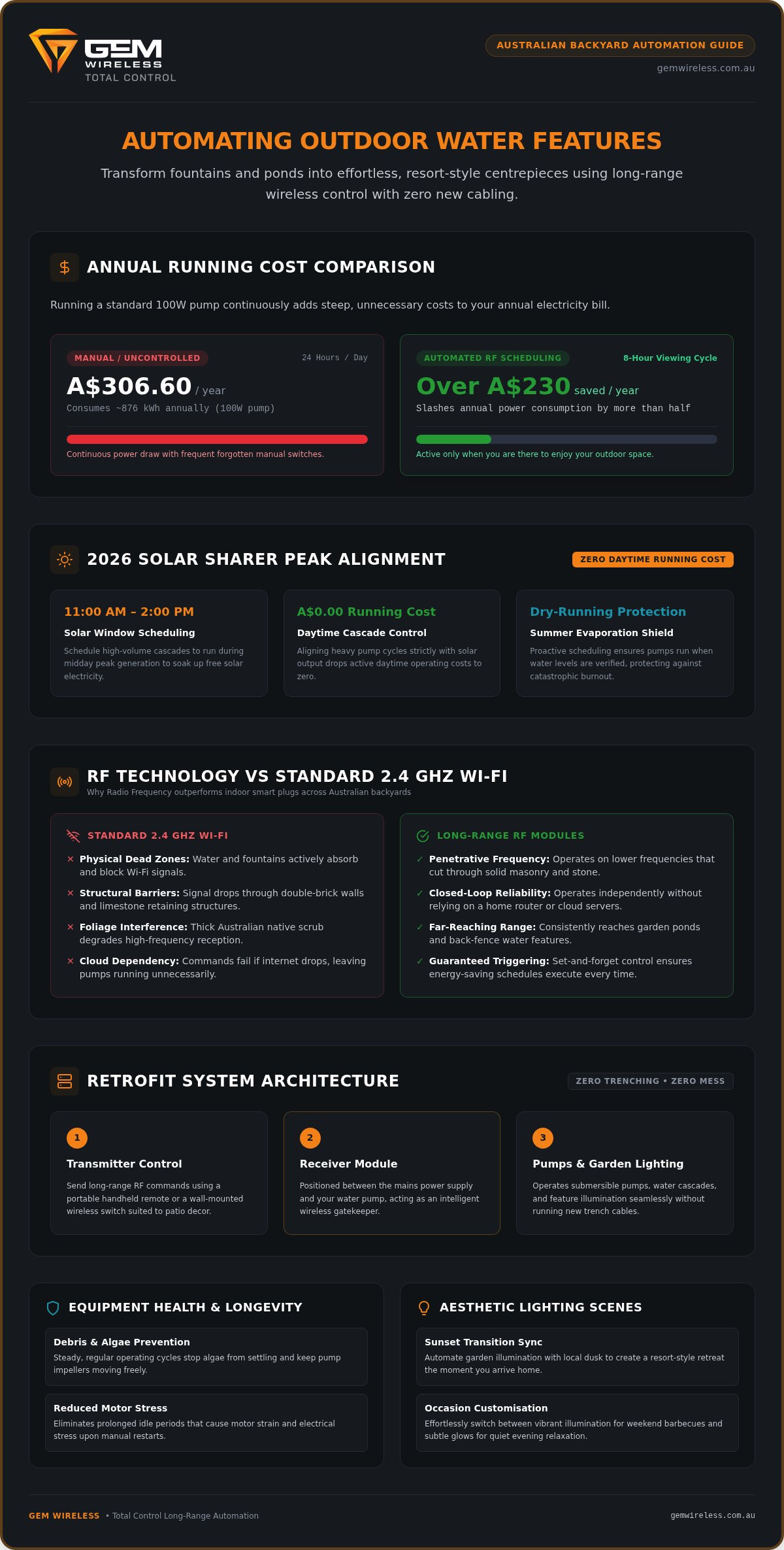
The financial impact of automating outdoor water features is substantial for Australian households. Running a standard 100W pump 24/7 consumes roughly 876 kWh per year, which costs about A$306.60 at current average tariffs. By automating that pump to run an 8-hour viewing cycle, you slash those costs by more than half.
Modern automation also lets you capitalise on the 2026 Solar Sharer Offer. You can schedule high-volume cascades between 11:00 AM and 2:00 PM to soak up free solar energy, dropping daytime running costs to zero. This proactive approach also prevents “dry-running” during the peak of summer. By scheduling operation only when water levels are stable, you protect your pump from the catastrophic burnout caused by evaporation.
Understanding the Tech: RF vs Wi-Fi for Garden Control
Many homeowners start their automation journey by trying a basic smart plug from the local hardware store. While these work well for indoor lamps, they often struggle in the Australian backyard. The 2.4 GHz Wi-Fi signal used by standard smart home gear is easily blocked by double-brick walls, limestone retaining structures, and dense native foliage. Water itself is a physical dead zone for Wi-Fi, meaning a smart plug positioned near a fountain or behind a stone wall will often experience frustrating signal drops. This is why Radio Frequency (RF) technology is the superior choice for automating outdoor water features.
RF operates on a lower frequency that penetrates solid obstacles far more effectively than standard home internet signals. It’s a closed-loop system that doesn’t rely on your router or a cloud connection to function. The hardware is straightforward. A receiver module sits between your mains power supply and your water pump, acting as an intelligent gatekeeper. You then control that receiver with a transmitter. This might be a handheld remote for portability or a wall-mounted wireless switch that fits perfectly into your existing patio decor. This setup provides the “set and forget” reliability that busy households need.
Why Range Matters in Australian Properties
Australian property sizes and building materials demand robust signal strength. A signal that works in a small suburban lounge room often won’t reach a distant garden pond or a back-fence waterfall. Using long range wireless light switches ensures your commands reach the equipment every time, even through masonry and thick scrub. This reliability is a cornerstone of energy-efficient smart home automation. When your signal is guaranteed, your power-saving schedules actually trigger, preventing your pump from running unnecessarily because a Wi-Fi command failed to arrive.
Mains-Powered vs Battery-Operated Modules
Choosing the right power source for your modules depends on your specific installation. For permanent water features, mains powered wireless switches are the ideal choice. They provide consistent performance and can easily handle the inductive load of a pump motor. Most residential fountain pumps range from 25W to 150W, which is well within the 500W capacity of a standard switching module. If you need a control point on a timber deck or a stone pillar where cabling is impossible, battery-free kinetic switches are a brilliant alternative. They harvest energy from the force of your press, meaning you’ll never have to worry about replacing corroded batteries. If you want to modernise your setup without the hassle, check out the wireless switching kits designed for local conditions.
Comparing Automation Methods: Hardwired vs Smart vs Wireless
Choosing a control method for your garden usually involves a trade-off between reliability and disruption. Traditional hardwiring is often touted as the gold standard for permanent installations. While it offers high reliability, the physical cost is immense. Trenching through established Australian landscaping typically costs between A$80 and A$160 per linear metre just for the excavation and conduit. When you add the labour of a licensed electrical contractor and the cost of surface restoration, the budget for a simple fountain upgrade can quickly spiral.
Smart plugs represent the opposite extreme. They’re cheap and easy to set up, but they’re often a temporary fix for a permanent problem. Most consumer-grade smart plugs aren’t built to survive the harsh Australian sun or the moisture levels found near a splash zone. They also rely on the same Wi-Fi signals we’ve already identified as unreliable in the backyard. Wireless switching kits provide the professional middle ground. They offer the same rock-solid performance as a hardwired circuit but without the invasive renovation. These systems follow ACMA low interference potential devices regulations, ensuring they operate safely alongside your other household tech.
The “mess factor” is perhaps the biggest deterrent for homeowners. Automating outdoor water features shouldn’t mean turning your garden into a construction site. Wireless solutions protect your investment by leaving your lawn and pavers exactly as they are. You get the benefit of modern control without the long-term scarring of your landscape architecture.
The Hidden Costs of Trenching
Digging a trench in Australia isn’t always a simple matter of moving dirt. Many backyards consist of heavy clay or rock-heavy soil that requires specialised equipment. There’s also the constant risk of striking existing irrigation lines or utility pipes, which can turn a small project into a major repair job. Beyond the digging, you have to account for the cost of replacing premium turf, relaying pavers, or patching decorative concrete. Wireless modules eliminate these risks entirely, preserving your garden’s aesthetic while upgrading its functionality.
Durability and Weather-Proofing Requirements
Outdoor automation requires hardware that can withstand more than just a light drizzle. Ingress Protection (IP) ratings are the standard you need to watch. For general outdoor switches, you should look for at least IP54 or IP65 to ensure protection against dust and water spray. Standard indoor smart gear simply isn’t designed for the 45°C heatwaves or the humidity of an Australian summer. Dedicated wireless switching modules are engineered for these conditions. They sit inside weatherproof enclosures, ensuring your system remains operational year after year without the risk of short-circuits or housing degradation.
How to Automate Your Water Feature Without Rewiring
Retrofitting an existing garden fountain or pond pump doesn’t have to be a major construction project. By using wireless technology, you can bypass the need for new cables while still achieving professional-grade control. Automating outdoor water features on an established property follows a logical, five-step process that prioritises both safety and convenience.
- Step 1: Identify pump specifications. Check the wattage and voltage of your current pump. Most residential fountain pumps draw between 25W and 150W; ensure your switching module is rated for these inductive loads.
- Step 2: Install the wireless receiver. The receiver module is installed at the power source or within the feature base. This acts as the “brain” that toggles the power based on your commands.
- Step 3: Pair your transmitter. Sync your wireless wall switch or handheld remote with the receiver. This usually involves a simple button-press sequence to lock in the secure RF frequency.
- Step 4: Mount your controls. Fix your wireless switches to any surface using adhesive pads or screws. Since there’s no wiring behind the switch, you aren’t restricted by stud locations or brickwork.
- Step 5: Set your schedules. Use the module’s internal timer or manual override to test the range and confirm your water feature triggers exactly when you want it to.
Safety First: Working with Outdoor Electrics
Electrical safety is paramount in the Australian backyard. While the wireless switches themselves are safe for anyone to handle, any modification to fixed 240V mains wiring must legally be performed by a licenced electrician. This includes the installation of wireless switching modules behind existing wall plates or within junction boxes. Ensure all modules are housed in IP-rated, weather-proof enclosures to prevent moisture ingress. Before you energise the system, always check that the circuit is protected by a 30mA Residual Current Device (RCD) to meet AS/NZS 3000 safety standards.
Mounting Your Controls for Convenience
The beauty of wireless automation is the freedom of placement. You can mount a switch right next to the back door, allowing you to activate your waterfall as you walk out with guests. Long-range remotes are perfect for control from the pool or alfresco dining area, ensuring you never have to leave your seat to adjust the garden’s ambience. If you have multiple features, such as submersible lights and a cascading pump, you can organise them onto a single multi-channel switch for unified control. If you’re ready to start your retrofit, browse our full range of switch module kits to find the right fit for your garden.
Choosing Gem Wireless for Long-Range Garden Automation
Gem Wireless is the preferred choice for Australian garden retrofits because our systems are built for local conditions. We understand that your backyard isn’t just a patch of grass; it’s an investment in lifestyle and property value. Our “No Rewire” promise means you can modernise your outdoor space without the renovation headache or the high cost of an excavator. You get professional-grade control without disturbing a single blade of buffalo grass or lifting a single sandstone paver.
Compatibility is at the heart of our design. Our switch module kits work seamlessly with the pumps, solenoids, and lights you already own. Whether you’re managing a heavy-duty pond filter or a delicate fountain pump, our modules handle the load with ease. Choosing an Australian-designed solution also means you get local support and hardware that meets our national safety standards. Generic overseas imports often lack the robust weather-proofing or the specific RF frequencies required for reliable operation in our unique climate.
The Power of Long-Range RF Technology
Signal reliability is the biggest hurdle when automating outdoor water features. Standard Wi-Fi simply cannot match the penetration power of Radio Frequency in an outdoor environment. Our specialised kits provide up to 100 metres of open-air range, which is ample for even the largest suburban blocks. This technology cuts through brick walls and thick vegetation, ensuring your commands reach the pump every time you press the switch. Gem Wireless has been the leader in no-rewire automation since 2026.
Simplifying Your Outdoor Lifestyle
Moving from a manual chore to automated luxury takes less than an hour. You no longer have to remember to turn the pump off before bed or venture out in the rain to toggle a switch. The versatility of wireless light switch kits allows you to expand your system as your garden grows. You can add control for garden art, spotlighting, or pond aeration without ever running a new cable. Getting started is simple with a Gem Wireless starter kit, providing everything you need to take back your time and enjoy a truly effortless garden.
Ready to Streamline Your Outdoor Sanctuary?
Automating outdoor water features shouldn’t be a source of stress or a reason to dig up your backyard. You’ve seen how long-range RF technology overcomes the physical limitations of Wi-Fi, providing a rock-solid connection even in the furthest corners of your property. By choosing a no-rewire installation, you preserve your expensive landscaping while gaining professional control over your garden’s ambience.
Our Australian-designed solutions are engineered specifically for local conditions, ensuring your pumps and lights perform reliably through every summer heatwave. You’re now equipped with the knowledge to slash your energy bills and move from manual chores to automated luxury. It’s time to experience the peace of mind that comes with a truly effortless garden.
Browse Gem Wireless Garden Automation Kits to start your transformation today. We’re here to help you modernise your home with confidence and ease.
Frequently Asked Questions
Do I need a licenced electrician to install a wireless water feature switch?
Yes, any modification to fixed 240V mains wiring or the installation of recessed switching modules must legally be completed by a licenced electrical contractor. While the wireless switches themselves are safe for anyone to handle, the receiver module that sits behind your power point requires professional installation to comply with AS/NZS 3000 standards. This ensures your system is safe, correctly earthed, and protected by an RCD before you begin automating outdoor water features.
Will a wireless switch work through brick walls or from inside the house?
Yes, our RF switching technology is specifically engineered to penetrate solid obstacles like double-brick walls, limestone retainers, and low-E glazing. Unlike Wi-Fi, which often struggles to reach the garden from inside the home, sub-gigahertz radio frequencies maintain a stable connection through masonry. This allows you to mount a switch in your kitchen or lounge room and reliably trigger a distant pond pump without worrying about signal dropouts.
Can I control both my fountain pump and garden lights with one wireless switch?
Yes, you can easily manage multiple features using a multi-channel switch or by pairing several receiver modules to a single control point. This setup allows you to toggle your fountain pump and garden lighting simultaneously or independently. It provides a unified way of automating outdoor water features and their associated aesthetics, giving you the flexibility to create different garden “scenes” from a single, convenient interface on your patio.
What happens to my automated water feature during a power outage?
Your system is equipped with non-volatile memory that retains all pairing information and programmed states even during a total blackout. Once the mains power is restored, the switching modules will return to their previous state or await the next scheduled command. You won’t need to manually re-pair your remotes or reset the wireless switches, which ensures your garden automation remains a “set and forget” solution for your peace of mind.
Are wireless switching modules waterproof enough for a pond environment?
Switching modules themselves must be installed within a suitable weather-proof enclosure to protect against the elements. For most Australian backyards, an IP54 or IP65 rating is required for any housing located near a splash zone or exposed to rain. While the modules are robust, they shouldn’t be submerged. Proper placement inside a junction box or mounting block ensures your hardware survives the humidity and moisture typical of a pond environment.
Can I automate an older water feature that didn’t come with smart features?
Yes, wireless switching kits are the ideal solution for retrofitting older fountains and ponds that lack modern connectivity. You don’t need a “smart” pump to achieve automation. By simply installing a receiver module at the existing power source, you can add remote control and scheduling to any standard 240V equipment. This approach allows you to modernise your garden’s functionality without the expense of replacing perfectly good hardware.
How long do the batteries last in a wireless garden remote or switch?
We offer kinetic switches that require zero batteries because they harvest energy from the physical force of your press. These are maintenance-free and ideal for permanent wall mounting. For handheld remotes or battery-powered transmitters, the power draw is extremely low, typically lasting several years under normal use. This eliminates the annoyance of frequent battery changes and ensures your garden controls are always ready when you need to adjust your water feature’s flow.
Is RF switching better than Wi-Fi for a large Australian backyard?
RF is significantly more reliable than Wi-Fi for large Australian properties due to its superior range and obstacle penetration. Standard Wi-Fi signals degrade quickly when passing through brick or near large bodies of water. RF modules, particularly our long-range variants, can reach up to 100 metres in open-air conditions. This makes RF the logical choice for distant ponds or waterfalls where mesh networks and Wi-Fi extenders often fail to provide a stable connection.
backyard upgradesenergy savinggarden automationlandscape designoutdoor water featurespond pumpsRF controllerssmart gardens