- Empty cart.
- Continue Shopping
Long Range Wireless Light Switches: 2026 Australian Guide
- Posted on
 Strong Digital
- 0
- Categories: Uncategorized
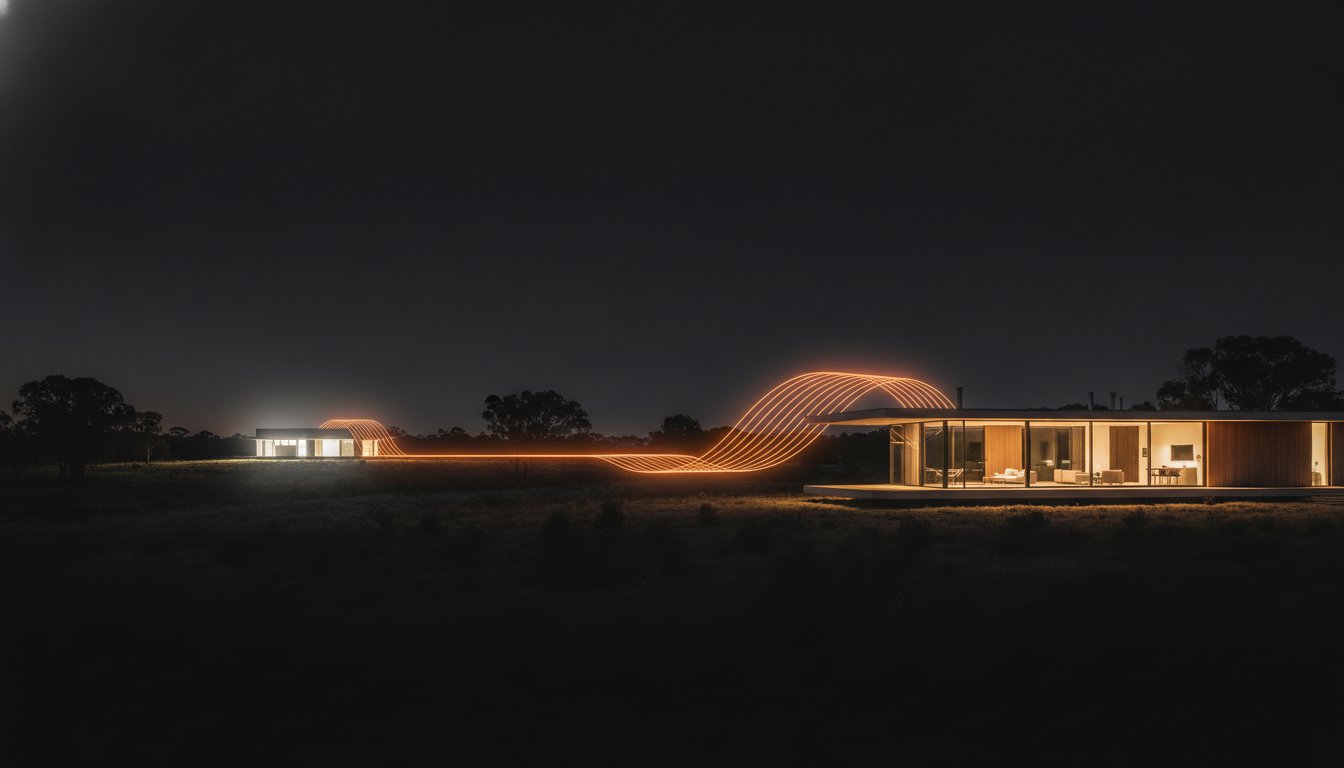
What if you could flick a switch in your kitchen and light up a shed two kilometres away without digging a single centimetre of trenching? For most Australian property owners, the dream of controlling remote lights or equipment usually ends the moment the quote for electrical excavation arrives. It’s frustrating to deal with the high cost of labour and the mess of tearing up finished walls just to move a simple control point. You might have even tried cheap DIY options in the past, only to find they drop signal the moment a bit of weather rolls in.
We understand that you need a solution that actually works every single time you press the button. This 2026 guide explains how a modern long range wireless light switch can bridge massive distances without the need for complex rewiring or expensive groundworks. You’ll discover how to achieve professional-grade control that integrates seamlessly with your existing lights and equipment. We’ll walk you through the latest Australian standards, the shift towards Matter-compatible systems, and how to choose a setup that offers both high performance and low installation costs.
Key Takeaways
- Stop paying for expensive trenching and electrical excavation by using Radio Frequency systems to control remote buildings.
- Discover how a long range wireless light switch provides reliable control across distances of up to two kilometres without physical cables.
- Protect your property’s aesthetics by retrofitting modules into finished walls and ceilings without the mess of structural rewiring.
- Select the right kit by calculating wattage loads and over-specifying range to ensure performance in all conditions.
- Learn how to integrate modern switching modules with your existing mains-powered switches for a sophisticated, simple upgrade.
What is a Long Range Wireless Light Switch?
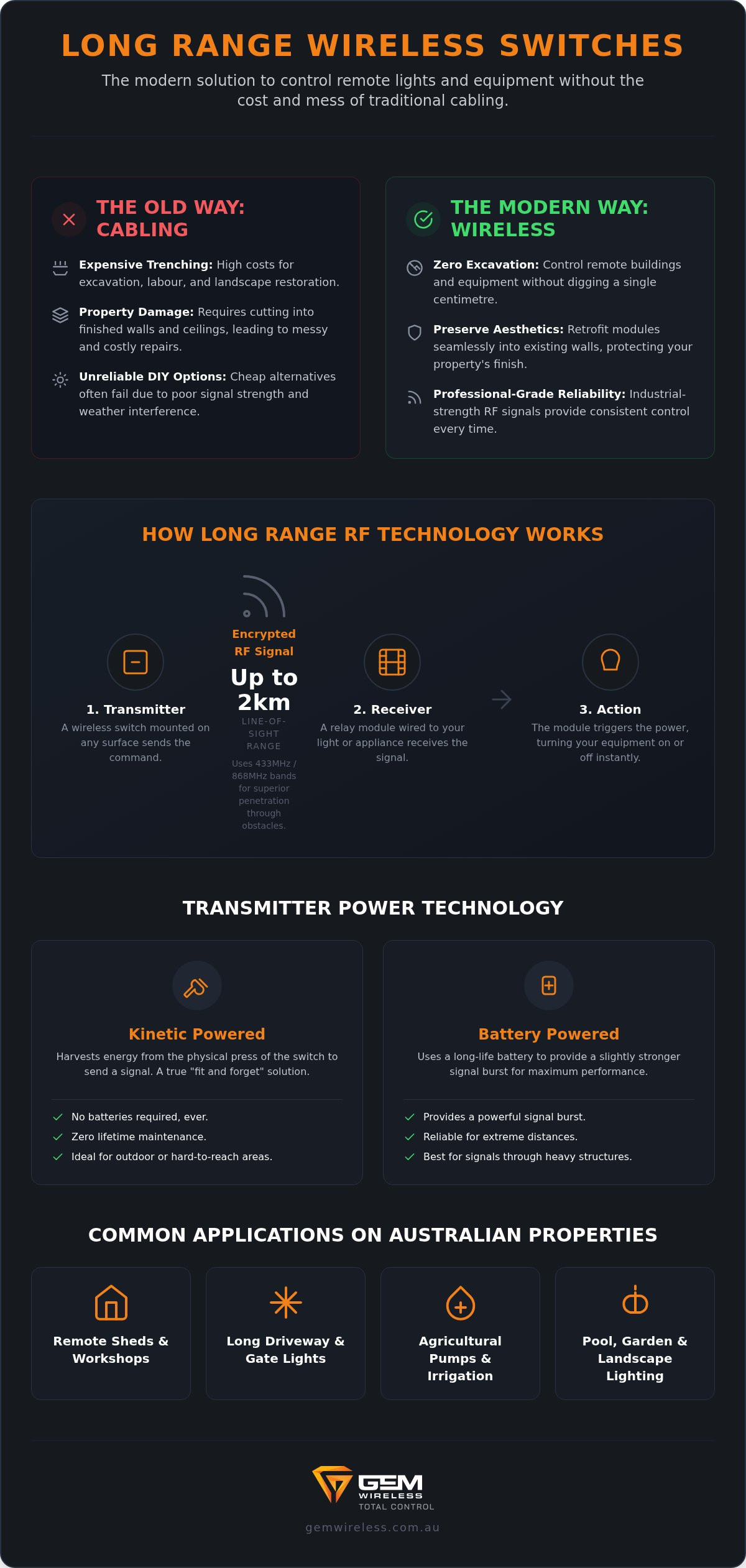
If you have ever wondered What is a Wireless Light Switch?, it’s essentially a system that uses Radio Frequency (RF) to send commands between a control point and an electrical load without any physical cabling. Unlike standard indoor switches that might struggle to reach the next room, these industrial-grade systems are built to traverse hundreds of metres. In many cases, a high-quality long range wireless light switch can bridge gaps of up to two kilometres, making it a powerful tool for large-scale property management.
The system consists of two primary components. The transmitter is the switch itself, which you can mount to any surface without cutting holes for wires. The receiver is a switching module or relay kit that sits at the light fitting or equipment you want to control. When you press the switch, it sends an encrypted RF signal to the module, which then triggers the power. It’s a clean, efficient way to add control exactly where you need it.
For Australian property owners, the “long range” aspect is vital. Range matters on the land. We often deal with large blocks, detached sheds, or long driveways where standard Wi-Fi or Bluetooth signals simply fail. A dedicated long range wireless light switch uses lower frequency bands that cut through obstacles more effectively. This ensures your lights or pumps activate instantly, even if the receiver is located at the far end of a paddock.
How RF Technology Works Over Distance
Signal reliability depends on the frequency used. In Australia, these systems typically operate on the 433MHz or 868MHz bands. These frequencies are ideal because they offer better penetration through brick walls, timber, and dense foliage than higher-frequency alternatives. Line-of-sight range refers to the maximum distance a signal travels across a clear, unobstructed path, whereas obstructed range accounts for the signal loss caused by physical barriers like walls or trees.
Kinetic vs Battery Powered Transmitters
You have two main choices for how the transmitter gets its power. Kinetic switches are a marvel of modern engineering. They harvest a tiny amount of energy from the physical force of your finger press to send the signal. This means they require no batteries and zero maintenance for the life of the product. It’s an ideal “fit and forget” solution for outdoor areas.
Battery-powered options are also common. While they do require a battery change every few years, they often provide a slightly stronger signal burst. This makes them a reliable choice for extreme distances or environments where the signal must pass through multiple heavy structures. Both options remove the need for invasive electrical work, keeping your walls intact and your installation costs low.
Wireless vs Traditional Cabling: A Cost Comparison
Traditional electrical work often involves high overheads that go beyond the invoice for the switches themselves. When you opt for a hardwired setup, you pay for the hidden costs of trenching, heavy-duty conduit, and extensive labour. For a 50-metre run across a driveway, you aren’t just paying for cable. You’re paying for a mini-excavator, the time to dig, and the effort to restore the landscape afterward. A long range wireless light switch eliminates these civil works entirely.
Retrofitting is where the savings become even more apparent. Installing new cables in finished walls usually requires “making good,” which is tradie-speak for patching plaster and repainting. Wireless systems avoid this mess. Modern innovations in wireless lighting control have made these systems as reliable as their wired counterparts while being significantly faster to implement. What takes days of drilling and chasing can now be achieved in minutes with a simple module installation.
From an environmental perspective, wireless is the cleaner choice. It drastically reduces the consumption of copper and PVC plastic conduit. By choosing a system that doesn’t require kilometres of cabling, you are lowering the material footprint of your property upgrade. It’s a pragmatic way to modernise your infrastructure while respecting your budget and the planet.
The Labour Gap: Why Tradies Prefer Wireless
Licensed electricians often prefer wireless modules because they remove the most difficult parts of the job. No one enjoys crawling through tight roof spaces or under floorboards in the Australian heat. By using a long range wireless light switch, the sparky can focus on the technical connection at the light and the switch, rather than the physical slog of pulling cables. This efficiency often translates to lower labour charges for the homeowner. It also empowers you to decide on your lighting layout without being restricted by where the existing cables run.
Calculating the ROI on Wireless Upgrades
The return on investment for a wireless system is immediate. When you factor in the material costs of a long cable run versus a wireless kit, the hardware costs are often comparable. However, the real saving is the “avoided cost.” By skipping the hire of heavy machinery and the hours of manual labour, you keep thousands of dollars in your pocket.
Long-term flexibility adds further value. If you decide to move your shed or change your driveway layout, you can simply unmount the switch and move it. There is no need to dig up old cables or lay new ones. If you’re looking for a way to modernise your property without the headache, exploring a long range wireless light switch kit is a sensible first step.
Practical Applications for Australian Properties
Australian properties often present unique challenges for electrical layouts. Whether you are managing a suburban block with a detached granny flat or a sprawling rural acreage, the distances involved make traditional wiring a logistical headache. This is where a long range wireless light switch becomes an essential tool for modern property management. It allows you to bridge the gap between separate structures without ever lifting a shovel or hiring a trenching contractor. To find more ways to improve your outdoor living environment, you can discover Bakyard Australia and their range of fire pits and garden tools.
For many Australians, the shed is more than just storage; it is a workshop, a gym, or a home office. One of the most common frustrations is walking across a dark backyard to reach the shed door. By installing a long range wireless light switch inside your back door, you can light up the path and the shed interior before you even step outside. This setup also makes it easy to Add a Light Switch Without Rewiring inside the shed itself. You can place extra switches at the workbench or the mezzanine level without the need to run new circuits through the walls.
Outdoor Equipment and Water Pumps
Managing water on a larger block requires reliable control over irrigation pumps and garden features. When you are understanding wireless lighting technology, you quickly see that these systems are robust enough to handle more than just bulbs. You can use a switching module to trigger a remote pump from the main house, saving you a trip across the paddock in the rain.
Safety is another major benefit. Being able to switch pool lights or water features from a dry, indoor location removes any risk associated with wet hands and outdoor electrical points. If you have a pool, a dedicated wireless pool light switch lets you control your pool lighting from the patio without trenching through expensive landscaping. When installing these systems outdoors, ensure the receiver modules are housed in appropriate weatherproof enclosures. If you want a practical walkthrough of the full process, our guide on how to install a wireless switch for outdoor security lights covers every step from mounting the receiver to pairing your transmitter. The transmitters themselves are often built to withstand the elements, but always check the IP rating for your specific environment to ensure long-term reliability in the harsh Australian sun.
Choosing the Right Long Range Switch Kit
Selecting a long range wireless light switch kit involves more than just picking the highest number on the box. You must account for the specific layout and construction materials of your Australian property. While many systems boast impressive line-of-sight distances, real-world performance is what matters most. A pragmatic approach is to always over-spec your range requirements. If your shed is 50 metres away, choosing a kit rated for 200 metres provides a vital reliability buffer against atmospheric interference and physical obstacles.
Beyond distance, you need to verify the receiver’s load capacity. Most wireless switching modules can handle standard LED lighting loads with ease. However, if you are controlling a heavy-duty irrigation pump or a large array of halogen floodlights, check the wattage rating carefully. High-quality modules are specifically designed to be compatible with modern LED bulbs. This prevents common issues like flickering or “ghosting,” where the light remains dimly lit even when turned off due to residual current.
Reliability during a blackout is another critical factor. Regional areas often experience power fluctuations or brief outages. Ensure your chosen kit features non-volatile pairing memory. This ensures the switch and receiver automatically reconnect once power is restored. Without this feature, you might find yourself needing to manually re-pair the devices every time the grid blips, which is a frustration you don’t need. Business owners managing multiple sites should also explore commercial wireless lighting solutions for a deeper look at how these systems scale across larger and more complex environments.
Range Factors and Signal Obstructions
Metal structures, such as Colorbond sheds and garages, can act as shields that block RF signals. If you are mounting a receiver inside a metal building, the signal strength will drop significantly. To maximise reception, mount the receiver module near a window or high up on a timber frame rather than tucked behind steel beams. For extreme distances or through multiple brick walls, some professional kits allow for an external antenna to be connected to the receiver, ensuring the signal reaches its destination without fail.
Multi-Switch Configurations
One of the greatest advantages of wireless technology is the ability to create complex switching layouts without “traveller wires.” You can easily set up 2-way or 3-way switching, allowing you to control the same light from the house, the shed door, and the workbench. You can also pair multiple receivers to a single master remote for “all-off” convenience when leaving the property. For a deeper look at specific hardware options, consult our Wireless Light Switch Kit Guide.
Ready to simplify your property’s electrical layout? Explore our range of Switch Module Kits to find the perfect fit for your project.
The Gem Wireless Advantage: Sophisticated Simplicity
At Gem Wireless, we believe that advanced technology should make your life simpler, not more complicated. A long range wireless light switch from our range is designed specifically for the unique demands of Australian and New Zealand properties. We don’t just provide hardware; we offer a pragmatic way to modernise your infrastructure without the stress of invasive construction. Our systems are built to integrate seamlessly with the existing mains-powered switches already on your walls, preserving the look of your home while adding modern functionality.
Choosing a local brand means you aren’t left guessing about compatibility or reliability. While generic imports often lack local certification or clear instructions, our products are backed by a dedicated network of Australian stockists and agents. This ensures you have access to expert advice and support whenever you need it. We deliver high-tech performance at a cost-effective price point, proving that sophisticated lighting control doesn’t have to break the bank. It is about providing a reliable, no-fuss solution that works every time you press the button.
Our Long Range Product Philosophy
Our philosophy centres on empowerment through “no rewire” solutions. We know that the biggest barrier to property upgrades is often the complexity of the job. By focusing on wireless switching modules and kits, we remove that barrier entirely. Our gear is built for durability, designed to handle the varied Australian climates from the humid north to the dusty outback. We use a “plug and play” logic for our systems, which eliminates technical stress and ensures that your new setup is up and running as quickly as possible. It is a proactive approach to problem-solving that respects both your time and your budget.
Getting Started with Your Installation
Ready to upgrade your property? Finding the right gear is easy through our network of local stockists. Once your electrician has mounted the receiver module, the pairing process for new kits is incredibly straightforward. Usually, it involves a simple button press to sync the transmitter and receiver, creating a secure, encrypted connection in seconds. This speed of implementation is why so many property owners are moving away from traditional cabling. You can start small with a single shed light or kit out your entire property with a comprehensive long-range system.
Take the first step toward a more efficient property today. Explore our Long Range Switches here and discover how simple sophisticated control can be.
Modernise Your Property Control Today
Modernising your property shouldn’t involve the high cost of electrical trenching or the mess of tearing up finished walls. By investing in a long range wireless light switch, you can bridge the gap between your home and remote sheds or gates with total confidence. This technology is a strategic infrastructure upgrade that saves thousands in labour and materials while providing the reliability required for large Australian blocks.
Our solutions are built for sophisticated simplicity. They ensure your lighting and equipment work exactly when you need them to, without the stress of complex technical upgrades. Because there is no rewiring required, you can achieve a professional-grade result in a fraction of the time. Our modules are compatible with all AU/NZ light fittings and are trusted by local stockists across the country. It’s a pragmatic way to operate more efficiently without disrupting your existing structures.
Take control of your property’s infrastructure with a system that prioritises your peace of mind. View our range of Long Range Wireless Switches to start your upgrade. It’s time to experience the freedom of wireless control that actually goes the distance.
Frequently Asked Questions
How far will a long range wireless light switch actually reach?
A high-quality long range wireless light switch can achieve a line-of-sight range of up to two kilometres. This distance is ideal for large Australian rural properties or commercial sites. In real-world conditions with obstructions like brick walls or metal sheds, the effective range will decrease. We recommend over-specifying your requirements to ensure a consistent signal. This buffer helps maintain a reliable connection even during adverse weather or through dense foliage.
Do I need a licensed electrician to install a wireless switch receiver?
Yes, you must engage a licensed electrician to install any hardwired receiver or switching module. In Australia, all electrical work must comply with the AS/NZS 3000:2018 Wiring Rules. While the wireless switches themselves are often surface-mounted and don’t require wiring, the relay that connects to your lights or equipment is a mains-powered component. Using a professional ensures your installation is safe, legal, and covered by your home insurance policy.
Will my neighbours wireless switch interfere with mine?
Interference from a neighbour’s system is effectively impossible due to unique digital pairing. Each transmitter and receiver are synced using an encrypted RF signal that ignores other nearby devices. You can have dozens of units operating on the same property without any cross-communication. This security feature ensures that your driveway gates or shed lights only activate when you press your specific switch, providing peace of mind in high-density areas.
Can I control a water pump or heavy motor with these switches?
You can control water pumps and small motors as long as the equipment stays within the receiver’s rated load capacity. Many switching modules can handle loads up to 500 watts, which is sufficient for most residential irrigation pumps and garden water features. For larger commercial motors, your electrician may need to use the wireless module to trigger a heavy-duty contactor. Always check the specific wattage of your equipment before finalising your setup.
What happens to the wireless switch during a power failure?
Your system will retain its settings during a power outage thanks to non-volatile pairing memory. Once the mains power is restored to your property, the receiver module automatically reconnects with its paired switches. You won’t need to climb into the ceiling or open up equipment boxes to re-sync the devices. This feature is particularly important for regional areas where brief grid fluctuations are common, ensuring your lighting control remains reliable and maintenance-free.
Do wireless light switches work with LED globes?
Yes, these systems are fully compatible with modern LED lighting and all standard AU/NZ fittings. High-quality modules are designed to handle the specific electronic characteristics of LEDs, which prevents common issues like flickering or ghosting. Because the switching happens at the module level, you can continue using your preferred energy-efficient globes. This makes wireless retrofitting an excellent way to modernise older homes while taking full advantage of current energy-saving technology.
Can I add a wireless switch to a heritage home without damage?
Wireless switching is the perfect solution for heritage homes because it requires zero damage to lath-and-plaster walls or ornate ceilings. Since there is no rewiring required for the switch itself, you can mount a slimline transmitter directly onto timber panelling or delicate wallpaper using adhesive strips. This allows you to add modern two-way switching or remote control without the invasive chasing and plastering that traditional electrical work usually demands.
Are kinetic wireless switches as reliable as battery ones?
Both options are highly reliable, but they serve slightly different needs. Kinetic switches are entirely maintenance-free as they harvest energy from the physical press of your finger. They are a “fit and forget” solution ideal for most residential applications. Battery-powered transmitters often provide a slightly more powerful signal burst, which can be useful for extreme distances or passing through multiple heavy structures. Both types offer a robust connection for your long range wireless light switch system.
avoid trenchingelectrical solutionshome automation Australialong range wireless light switchproperty maintenanceremote control switchsmart homewireless lighting