- Empty cart.
- Continue Shopping
Commercial Wireless Lighting Solutions: The 2026 Australian Retrofit Guide
- Posted on
 Strong Digital
- 0
- Categories: Uncategorized

What if your next lighting upgrade didn’t require a single centimetre of new cabling or a week of lost trade? For many Australian business owners, the thought of a retrofit conjures images of expensive electrical labour, dust-covered stock, and the impossible task of mounting switches on structural concrete or glass. It’s a logistical headache that often stalls necessary modernisation. By adopting commercial wireless lighting solutions, you can sidestep the traditional construction mess while gaining sophisticated, flexible control over your environment.
We understand that downtime is the enemy of profit. You need a way to organise your workspace or retail floor that doesn’t involve tearing out the walls or chasing wires through the ceiling. This guide outlines how to modernise your commercial lighting systems across Australia without the cost or disruption of a complete rewire. You’ll discover how switching modules and long range switches provide the rapid deployment your project demands. We will walk through the latest hardware options that ensure flexible control for open-plan offices and shopfitting projects, all while keeping your installation costs firmly under control.
Key Takeaways
- Modernise your premises without the dust, downtime, or high electrical labour costs associated with a full rewire.
- Compare the rapid deployment and lower total cost of wireless retrofits against complex wired systems like DALI.
- Identify the best hardware for your industry, from long range switches for warehouses to sleek modules for retail shopfitting.
- Discover how commercial wireless lighting solutions allow you to mount switches effortlessly on difficult surfaces like glass and structural concrete.
- Learn the straightforward process for sourcing Gem Wireless kits through local stockists across Australia for your next project.
Modernising Commercial Spaces Without the Rewire Cost
Modernising a commercial premises in Australia often feels like a choice between living with outdated tech or enduring a construction nightmare. Commercial wireless lighting solutions change this dynamic by shifting the focus from infrastructure to hardware. Instead of running kilometres of copper through a ceiling, you use a system of receivers and transmitters to send commands through the air. This bypasses the need for traditional “switch-to-light” cabling entirely.
The Australian retrofit reality is particularly challenging. Our buildings are often constructed with structural concrete, masonry, or fire-rated partitions that don’t play well with new wiring. Chasing a cable into a brick wall creates a mess that requires plastering and repainting; passing through a fire-rated wall requires expensive sealing and certification. Gem Wireless offers a pragmatic path forward for national retail and office upgrades. By using wireless switching modules, you achieve an immediate return on investment through drastically reduced labour hours and zero business downtime.
The Problem with Traditional Commercial Lighting Upgrades
Physical cabling is rigid. When you need to add a switch to a glass partition or a concrete pillar, traditional methods fail or become prohibitively expensive. In high-ceiling warehouses, even a simple switch relocation requires hiring access equipment like scissor lifts, which adds hundreds of dollars to a basic task. This disruption often forces businesses to delay upgrades, leading to inefficient workspaces and frustrated staff.
Traditional wiring also struggles with the needs of modern, agile offices. If you reconfigure your floor plan, your fixed switches become redundant or hard to reach. While some large-scale network-based lighting control systems attempt to solve this with software, they still often require a complex wired backbone. Modular wireless hardware removes this barrier, allowing you to place control exactly where it’s needed without touching the building’s core structure.
Wireless Switching as a Strategic Business Asset
Flexible lighting control is a powerful tool for reducing operational costs. Commercial wireless lighting solutions allow you to create zones easily, ensuring unoccupied areas aren’t wasting energy. In retail environments, shopfitters can reconfigure floor layouts and display lighting in hours rather than days. You don’t need to call back an electrician for a full rewire every time a display changes.
This hardware approach empowers business owners to take control of their environment. It’s about removing the friction from modernisation. Wireless modules act as the bridge between legacy infrastructure and modern control. They provide the agility required for 2026 and beyond.
Understanding Commercial Wireless Switching Technology
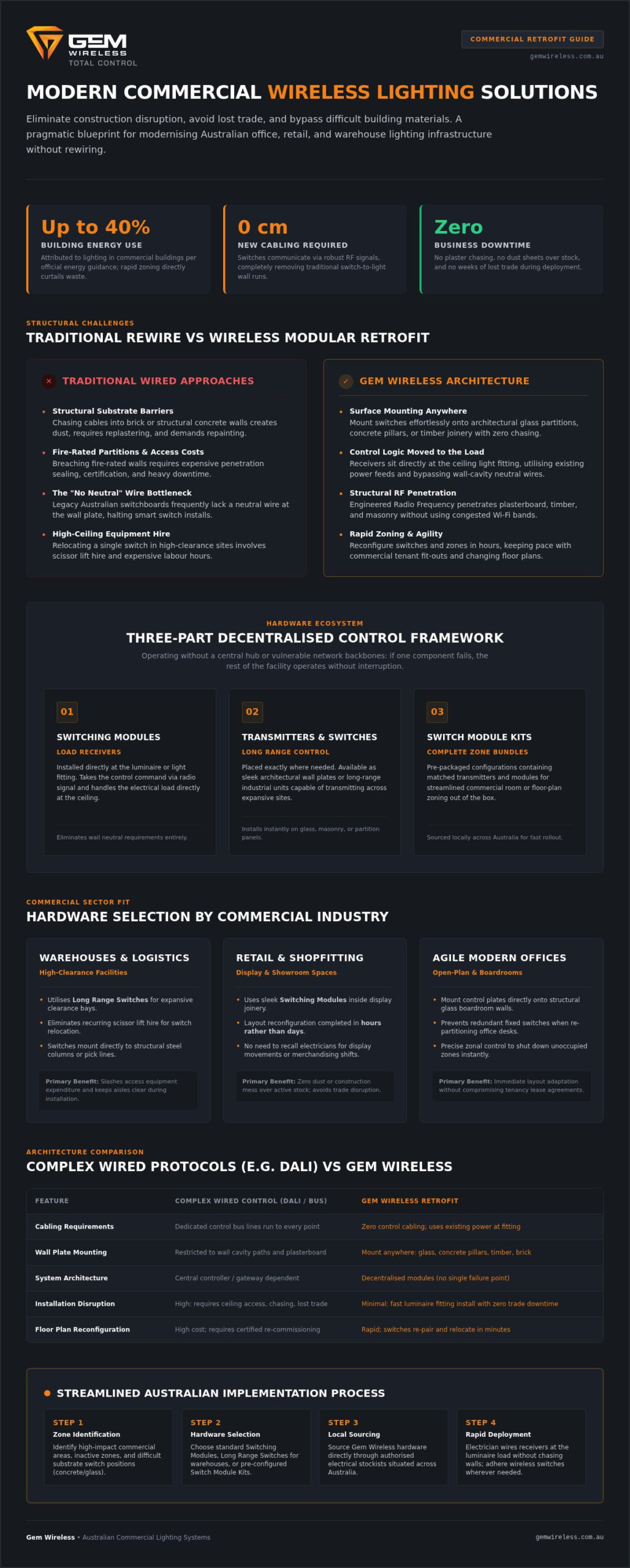
Modern commercial wireless lighting solutions rely on a robust ecosystem of hardware designed to work together without the need for a central hub or complex software. The system consists of three main parts. First, Switching Modules act as receivers and are installed directly at the light fitting. Second, the transmitters (the switches) are placed wherever you need them. Finally, Switch Module Kits provide everything required for a standard zone setup. This decentralised approach ensures that if one component fails, the rest of the system continues to operate perfectly.
Reliability in a business setting is non-negotiable. Modern RF technology is engineered to penetrate common Australian building materials like plasterboard, timber, and masonry. Unlike standard Wi-Fi, these signals operate on frequencies that avoid congestion, ensuring a zero-lag response when you hit the switch. This technical stability is why modular hardware is now the preferred choice for those following official energy-efficient commercial lighting guidance. Official data suggests lighting can account for up to 40% of a building’s energy use; precise, wireless control is the fastest way to bring that number down.
A significant hurdle in older Australian commercial buildings is the “No Neutral” wire problem. Traditional smart switches often require a neutral wire at the wall plate to function, which many legacy switchboards lack. Wireless modules solve this by moving the control logic to the ceiling. By installing the receiver at the light load, you use the existing power supply and skip the expensive task of pulling new neutral cables through the walls. If you are ready to upgrade your premises, you can view our full range of switching modules to see how they fit your layout.
Mains Powered Switches vs. Kinetic Options
Choosing between power sources depends on the specific surface and traffic levels. Mains Powered Switches are the best fit for high-traffic corridors and main office areas. They provide a permanent, maintenance-free solution that looks identical to a standard switch. For glass partitions, marble foyers, or heritage-listed surfaces where you cannot drill holes, kinetic or battery-powered options are the smarter choice. These units are completely wire-free and can be adhered to any flat surface in seconds. Both options provide the same high-performance switching without the need for a physical connection to the light fitting.
The Role of Long Range Wireless Switching
Industrial properties and vast warehouses require more power than a standard office setup. Large distances and heavy structural steel can dampen standard wireless signals. This is where long range wireless light switches are essential. These units are designed to bridge the gap between detached buildings or across massive factory floors. They feature enhanced signal processing to filter out electronic noise from heavy machinery, ensuring your lighting commands are received every single time, regardless of the distance or environmental interference.
Comparing Commercial Lighting Control Systems: Wireless vs. Wired
Many facility managers assume that professional lighting control requires a wired DALI (Digital Addressable Lighting Interface) backbone. While DALI offers control, it carries massive upfront installation costs and requires specialist programming. In contrast, modern commercial wireless lighting solutions provide a modular alternative that is faster to deploy and easier to maintain. These systems aren’t just for homes; industrial-grade switching modules are built to handle the rigorous demands of factories and retail hubs. This hardware-first approach removes the complexity of central controllers, making the system more resilient and easier for on-site staff to manage.
Installation Speed and Labour Savings
Time is the most expensive variable in any Australian fit-out. A traditional rewiring project for a single floor can take days of labour, involving cable runs, wall-chasing, and fire-wrap installations. A wireless module install takes roughly 15 minutes per unit. Shopfitters use this speed to meet tight handover deadlines that would be impossible with traditional cabling. You also eliminate the “hidden” costs of renovation. Because you aren’t cutting into walls, you save thousands on wall-patching, sanding, and repainting. This makes no rewire lighting control a strategic choice for businesses that need to remain operational during an upgrade. It allows you to transform a space over a weekend without a single speck of dust.
Total Cost of Ownership (TCO) Analysis
The value of a lighting system isn’t just the purchase price; it’s the cost over ten years. When evaluating commercial wireless lighting solutions, the ability to relocate switches without professional help is a major differentiator. Wired systems are notoriously rigid. If you move a desk or a partition wall, you have to call back an electrician to rewire the switch. With a wireless system, you simply unstick the switch and move it. This flexibility is supported by the Australian Government commercial lighting guide, which notes that automated controls and adaptable layouts are key to long-term energy efficiency. High-quality switching hardware is designed for durability in high-use environments, ensuring the tactile feel of the switch remains consistent over thousands of presses. Investing in a wireless light switch kit represents a more agile investment than fixed infrastructure. It allows your lighting to evolve alongside your business rather than acting as a permanent constraint.
Selection Guide: Choosing Wireless Modules for Your Industry
Selecting the right hardware for your premises requires a pragmatic look at your building’s physical layout and daily operations. Not all commercial wireless lighting solutions are suited for every environment. A warehouse with structural steel has vastly different requirements than a modern office with glass partitions. By matching the hardware to the archetype, you ensure a seamless installation that lasts for years. This approach empowers business owners to solve specific logistical hurdles without over-engineering the solution.
Warehouses and Industrial Sheds
Industrial properties often feature vast open spaces and high-bay LED lighting that is difficult to access. For these settings, you need long-range receivers that can communicate reliably over 50 metres or more. Metal-clad buildings can sometimes interfere with radio signals, so strategic placement of signal repeaters is essential for maintaining a strong connection across the entire factory floor. This ensures that every command from the switch reaches the light fitting instantly, regardless of the machinery operating nearby.
Industrial modules also allow you to control more than just the overhead lights. You can easily set up a system to toggle external gate lights, loading dock lamps, or even water pumps from a central control point in the office. This removes the need for staff to navigate dark or wet yards to reach manual switches. When selecting modules for these zones, prioritising a high IP rating is vital. Dust and moisture are common in industrial sheds; an appropriately rated enclosure protects the internal electronics and prevents unnecessary maintenance call-outs. It’s a simple way to build a more resilient infrastructure. For a comprehensive look at how wireless lighting for warehouses can be retrofitted without disrupting your operations, our dedicated 2026 Australian guide covers the full scope of long-range switching modules and scalable zone control.
Offices and Retail Fit-outs
In a corporate or retail setting, the focus shifts toward aesthetics and rapid deployment. One of the most common challenges for shopfitters is adding control to glass meeting room walls or marble foyers. Traditional wiring requires surface-mounted conduit that ruins the clean lines of a modern design. Wireless modules allow you to adhere a switch directly to any flat surface, making it look like a native part of the architecture. This provides a professional finish that is impossible to achieve with traditional cabling methods.
Large showrooms and open-plan offices typically require multi-way switching. This allows staff to control a single lighting zone from multiple entry points. Instead of a complex web of “traveller” wires, you simply pair multiple transmitters to a single Switching Module. Retailers also find great value in using remote control light switch modules for window displays and feature lighting. It gives staff the ability to adjust the atmosphere of the shop floor from the point of sale without leaving the counter. This level of flexibility is what makes a wireless retrofit a strategic business asset rather than just a technical upgrade.
If you need to kit out a new premises or upgrade an existing one, you can order Gem Wireless switching modules to get your project moving today.
Implementing Gem Wireless Solutions for Your Business
Modernising your premises doesn’t have to be a multi-month construction project. While many corporate competitors require lengthy design consultations and complex quote forms, Gem Wireless prioritises a hardware-first approach. We provide the tools you need to upgrade your space on your own terms. Our commercial wireless lighting solutions are designed to be sourced quickly and installed without the need for a site-wide shutdown. This empowers you to move from a legacy setup to a modern, flexible environment in a fraction of the time.
The technical advantages are clear. By using wireless switching modules for retrofit control, you eliminate the mess of a full rewire while maintaining compatibility with your existing LED fixtures. We encourage business owners to consult with their preferred electrician about integrating these modules into their next maintenance cycle or office refresh. For those also looking to restock their administrative areas, Mega Office Supplies provides the essential stationery and paper needed for a functional workspace. It’s a pragmatic way to add value to your building without over-investing in permanent, rigid infrastructure. You get the control of a high-end system with the simplicity of modular hardware.
We’ve made sourcing our hardware straightforward for trade professionals and business owners alike. For those managing national retail rollouts or large-scale office refurbishments, we offer a dedicated retailer login portal for wholesale distribution across Australia. This allows builders and shopfitters to integrate our Switch Module Kits into their standard service offerings, providing their clients with a faster, cleaner alternative to traditional cabling. Our stockists and agents are equipped to handle bulk orders and can provide specialised components for various commercial loads, ensuring you have the right gear for the job at hand.
Final Checklist for a Successful Upgrade
Before you begin your retrofit, a small amount of planning ensures a smooth deployment. Follow this checklist to guarantee your commercial wireless lighting solutions perform as expected from day one:
- Verify Load Compatibility: Ensure your existing LED fixtures or high-bay lights are compatible with the switching modules. Our hardware is designed for high compatibility, but checking the total wattage per zone is a vital first step.
- Confirm Range Requirements: Review the distance between your intended switch placement and the receiver module. For warehouses, you might need Long Range Switches to bypass structural steel interference; for standard offices, our standard modules are usually perfect.
- Plan Switch Placement: Think about staff productivity. Place switches where they are most convenient for daily use, such as near entry points or on glass meeting room walls, rather than where the old wiring dictated they should be.
- Consult Your Sparky: Share the technical specs with your electrician. They’ll appreciate the “no-rewire” design as it allows them to complete the job faster and move on to the next project.
By following these steps, you can modernise your Australian commercial space with total confidence. You’re not just changing a light switch; you’re building a more agile, cost-effective foundation for your business operations in 2026 and beyond.
Modernise Your Workspace with Confidence
Upgrading your business infrastructure doesn’t have to be a construction nightmare. By adopting commercial wireless lighting solutions, you gain the ability to reconfigure shop floors, add switches to glass partitions, and control vast industrial spaces without a single centimetre of new cabling. This hardware-first approach ensures your premises remains agile while significantly lowering your total cost of ownership. You’re no longer limited by the original wiring of the building.
Gem Wireless is an Australian owned and operated business committed to simplifying technical upgrades. Our national stockist network ensures you have access to the right hardware when deadlines are tight. Because there is no rewire required, your electrician can complete the job in hours rather than days, keeping your business running smoothly. It’s a pragmatic way to future-proof your layout for 2026 and beyond.
Ready to transform your environment? Browse our commercial-grade wireless switching modules and kits to find the perfect fit for your next project. It’s time to build a smarter, more efficient workspace without the mess.
Frequently Asked Questions
Are wireless lighting solutions reliable enough for a large commercial warehouse?
Yes, modern commercial wireless lighting solutions are specifically engineered for high-interference environments. Long Range Switches use advanced signal processing to cut through electronic noise from heavy machinery. This ensures that a command sent from a warehouse floor reaches the high-bay LED fitting instantly. Unlike consumer-grade smart home gear, these industrial modules provide the consistent performance needed for 24/7 operations in large-scale Australian sheds and industrial properties.
Do I need a special electrician to install wireless switching modules?
No specialist training is required; any licensed Australian electrician can complete the installation. The receiver is wired into the lighting circuit at the load, which is a standard task for any qualified sparky. Because the system requires no new cabling to the switch point, the job is often finished much faster than a traditional rewire. This allows trade professionals to meet tight handover deadlines while ensuring full compliance with local electrical safety regulations.
Can I use wireless switches on glass partitions or concrete walls?
Yes, the ability to mount switches on difficult surfaces is a major advantage of this technology. You can adhere a wireless switch directly to glass meeting room walls or structural concrete pillars without drilling or unsightly conduit. This provides a clean, professional finish for modern retail fit-outs and heritage buildings where structural changes are prohibited. It removes the logistical headache of chasing cables into masonry or fire-rated walls during a renovation.
What is the maximum range for a commercial wireless light switch in Australia?
Range depends on the specific hardware chosen for the site. Standard Switching Modules are perfect for typical office layouts and retail shops. For industrial applications, Long Range Switches are required to bridge distances over 50 metres or to penetrate heavy steel cladding. If you are managing a large-scale facility, choosing the correct industrial-grade transmitter ensures that signals remain robust across the entire factory floor without the need for complex wired repeats.
Will wireless switches interfere with other office Wi-Fi or electronic equipment?
No, these commercial wireless lighting solutions operate on dedicated radio frequencies that sit outside the common 2.4GHz and 5GHz Wi-Fi bands. This prevents interference with your office internet, wireless headsets, or sensitive electronic equipment. The signal is a brief, encrypted burst that doesn’t clog up your network bandwidth. This makes them a safe and reliable choice for high-tech environments like medical centres or data-heavy corporate offices across Australia.
Is it possible to control multiple lights from a single wireless switch kit?
Yes, Switch Module Kits are highly flexible and can be configured to suit your specific layout. You can pair a single switch to multiple receivers to create lighting zones, or link multiple switches to one receiver for multi-way control. This is ideal for large showrooms or open-plan offices where staff need to control the same set of lights from different entry points without the complexity of traditional traveller wiring.
Do these wireless modules comply with Australian electrical safety standards?
Yes, all Gem Wireless hardware is designed specifically for the Australian and New Zealand markets. These modules and switches comply with relevant AS/NZS standards, ensuring they are safe for permanent installation in any commercial premises. Using compliant hardware is essential for maintaining your building’s insurance and meeting workplace health and safety requirements. Your electrician can install these kits with total confidence that they meet local regulatory expectations.
How long do the batteries last in a commercial-grade wireless switch?
Battery-powered switches are designed for efficiency and typically last several years before requiring a simple cell replacement. However, many commercial users prefer our Mains Powered Switches or kinetic options. Mains-powered units use the existing power at the switch point and never require batteries. Kinetic switches are entirely self-powered, generating a tiny burst of energy from the physical press of the button. Both options provide a maintenance-free solution for high-traffic environments.
commercial electricalcommercial wireless lighting solutionslighting retrofitoffice modernisationshopfittingsmart lightingwireless switches