- Empty cart.
- Continue Shopping
No Rewire Lighting Control: Modernising Your Australian Home Without the Mess
- Posted on
 Strong Digital
- 0
- Categories: Uncategorized
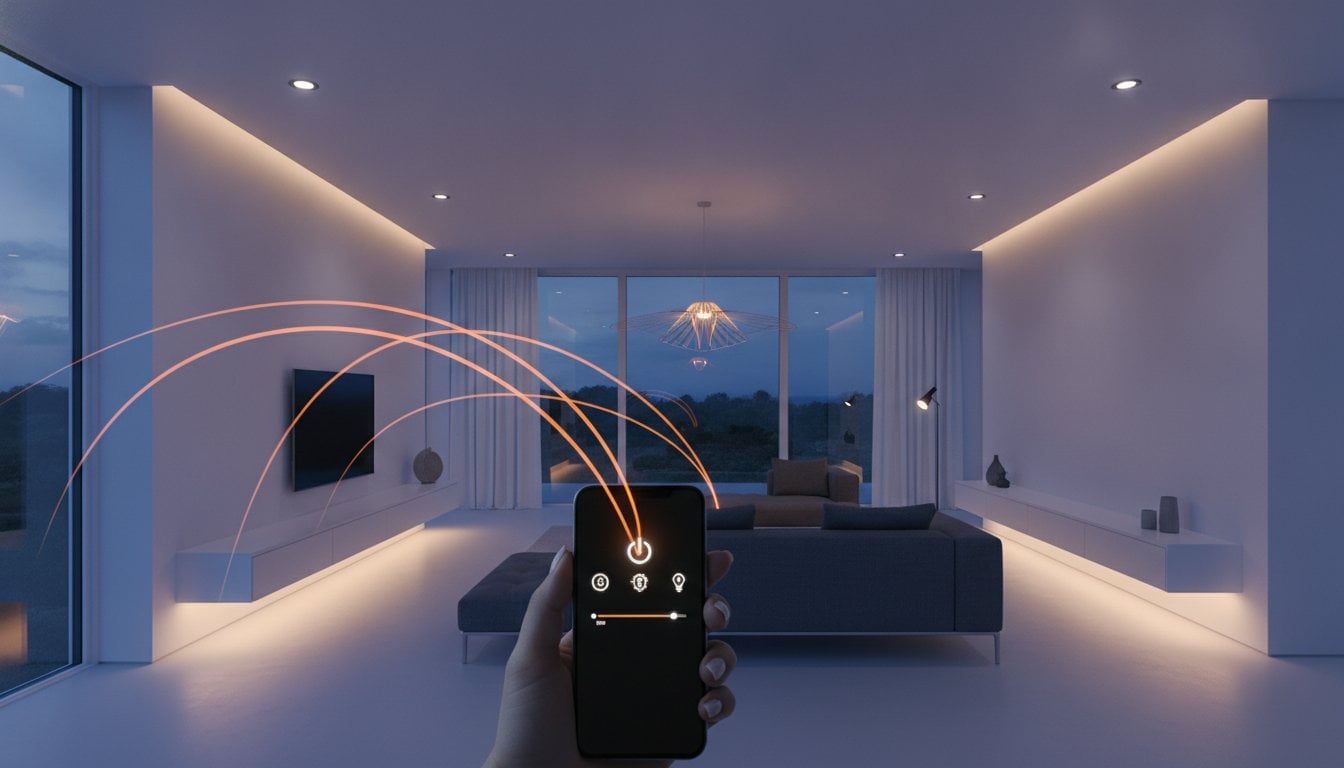
What if you could relocate every light switch in your house without creating a single speck of plaster dust? For most Australians, the thought of modernising a home’s electrical system brings up images of “chasing” masonry walls, shredded gyprock, and the inevitable, expensive repainting that follows. When you factor in professional electrician rates that typically range from $80 to $120 per hour, a traditional lighting upgrade can feel more like a financial burden than a benefit. It is a common frustration, especially if you are restricted by heritage listings or rental agreements that strictly forbid structural changes.
The good news is that you don’t have to compromise on your home’s integrity to enjoy a sophisticated lifestyle. By implementing no rewire lighting control, you can gain total command over your environment without the mess or the massive bill. This guide explores how wireless switching modules and kits provide a structural bypass for the modern Australian home. You will discover how these “smarter, cleaner” solutions integrate behind the scenes with your existing wall plates, giving you a professional result with minimal disruption to your daily life.
Key Takeaways
- Eliminate the dust and mess of chasing gyprock by using a system that leaves your existing walls and paintwork completely intact.
- Discover how no rewire lighting control uses radio frequency to bypass the need for expensive new cabling and high electrical labour costs.
- Learn to add two-way switching or bedside controls in minutes, placing switches exactly where they are needed regardless of wall studs or crawlspaces.
- Understand why choosing hardware designed for Australian wall plates ensures a seamless, professional finish without the need for complex software.
- Find out how to modernise heritage or rental properties where structural modifications are restricted or strictly forbidden.
Why Traditional Lighting Upgrades Are a Renovation Nightmare
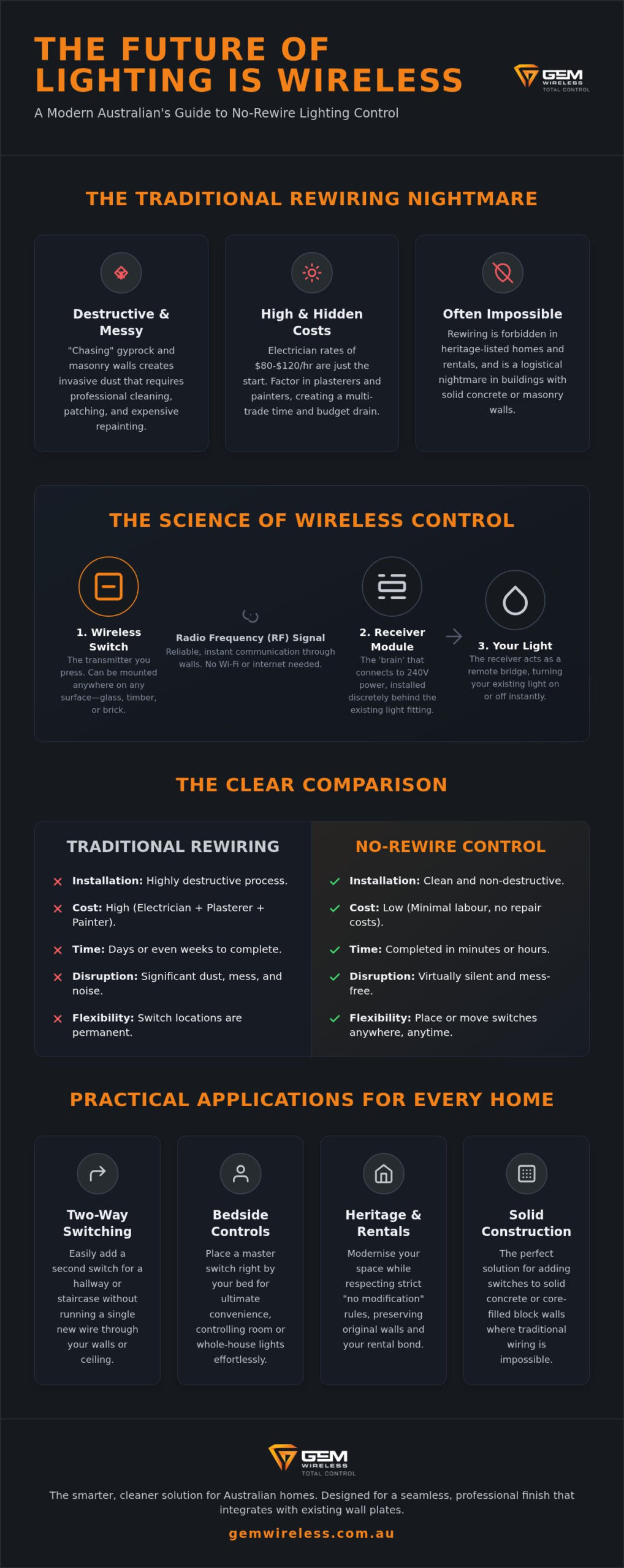
Traditional electrical upgrades are often more destructive than homeowners anticipate. When you decide to move a switch or add a new light point, the process usually begins with “chasing”. This involves cutting deep grooves into your gyprock or solid masonry to house new copper cables. The result is a fine, invasive dust that settles into every corner of your home, often requiring professional cleaning and weeks of repainting. It’s a high-friction approach to a problem that modern technology has already solved.
Beyond the mess, there is the “sparky” factor. With Australian electrician rates typically sitting between $80 and $120 per hour, every minute spent crawling through a tight ceiling space or grinding into a brick wall adds up quickly. In older Australian homes, particularly those built before 1990, there is also the looming risk of asbestos. Disturbing these materials requires specialised contractors and significant expense, turning a simple lighting change into a high-risk project that most people would rather avoid.
The Hidden Costs of Traditional Rewiring
The quote from your electrician is rarely the final price of the project. A traditional rewire is a multi-trade event. Once the cables are in, you’ll need a plasterer to patch the holes and a painter to colour-match the walls. This creates a massive time sink, as you coordinate three different schedules just to move a single switch. Using a Wireless light switch bypasses this entire cycle. By opting for no rewire lighting control, you eliminate the need for structural repairs entirely; this keeps your renovation budget focused on quality fittings rather than repair work.
When Rewiring Isn’t an Option
In many Australian properties, traditional rewiring is physically or legally impossible. Heritage-listed homes often feature original lath and plaster walls or ornate timber panelling that cannot be replaced if damaged. Similarly, renters face strict “no-modification” clauses. Drilling into walls or modifying the circuit could lead to a lost bond or a breach of lease. It’s a frustrating barrier for those who want to modernise their living space.
Solid construction also presents a barrier. Many modern apartments use reinforced concrete or core-filled masonry. Retrofitting cables into these structures is a logistical nightmare that most contractors won’t even attempt. A no rewire lighting control system provides the only viable path forward. It offers modern convenience without compromising the building’s structural integrity or your rental agreement.
The Science of Wireless: How No-Rewire Control Actually Works
Understanding no rewire lighting control starts with moving away from the idea of the internet. While “smart homes” often rely on Wi-Fi and mobile apps, dedicated wireless switching uses Radio Frequency (RF). This is a specialised signal that travels through walls and floors without needing a router or an active internet connection. It is a closed-loop system; this makes it faster and more reliable than a standard home network. If your NBN goes down, your lights still work perfectly.
The system relies on two main components: a receiver and a transmitter. The receiver is the active part that handles the 240V power, while the transmitter is the switch you interact with. This separation allows you to place switches on glass, brick, or timber without running a single centimetre of copper cable. It is a clean, professional solution that functions exactly like a traditional switch but without the structural requirements. Many older Australian homes also use “loop-at-the-light” wiring that leaves wall boxes without a neutral wire; if this applies to your property, our guide to the no neutral wireless light switch for Australian retrofits explains exactly how to stay compliant while modernising your lighting.
The Role of the Wireless Relay Module
A wireless relay is a remote-controlled bridge for electrical circuits. In a standard Australian setup, this module is installed directly behind your light fitting or tucked inside an existing wall plate. These modules are designed with a compact footprint to fit within standard mounting blocks. They act as the “brain,” listening for a signal from the switch and then instantly connecting or disconnecting the power. You can find high-quality switching modules that make this transition seamless for any room in your house.
Transmitters and Kinetic Energy
The transmitter is the switch itself. Unlike traditional switches that must be hardwired to the light, these can be mounted anywhere. Some modern designs utilise kinetic energy. The physical act of pressing the switch generates a tiny burst of electricity, which is enough to broadcast the RF signal to the receiver. This means you never have to worry about changing batteries or losing power during a blackout. It is a set-and-forget technology that values your time and peace of mind.
Security is handled through pairing logic. Each transmitter has a unique ID, ensuring your kitchen lights don’t turn on when your neighbour flicks their switch. The signal range is impressive. Some long-range modules are capable of reaching 100 metres in open air, easily penetrating standard Australian internal walls and floors to ensure a consistent connection throughout the home. If you ever experience intermittent responses or a switch that only works part of the time, our wireless light switch troubleshooting guide for Australian homes walks you through diagnosing signal interference and restoring reliable performance.
Comparing Traditional Rewiring vs Wireless Retrofitting
Choosing between traditional methods and no rewire lighting control often comes down to one thing: your time. A standard rewire project is measured in days. It involves scheduling multiple trades and living in a construction zone. In contrast, a wireless retrofit is measured in minutes. Once the module is in place, pairing a switch is as simple as a few clicks. This speed doesn’t just save you from a headache; it fundamentally changes the economics of your renovation.
While the upfront hardware cost for wireless components might be higher than a few metres of copper cable, the total project cost is usually lower. You are trading expensive, multi-day labour for a one-off hardware investment. In the Australian market, where trade labour is a significant portion of any budget, this trade-off is highly logical. You avoid the cost of plasterers and painters entirely, keeping your budget focused on the technology itself.
Speed and Efficiency on Site
The “In-and-Out” factor is a major benefit for busy households. Because the electrician only needs to access the light fitting or the existing switch box to install a module, they spend far less time on-site. This minimises disruption to your daily routine. It also makes the system incredibly scalable. You can start with a single room and add more no rewire lighting control modules later as your needs change, all without ever pulling a new cable through your ceiling.
There is also a clear division of labour that empowers the homeowner. While a licensed sparky must handle the 240V installation of the modules to stay compliant with Australian law, you can handle the placement and pairing of the switches yourself. If you decide a switch would be better on the other side of the door after the furniture arrives, you simply unstick it and move it. There are no holes to patch and no new wires to run.
Long-Term Value and Adaptability
Future-proofing is built into the wireless approach. Traditional cables buried deep inside your walls are difficult and expensive to upgrade or repair. Wireless modules, however, are accessible and easy to replace if technology evolves. This adaptability is a strong selling point for Australian properties. Modern buyers value “smart” ready homes that don’t require structural surgery to customise.
Maintenance concerns are also minimal. High-quality wireless modules are designed for longevity, often outlasting the decorative fittings they control. Unlike physical cables that can degrade or be damaged by rodents in roof spaces, a wireless signal remains consistent. You gain a modern, reliable system that adapts to your life, rather than forcing you to adapt your life to the original electrical plan of the house.
Practical Applications: Where to Use No-Rewire Switching
If you’ve ever tried to add a second switch to a long hallway, you know the frustration of an electrician spending hours in a hot, cramped ceiling space. Traditional two-way switching requires complex cabling through the crawlspace. With no rewire lighting control, you skip the dusty loft entirely. You can mount a new switch at the far end of the hall in seconds. It’s a pragmatic solution for homes with solid brick internal walls where chasing cables is simply too messy and expensive.
Bedside convenience is another significant win for the modern homeowner. Most older Australian houses have light switches located near the bedroom door, often far from the bed itself. Instead of fumbling in the dark, you can place a wireless switch exactly where you reach, whether that’s on your headboard or a bedside table. Because these transmitters don’t need a power source, they aren’t limited by the location of timber studs. It’s about making your home work for your habits.
Residential Problem Solving
Fixing a “dark entryway” is a classic use case for this technology. Many older builds lack a switch near the front door, forcing you to walk across a pitch-black room to find the light. Adding a wireless switch here creates a safer, more welcoming environment. For those with open-plan living areas, you can easily create lighting zones. This lets you dim the lounge lights for a movie while keeping the kitchen bright, all without a full electrical overhaul. For detailed advice on selecting the right hardware, check out this Wireless Light Switch Kit Guide for Australian Homes 2026.
Sheds, Garages, and Outbuildings
Long-range modules are essential for larger properties or rural blocks. If you need to control garden lights or shed power from the main house, running underground cables is a massive expense. Our Long Range Switches can bridge these gaps; some modules are capable of reaching up to 100 metres in open air. This is a game-changer for rural applications like water pump or gate control. For Australian property owners managing remote outbuildings or large acreage, a dedicated long range wireless light switch provides the signal strength and reliability needed to control lights and equipment across significant distances without any groundworks. The transmitters are designed to be durable, ensuring they can handle the harsh Australian sun in external settings.
In a commercial setting, time is money. Retrofitting an office or warehouse with no rewire lighting control means zero downtime for your staff. You can reorganise the floor plan and move every light switch over a lunch break. For business owners looking to scale this approach across their entire premises, our commercial wireless lighting solutions for Australian retrofits outlines how to modernise offices, warehouses, and retail spaces without cabling costs or construction disruption. If you’re ready to upgrade your property without the structural damage, explore our range of Switch Module Kits today.
Choosing Your System: The Gem Wireless Advantage
Selecting the right hardware is the final step in modernising your home. Gem Wireless modules are engineered specifically for Australian electrical standards and standard mounting blocks. This pragmatic approach ensures that your no rewire lighting control system is both safe and effective. By choosing a system designed for the local market, you avoid the compatibility issues that often plague generic international imports. You gain a solution that is built to last in Australian conditions.
We believe in empowerment through simplicity. While many tech companies focus on complex mobile apps that fail when the internet drops out, our system prioritises immediate, tactile response. You don’t need to be a software expert to turn on your lights. The setup is designed to work behind the scenes, allowing you to enjoy a modern home without changing your daily habits. It is a sophisticated technological upgrade delivered with a down-to-earth, accessible service mindset.
Integration with Existing Hardware
One of the biggest advantages of our system is its ability to blend in. You can keep your preferred brand of wall plates and your existing home decor. Our modules are compact enough to hide behind your current fittings, maintaining the aesthetic integrity of your rooms. Whether you are using our Mains Powered Switches for standard rooms or Long Range Switches for larger properties, the result is always a clean, professional finish. Gem Wireless prioritises hardware reliability over software complexity.
This compatibility extends to national availability. Our products are stocked through a network of agents across Australia, ensuring you have local support whenever you need it. You aren’t just buying a kit; you are partnering with a forward-thinking innovator that values your time and cost-effectiveness. We have done the hard work behind the scenes so your installation is as frictionless as possible.
Next Steps for Your Project
Ready to start? Begin by auditing your space to identify where you need better control. Look for dark entryways, inconvenient bedside switches, or outdoor areas that are currently hard to reach. Once you have a plan, consult a licensed sparky. When requesting a quote, ask for a wireless retrofit using Gem Wireless components. This ensures they understand you want to avoid structural damage and chasing walls. You can browse the range of wireless switching modules at Gem Wireless to find the exact Switch Module Kits for your specific needs. Taking this smarter, cleaner path saves you from the renovation nightmare and delivers total control over your home’s lighting.
Take Control of Your Lighting the Smarter Way
Modernising your home doesn’t have to mean living in a construction zone. By choosing no rewire lighting control, you bypass the dust of chasing walls and the high costs of traditional electrical labour. You gain a system that works behind the scenes, providing total flexibility to move or add switches exactly where you need them. It is a pragmatic approach that respects both your budget and your home’s structural integrity.
Our technology prevents structural damage while remaining fully compatible with standard Australian wall plates. This ensures a professional finish that matches your existing decor. With national support and stockists available across the country, you have access to expert guidance throughout your project. You don’t have to settle for an outdated electrical layout or a messy renovation. It is time to empower your living space with a solution that values simplicity and reliability.
Ready to upgrade your property without the headache? Explore Gem Wireless Switching Solutions for your home or business and discover how easy a professional retrofit can be. Your cleaner, more efficient home is just a few modules away.
Frequently Asked Questions
Do I still need an electrician for no-rewire lighting control?
Yes, you must engage a licensed electrician to install any components connected to your home’s 240V mains power. While you can handle the placement and pairing of the wireless switches yourself, Australian law requires a professional to wire the no rewire lighting control modules into your ceiling or wall boxes. This ensures your installation remains safe, compliant with local standards, and does not void your home insurance.
Will a wireless light switch work through thick brick or concrete walls?
Yes, the Radio Frequency (RF) signals used in these systems are specifically designed to penetrate standard building materials like brick, timber, and concrete. Unlike Wi-Fi, which can struggle with density, dedicated wireless signals are highly reliable for domestic use. For larger properties or particularly thick structures, our long-range modules provide even greater signal strength to ensure your switches respond instantly every time you press them.
Can I use a wireless switch with my existing LED downlights?
Absolutely, wireless switching modules are fully compatible with standard LED downlights and other common Australian light fittings. The module simply acts as a remote-controlled bridge for the existing power circuit. It does not change how the light operates; it just changes how you trigger the power. This makes it a perfect solution for retrofitting modern lighting into older homes without needing to replace your current globes.
How far is the range of a typical wireless lighting module?
A standard wireless module provides more than enough range for a typical Australian home, easily reaching through several internal walls. For larger properties or outdoor applications, Gem Wireless offers long range wireless light switches that can communicate up to 100 metres in open air. This allows you to control lights in a detached garage or shed from the comfort of your main living area without running any new underground cables.
What happens if the power goes out? Do I need to re-pair the switches?
Your system will retain all pairing information automatically after a power outage. The connection between the transmitter and the receiver is stored in non-volatile memory, so there is no need to re-pair the devices once the power returns. Your lights will function exactly as they did before the blackout, providing you with peace of mind and a truly set-and-forget experience for your no rewire lighting control setup.
Can I add multiple switches to control the same light (3-way or 4-way switching)?
Yes, you can easily set up three-way or four-way switching by pairing multiple transmitters to a single receiver module. This is one of the most popular uses for the system, as it allows you to add extra switches at either end of a hallway or in a large open-plan room. You can add as many switches as you need without ever having to crawl through a ceiling space to run extra copper wires.
Is wireless lighting control secure from interference or hacking?
These systems are highly secure because each switch uses a unique digital ID to communicate with its paired receiver. This prevents your neighbours from accidentally controlling your lights and ensures the signal remains interference-free. Because the system uses dedicated RF signals rather than your home Wi-Fi network, it is inherently protected from standard internet hacking attempts, providing a robust and private control solution for your property.
Do wireless switches require batteries that need frequent changing?
Many of our wireless switches use kinetic energy technology, which means they never require batteries. The physical force of pressing the switch generates enough power to send the signal to the receiver. For other models that do use batteries, the power consumption is so low that they typically last for several years of normal use. If you notice your switch becoming less responsive over time, our complete wireless light switch troubleshooting guide can help you quickly identify and resolve the issue. This design philosophy focuses on hardware reliability and minimal maintenance for the long term.
DIY electricalheritage home upgradeshome improvementhome renovation Australialighting controlrental property tipssmart homewireless switching