- Empty cart.
- Continue Shopping
Wireless Pump Switch Australia: The 2026 Buyer’s Guide to Remote Control
- Posted on
 Strong Digital
- 0
- Categories: Uncategorized
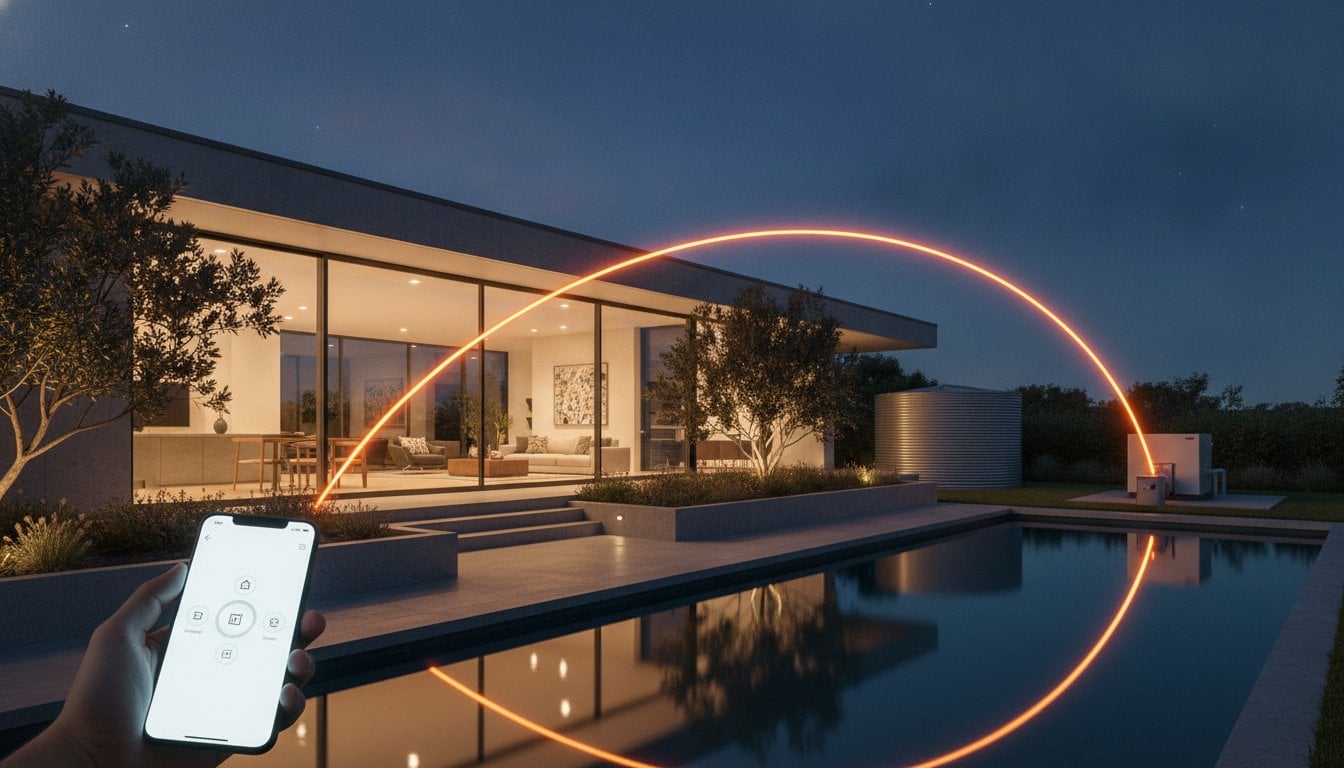
Digging a hundred-metre trench through sun-baked Australian clay just to flip a power switch is an expensive waste of your time. Most property owners accept the back-breaking labour or the massive electrical bill as a necessary evil for reliable water management. It’s a common frustration when the soil is too hard to dig and the cost of copper wire continues to climb. Finding a reliable wireless pump switch Australia wide shouldn’t feel like a gamble against the elements.
We believe that managing your water should be simple and cost-effective. You deserve a solution that works across long distances without a technical headache. This 2026 buyer’s guide shows you how to control any pump on your property without the massive cost of trenching or running new cables. We will explore the latest switch module kits and long-range switching modules that are easy to set up and built to survive the rugged Australian climate. You’ll learn how to modernise your setup while keeping your existing pump exactly where it is.
Key Takeaways
- Eliminate the need for expensive trenching and hard labour by modernising your property with a wireless system.
- Understand why Radio Frequency (RF) technology outperforms standard Wi-Fi for reliable long-distance outdoor switching.
- Learn how to select the right wireless pump switch Australia properties need by prioritising IP66 ratings and specific Line of Sight ranges.
- Explore how remote switching can simplify pool maintenance and automate your garden irrigation from the comfort of your home.
- Recognise the difference between simple DIY plug-and-play kits and installations that require a qualified electrician.
Why Wireless Pump Switches are Modernising Australian Properties
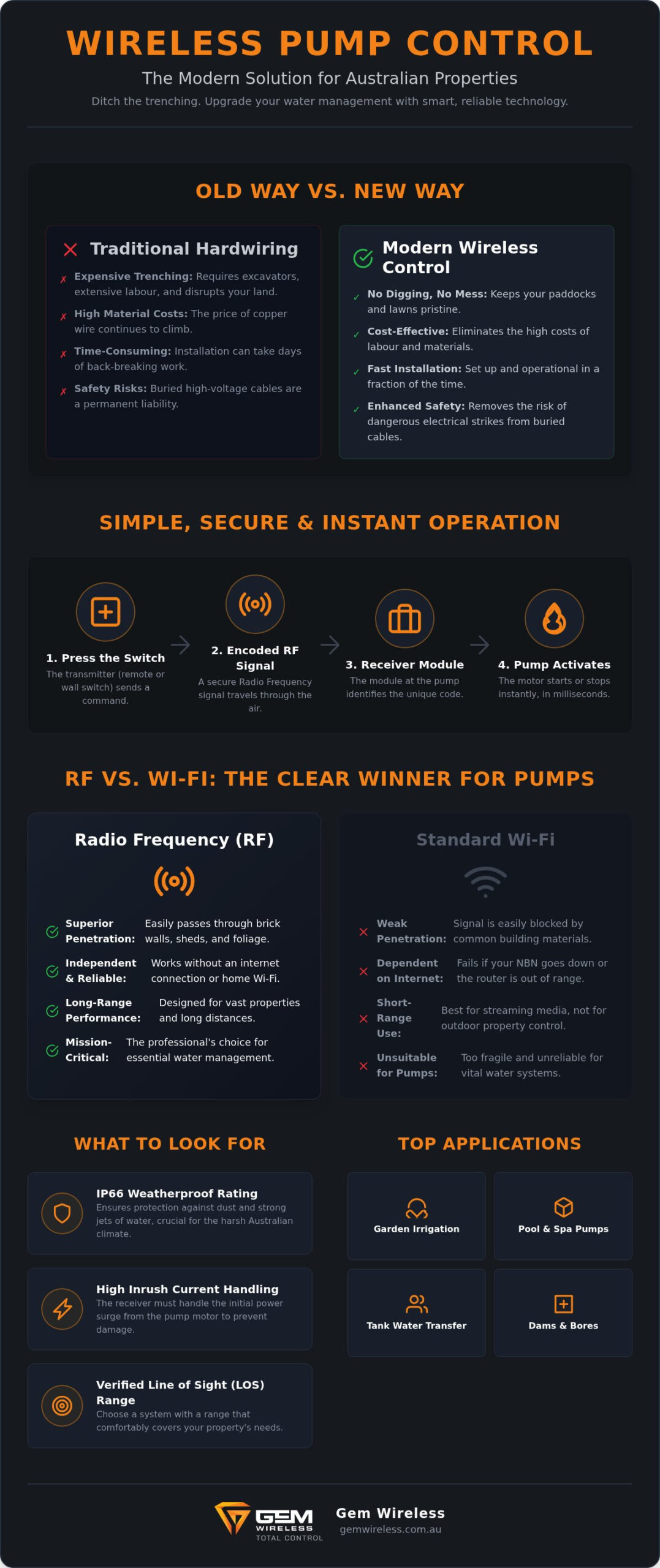
Traditional property management in Australia has long been defined by hard labour and heavy machinery. If you wanted to control a water feature, an irrigation system, or a transfer pump, you typically had to dig for it. This often meant hiring an excavator to cut through sun-baked clay just to lay a few metres of conduit. A wireless pump switch australia property owners can rely on has changed this dynamic entirely. It replaces the brute force of trenching with the precision of radio frequency, allowing for sophisticated control without the environmental or financial cost of digging.
The Hidden Costs of Trenching vs Wireless
Choosing a hardwired path involves more than just a shovel. You have to account for excavator hire, several days of professional labour, and the volatile price of copper wire. These costs add up quickly, especially on larger holdings where the pump is located far from the main switchboard. Wireless pump switching is the elimination of physical control lines between the switch and the motor. By choosing “no rewire” solutions, you can keep your existing infrastructure intact while upgrading the functionality. This approach has become the standard for modern Australian renovations because it prioritises efficiency over invasive construction.
Beyond the initial setup, wireless systems offer a level of safety that buried cables cannot match. High-voltage lines running through a paddock or garden are a permanent liability. A single misplaced fence post or a deep-reaching garden fork can lead to dangerous electrical strikes. Switching modules remove this risk by keeping the high-voltage components localised at the pump and the power source. Modern technology has also evolved to handle the unique challenges of Australian properties. Today’s hardware is designed to maintain a strong signal even when operating through thick brick walls or the heavy interference of corrugated iron sheds.
Remote Control Convenience for Every Day
The most immediate benefit of remote switching is the end of the “paddock walk”. On a rainy night or a blistering 40-degree afternoon, trekking to a distant shed to flip a manual switch is a chore that most people would happily avoid. Remote control gives you that time back. You can trigger irrigation cycles, manage greywater systems, or initiate tank transfers from your kitchen or back deck with a simple press of a button.
These systems are designed to be part of a cohesive property management strategy. You can integrate your pump control into a broader network of devices to manage your entire home or farm. Many owners combine their pump modules with no rewire lighting control to create a fully modernised environment without the mess of traditional electrical work. It’s a pragmatic way to bring older properties into the digital age while keeping your lawn and paddocks undisturbed.
How Wireless Pump Control Technology Works
Modern wireless systems rely on a simple, secure handshake between two primary components. You have a transmitter, which is the remote or wall switch you interact with, and a receiver, which is the module wired directly into your pump. When you press the button, the transmitter sends an encoded signal through the air. The receiver identifies this unique code and instantly opens or closes the electrical circuit to start or stop the motor. This process happens in milliseconds, providing the same responsiveness as a hardwired switch without the need for a physical cable.
RF vs Wi-Fi: Why RF Wins for Pumps
Wi-Fi is excellent for streaming media, but it’s often too fragile for reliable outdoor water management. A wireless pump switch australia needs to function through thick brick walls, dense garden foliage, and corrugated iron sheds. Radio Frequency (RF) technology operates on dedicated bands that penetrate these physical obstacles far better than a standard Wi-Fi signal. Because RF doesn’t rely on your home router or an internet connection, your pump remains fully operational even if your NBN goes down. This independence is vital for regional properties where connectivity can be patchy or restricted by distance from the main house.
Switching Modules and Receivers
The receiver, or switching module, is the workhorse of the setup. It is installed between your power source and the pump motor, acting as an intelligent gatekeeper. These wireless switching modules are the heart of the system, specifically engineered to handle the high inrush current that many pump motors require when they first kick over. They are designed to be compact enough to fit inside existing enclosures or their own weather-shielded housings.
Security is managed through a digital pairing process. This ensures that your transmitter only communicates with your specific receiver, preventing any signal cross-talk from nearby devices. Most modern transmitters are either battery-powered for long-range portability or use battery-free kinetic technology. Kinetic switches are particularly impressive; they generate a tiny pulse of electricity from the physical force of the button press, meaning they never require a battery change. Exploring our pre-paired Switch Module Kits can help you find a reliable setup that works straight out of the box.
To ensure long-term reliability, it’s essential to use hardware that operates on Australian-compliant frequencies. This prevents interference with other household electronics and ensures your signal remains clear and private across your entire property.
Choosing the Right Switch: Range, Power, and Ratings
Selecting a wireless pump switch australia requires looking beyond the basic on-off function. You need to match the hardware to your specific property layout, the distance of the signal, and the electrical load of the pump motor. Many off-the-shelf solutions fail because they don’t account for the unique demands of the Australian environment or the high startup current required by irrigation motors. Getting these specs right from the start ensures your system remains reliable and safe.
Range Requirements for Australian Blocks
Range is often quoted as “Line of Sight” (LOS), which assumes a perfectly flat paddock with no obstructions. In reality, your signal must often travel through timber frames, brick walls, or dense garden beds. You should always choose a range rating that exceeds your actual distance to account for these physical barriers.
- Standard Kits: These are ideal for backyard pool pumps or small garden water features, typically offering a reliable range of 30 to 50 metres through standard residential walls.
- Long Range Switches: For rural tank transfers or large acreage, you need specialised hardware that can reach 500 metres or more.
If your property has significant elevation changes or heavy foliage, you should consult a long range wireless light switch guide to understand how signal penetration works over vast distances. Choosing the right frequency and power output is the difference between a seamless experience and a frustratingly intermittent signal.
Durability and Weatherproofing
Australian conditions are notoriously harsh on electronics. Between the blistering UV rays of summer and the sudden downpours of the wet season, your switching module needs a robust enclosure. Look for hardware that has been tested for the local climate rather than generic imports that may crack under the sun. An IP66 rating ensures a module is dust-tight and protected against heavy seas or powerful jets of water. This level of protection is the gold standard for any equipment sitting near a bore, tank, or pool area.
Managing Load Capacity
Pumps are inductive loads, meaning they draw a massive amount of “start-up” current when the motor first engages. This “inrush” can be several times higher than the pump’s normal running current. It’s vital to ensure your switching modules are rated for these spikes. A module that is only rated for resistive loads, like a standard light bulb, will quickly burn out its internal relays if forced to start a heavy-duty pump motor every day. Choosing a kit specifically designed for motors ensures your remote control setup remains reliable for years to come.
Top Applications for Wireless Pump Switches
While industrial agriculture has used remote systems for years, the modern wireless pump switch australia is now accessible for everyday residential and small-holding use. These systems aren’t just for massive irrigation projects. They solve practical, daily problems for anyone managing water on their property. Whether you’re looking to automate a backyard water feature or manage a bore pump half a kilometre away, wireless control removes the physical barriers to efficient operation. Many farmers and small-holders rely on local experts like Gidge Rural to source the right hardware and supplies for these types of property upgrades.
Retrofitting a pool or spa usually involves messy electrical work and cutting into existing hard-piping. Wireless modules bypass this friction entirely. By installing a module at the power point, you can control your filtration system without touching the plumbing. This also improves safety by allowing you to operate the pump from a dry location, far from the water’s edge. You can create a complete backyard oasis by following our wireless pool light switch guide to sync your water and lighting systems together.
Garden and Agricultural Irrigation
Managing a garden or a small orchard often requires juggling multiple schedules. A unified wireless system allows you to pair your garden lights and pumps on the same network. This means you can trigger a cooling mist for your plants or start a greywater cycle from your kitchen or back deck. For those with larger blocks, long-range switches are a game-changer for bore pumps and dam transfers, reaching distances that would be impossible or too expensive to wire traditionally. Integrating these with wireless garden lighting control creates a seamless, professional outdoor environment without the need for an excavator.
Livestock and Emergency Use
Beyond the garden, remote switching is a vital tool for livestock management. You can initiate water transfers to remote troughs without driving across the property, saving time and fuel every single day. In more urgent scenarios, having a dedicated remote for a wash-down or fire-mitigation pump provides essential peace of mind. If you need to act quickly, you don’t want to be fumbling with manual switches in a dark shed or running across a paddock. You can browse our full range of Long Range Switches to find a solution that fits your property’s specific safety and operational demands.
These applications demonstrate that wireless technology is about more than just convenience. It’s about building a more responsive, safer, and more efficient property. By removing the need for physical cables, you gain the freedom to place your controls exactly where they are most useful.
Installing Your Wireless Switch: What You Need to Know
Setting up a modern wireless pump switch australia wide is designed to be a frictionless experience, but the method depends on your specific hardware. If you’ve chosen a plug-and-play kit with standard three-pin Australian plugs, the installation is a simple DIY task. However, if your pump is hard-wired into a circuit, you must call a licensed sparky. This ensures your setup complies with local regulations and remains safe under heavy electrical loads. Regardless of the model, the goal is to modernise your property without the invasive construction of the past.
The installation follows a logical three-step process. First, you mount the receiver module near the pump motor, ideally in a position that minimises physical obstructions. Second, you wire the module into the power circuit. Third, you pair the transmitter with the receiver to establish a secure digital link. Before you permanently fix any components, always perform a signal strength test. Walk to your desired switching location and trigger the pump several times. If the signal is intermittent, shifting the receiver just a few centimetres can often bypass a “dead zone” caused by metal structures or dense foliage.
Ongoing maintenance is minimal, especially if you opt for kinetic transmitters. These battery-free options use the physical energy of the button press to send the signal, meaning they never require a battery change. If you use battery-powered remotes for long-range applications, checking the power levels once a year is usually sufficient to ensure total reliability during the peak summer months.
Step-by-Step Pairing Guide
Most switching modules come pre-paired, but you may need to reset them or add extra controllers. To begin, clear any factory settings by holding the pairing button on the module until the indicator light flashes. Once cleared, press the pairing button again and immediately click your remote or wall switch. The light will stay solid to confirm a successful handshake. This system allows you to add multiple switches to a single pump, giving you the flexibility to control water transfers from the main house, the garden shed, or even your vehicle.
Safety and Australian Standards
Safety is the foundation of any electrical upgrade. All wireless hardware must carry the RCM (Regulatory Compliance Mark) to prove it has been tested for the Australian market. This mark is your guarantee that the device won’t interfere with other electronics and is built to handle our 240V mains power safely. Every installation must also align with AS/NZS 3000, commonly known as the Wiring Rules. By choosing Gem Wireless, you are opting for hardware that is trusted by both homeowners and tradies for its strict adherence to these national standards. It’s a pragmatic choice that prioritises long-term peace of mind over cheap, uncertified imports.
Modernise Your Water Management Today
Managing your property’s water shouldn’t be a source of stress or back-breaking labour. By moving away from traditional buried cables, you save thousands in excavation costs and future-proof your setup against physical damage. A high-quality wireless pump switch australia provides the reliability you need for everything from backyard pools to remote livestock troughs. You’ve seen how RF technology maintains a stable connection through the toughest obstacles, and how kinetic switches remove the need for battery maintenance entirely.
It’s time to reclaim your day and eliminate those unnecessary paddock walks. Gem Wireless is proud to be Australian-owned and operated, offering high-performance long-range options that require no messy rewiring. Our systems are designed to work with your existing pumps, making the transition to modern control as smooth as possible. You have the tools to simplify your water management; we’re here to help you get it right.
Browse Gem Wireless Pump Switch Kits for your property and take the first step toward a more efficient, modern home or farm today.
Frequently Asked Questions
Do I need a plumber or an electrician to install a wireless pump switch?
You need a licensed electrician for any hard-wired installation to comply with AS/NZS 3000 standards. While plug-and-play kits can be DIY, most permanent pump setups require a professional to wire the module into the mains circuit safely. A plumber is generally only needed if you are changing the actual pipework or valves. Using a qualified sparky ensures your warranty remains valid and your property stays insured.
How far will the wireless signal travel on an average Australian property?
Signal range depends on the specific hardware you choose for your property. Standard wireless pump switch australia kits typically cover 30 to 50 metres in a residential setting with walls. For larger rural blocks, long-range switching modules can reach 500 metres or more. Factors like terrain, foliage, and building materials will influence the final result; so it is always wise to test the signal before permanently mounting your receiver.
Will a wireless pump switch work through a metal shed wall?
Yes, RF signals can penetrate metal sheds, though the range might be slightly reduced compared to an open paddock. Corrugated iron can reflect or dampen signals, so positioning is key to success. If you find the connection is patchy, mounting the receiver module near a window or high up under the eaves often solves the problem. Our long-range modules are specifically designed to handle these types of physical interference on Australian properties.
Can I control multiple pumps from a single remote switch?
You can absolutely control multiple pumps from a single remote switch by pairing multiple receiver modules to one transmitter. This is a pragmatic way to manage a pool pump and a garden irrigation system simultaneously. Alternatively, you can set up multi-point control, where several different switches all trigger the same pump. This flexibility allows you to modernise your water management without needing a separate remote for every single device.
What happens to the wireless switch if there is a power outage?
If the power goes out, the receiver module will lose power just like the pump motor itself. Most systems are designed to remain in the “off” state when power is restored for safety reasons. You will simply need to press the remote switch again once the mains power is back. The digital pairing between your transmitter and receiver is stored in non-volatile memory, so the devices won’t forget each other after a blackout.
Are wireless pump switches waterproof enough for outdoor use?
Quality wireless modules are built to survive the harsh Australian climate. You should look for an IP66 rating, which ensures the hardware is dust-tight and protected against powerful jets of water or heavy rain. While the internal electronics are sealed, it is still best practice to mount the module in a slightly sheltered position. This protects the housing from direct, long-term UV exposure, which can eventually make plastic brittle.
How long do the batteries last in a remote pump switch?
Battery life depends on the type of transmitter you select. Kinetic switches are the ultimate “set and forget” solution because they generate their own power from the physical press of the button and never need batteries. For battery-powered long-range remotes, you can typically expect the power to last between one and two years with average daily use. Replacing the small coin-cell battery is a simple task that takes less than a minute.
Can I add a wireless switch to an existing pool pump timer?
Yes, you can integrate a wireless switch into an existing pool pump timer setup. The module is usually installed after the timer in the electrical circuit. This allows the timer to manage the daily filtration cycles while giving you the manual override to turn the pump on or off whenever you need it. It is a great way to gain instant control for vacuuming or backwashing without messing with the main clock.
farm technologyirrigation automationlong range switchingpool pump controllerproperty maintenanceremote pump controlRF technologywireless pump switch