- Empty cart.
- Continue Shopping
Wireless Garden Lighting Control: The 2026 Guide to Outdoor Automation Without the Trenching
- Posted on
 Strong Digital
- 0
- Categories: Uncategorized
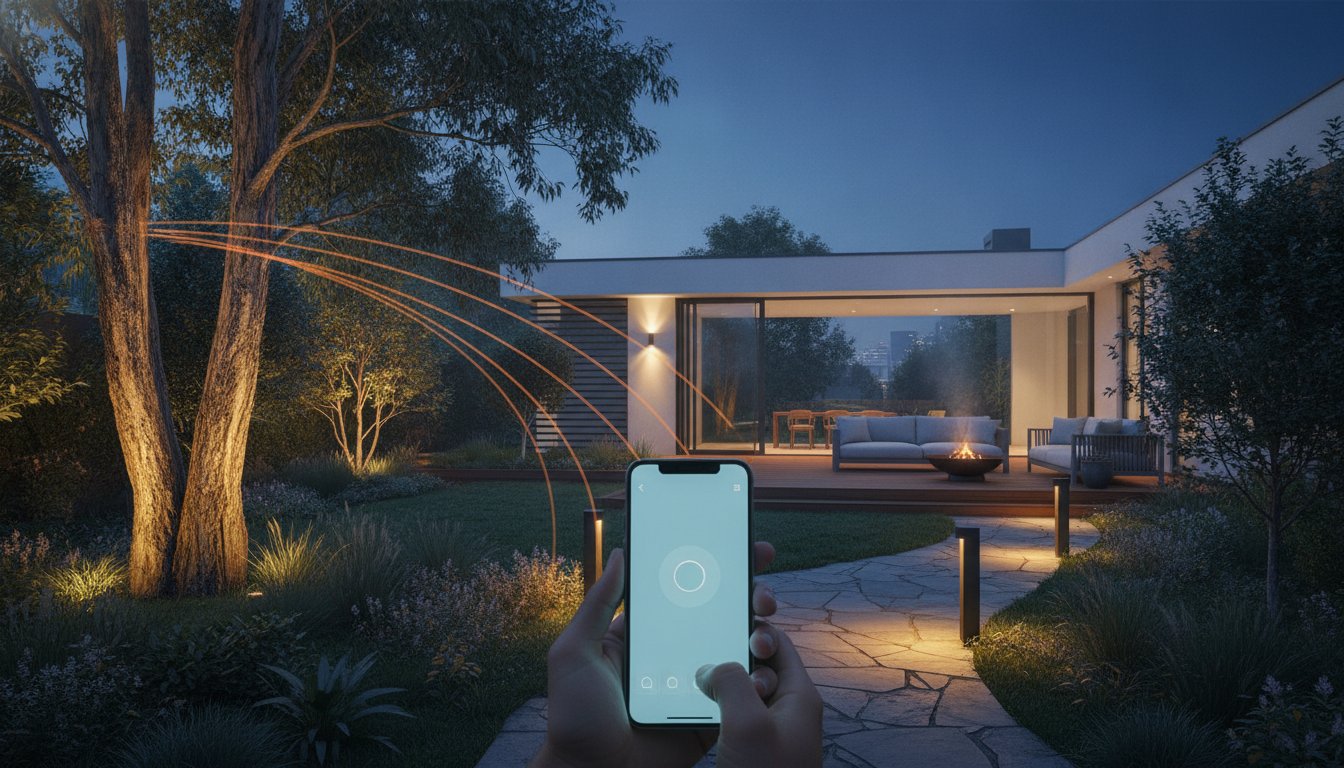
What if you could automate your entire backyard lighting without digging a single centimetre of trenching? Most homeowners assume that adding smart features to an established landscape requires a choice between a torn-up lawn or thousands of dollars in electrical labour. It’s frustrating to deal with weak Wi-Fi signals that drop out before they even reach the back fence. You can achieve professional wireless garden lighting control using long-range switching modules that bypass these traditional hurdles entirely.
We know you want a system that works with your current setup without the headache of a major construction project. This 2026 guide explores how to integrate modern automation with your existing lights. You’ll learn how to ensure a reliable connection from inside your home while keeping your garden and lawn pristine. We’ll show you how to skip the expensive retrofits and move straight to a seamless, automated outdoor space that works exactly when you need it to.
Key Takeaways
- Eliminate the “trenching tax” and protect your landscaping by using RF signals instead of physical wires to trigger your outdoor lights.
- Modernise your property with wireless garden lighting control systems that use switching modules to receive commands from long-range switches.
- Organise your outdoor lighting into functional zones like paths, feature trees, and pool areas to create a more efficient automation layout.
- Maximise signal reliability by learning how to position receivers to avoid common interference from metal fences or thick garden foliage.
- Retrofit your existing setup using simple “Pair and Play” kits that require no complex rewiring or destructive electrical work.
The End of Trenching: Why Wireless Garden Lighting Control is the Smarter Choice
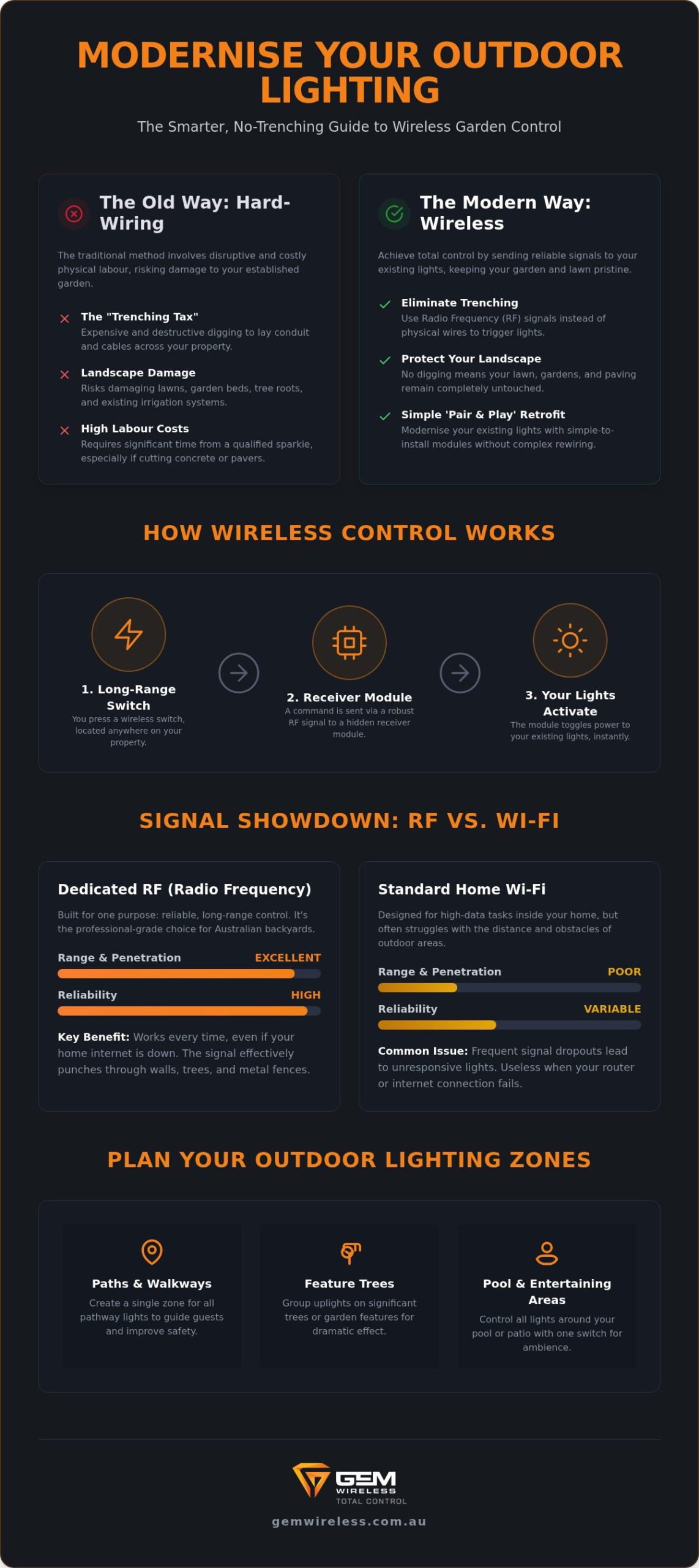
Traditional outdoor wiring is a major headache for Australian homeowners. To install a new switch, you would usually have to dig a trench, lay conduit, and pull heavy-duty cables across your property. This “trenching tax” adds thousands to a project before a single light even turns on. Modern wireless garden lighting control changes the logic of outdoor automation. By using dedicated radio frequency (RF) signals, these systems trigger your lights without needing a physical connection between the switch and the fixture. You can retrofit almost any existing outdoor setup into a high-tech, remote-controlled system without lifting a single spade.
By choosing a wireless setup, you aren’t just saving your lawn. You’re modernising the way your property operates. Industry data shows that the hardware segment of the smart lighting market represented 57.1% of global revenue in 2025, which reflects a clear shift toward dedicated control modules over simple bulbs. This hardware allows you to keep the aesthetic of your existing lanterns or floodlights while adding the intelligence of a modern automation system. It’s a faster, cleaner, and more cost-effective way to upgrade your outdoor living space.
The Hidden Costs of Traditional Outdoor Wiring
Hard-wiring a garden involves more than just buying cable. You’re paying for specialised outdoor junction boxes, UV-rated conduit, and the high cost of a sparkie’s time on-site. If your cables need to cross a driveway or a paved patio, the costs skyrocket as pavers must be lifted and concrete cut. There’s also the constant risk of hitting existing irrigation lines or damaging the root systems of established trees. A wireless approach eliminates these variables. It keeps your landscaping intact and significantly reduces the hours an electrician needs to spend on your property.
Wireless vs. Wi-Fi: Which is Best for the Backyard?
Many people try to use standard Wi-Fi bulbs for their gardens, but they often face signal dropouts. Wi-Fi is designed for high-data tasks inside the home, not for reaching a gate 30 metres away through brick walls and thick foliage. A dedicated lighting control system using RF is far more robust. These signals travel further and penetrate obstacles more effectively than standard home Wi-Fi networks. Because wireless modules don’t rely on your home internet to function, your lights will turn on every time, even if your router is acting up. It’s a pragmatic, professional-grade solution for the Australian backyard.
Understanding the Hardware: Modules, Receivers, and Long-Range Switches
Building a reliable system starts with the right components. Unlike Wi-Fi bulbs that act independently, a professional wireless garden lighting control setup relies on a dedicated receiver, often called a switching module. This module is the brain that receives a command from your switch and physically toggles the power to your lights. It’s a robust approach that works with almost any light source, from modern LEDs to older halogen floodlights.
Switching Modules: The Core of Your Outdoor Setup
Installation is surprisingly simple. These modules are small enough to be tucked behind an existing wall switch or housed within a weatherproof light fitting. Using wireless switching modules allows you to keep your property looking clean, with no visible external boxes or messy wiring. If you’re mounting a receiver directly in the garden, ensure it has an appropriate IP rating to handle Australian weather conditions. This hardware acts as a bridge, allowing your existing lights to join a modern automation network without a full electrical overhaul.
Long-Range Switches for Large Australian Properties
Standard smart home gear often fails when it meets a brick wall or a metal shed. For acreage or deep suburban blocks, you need a long range wireless light switch that uses radio frequency technology specifically designed for distance. These switches can penetrate obstacles that would kill a Wi-Fi signal instantly. You can choose between mains-powered switches for a permanent feel or battery-operated remotes for total flexibility. This makes it easy to control a front gate or a workshop light from your bedside table.
A major advantage of this hardware is its universal compatibility. Whether you’re running high-powered floodlights for security or soft LED path lights, the switching module handles the load. This versatility is essential when planning Energy-Efficient Exterior Lighting, as it allows you to automate high-efficiency bulbs that might not have built-in smart features. You get the benefit of lower power bills and the convenience of professional wireless garden lighting control in one package.
If you’re ready to bypass the trenching and start your setup, exploring our range of switching modules is the most practical first step.
Planning Your Outdoor Layout: A Practical Checklist for Every Property
Effective wireless garden lighting control starts with a map, not a spade. Before you install any hardware, you need to understand how your outdoor space actually functions. Many Australian backyards have “dead zones” where power is available nearby, such as a garden GPO or a shed circuit, but no lighting exists because the cost of trenching was too high. Identifying these points allows you to add new fixtures without the traditional labour costs. You should also decide where your master switch will sit inside the house. A common choice is near the back door or the bedside table for easy security access.
Zoning Your Garden for Maximum Impact
Grouping your lights into zones makes your automation far more useful. You don’t always want your high-intensity security floodlights on when you’re trying to enjoy a quiet evening on the deck. By separating your layout into zones, you can control different areas independently. Consider these common groupings:
- Path and Safety: Low-voltage lights for walkways and stairs.
- Ambience: Uplighting for feature trees or garden beds.
- Entertainment: Bright lighting for the BBQ area and patio.
- Water Features: Integrating a wireless pool light switch into your zone plan allows you to manage pool and spa lighting alongside your garden fixtures.
This approach also enables multi-way switching. You can have one switch at the back door and another in the master bedroom, both controlling the same garden zone without any extra cables.
Power Source Audit: Where is the Juice?
The beauty of wireless modules is that they can tap into existing circuits. Walk around your property and locate every external power source. This includes patio outlets, garage circuits, and even the power running to your pool pump. These are your “hubs” where a switching module can be installed to control a new set of lights. In many older Australian homes, you may encounter “no-neutral” wiring at the switch. Modern modules are designed to handle these scenarios, making them a pragmatic choice for retrofitting wireless garden lighting control into established properties.
If you have a detached structure, using wireless switches for sheds is a game changer. It allows you to use the existing shed power to run perimeter lighting that you can trigger from the main house. This eliminates the need to run a new control cable back across the yard, saving you both time and the cost of concrete cutting or lawn repair. The same long-range RF technology that controls your garden lights can also be applied to water management — a wireless pump switch Australia homeowners rely on uses identical switching modules to remotely control irrigation and water pumps without running a single extra cable across the property.
Performance and Reliability: Signal Strength in the Great Outdoors
A garden is a challenging environment for any wireless signal. Unlike your living room, the backyard is full of physical obstacles like brick walls, dense hedges, and water features. Reliable wireless garden lighting control depends on choosing the right frequency for the job. While Wi-Fi often fails at the back fence, dedicated radio frequency (RF) signals are designed to penetrate these barriers. They offer a stable connection without the need for messy Wi-Fi extenders that often create more points of failure than they solve.
Positioning is everything. To get the best results, mount your receivers as high as possible. This creates a clearer line of sight for the signal to travel. Dense foliage acts as a natural sponge for radio waves, especially after rain when leaves are coated in water. By elevating the module, you reduce the amount of organic material the signal has to fight through. Always perform a range test before final mounting. Simply hold your switch in the desired location and trigger the lights several times to ensure the connection is rock solid.
Dealing with Metal Barriers and Sheds
In Australia, Colorbond fencing and metal sheds are everywhere. These structures create a “Faraday Cage” effect, which can completely trap a wireless signal inside or block it from entering. If you’re automating a light on a metal shed, mount the receiver on the exterior or use a module with an external antenna. This allows the signal to reach the electronics without being smothered by the metal cladding. Long-range switches are particularly effective here, providing the extra punch needed to reach the far corners of a large suburban block or a rural property.
Weatherproofing and Longevity
The Australian climate is unforgiving. High UV levels and intense summer heat can degrade low-quality plastics in months. When selecting components for your wireless garden lighting control setup, look for high IP ratings. An IP66 rating or higher is recommended for any hardware exposed to the elements. This ensures the modules remain dust-tight and protected against heavy rain. For battery-operated switches, a quick annual check of the power cell is usually all the maintenance required. Choosing professional-grade hardware means your system will continue to work reliably for years to come.
To ensure your outdoor automation stands up to local conditions, browse our range of high-performance switching modules designed for the Australian backyard.
Retrofitting with Gem Wireless: Simple Steps to Modern Control
Gem Wireless has become the preferred choice for Australian homeowners and tradies because it solves the most common outdoor automation problems without adding technical complexity. While other systems require a constant internet connection or complex software, our hardware focuses on direct, reliable performance. It’s a pragmatic approach to wireless garden lighting control that respects your time and your budget. By choosing professional-grade modules, you can convert a single porch light into a fully automated system that responds instantly to your commands.
The Gem Wireless Advantage: No Hub Required
One of the biggest hurdles with modern smart lighting is the dependency on hubs and cloud accounts. If your internet goes down or a server fails, your lights often stop working. Gem Wireless removes this layer of friction. Our systems use direct-to-device communication, ensuring an instant response every time you hit the switch. This lack of cloud dependency makes the system incredibly resilient, especially in regional areas where internet can be patchy. It’s a system built for the Australian climate, designed to handle the heat and humidity while maintaining a rock-solid connection.
Getting Started: Your First Wireless Kit
The easiest way to begin is by selecting a wireless light switch kit that fits your immediate needs. You don’t have to automate the entire property at once. Many people start with a single zone, such as the patio or the front gate, and then expand as their garden evolves. The simplicity of the “Pair and Play” setup means you can sync your hardware in seconds, avoiding the tedious configuration processes common with Wi-Fi alternatives. While the wireless switches themselves are easy to place, you must consult with a licensed electrician to install the switching modules into your mains circuits. This ensures your setup is safe, compliant with Australian standards, and integrated correctly into your home’s electrical board.
As you get comfortable with the system, adding more zones becomes a simple task. You can add long-range switches for the back fence or integrate modules into your pool area without ever needing to dig another trench. This modular approach allows your wireless garden lighting control to grow alongside your landscaping. For those ready to upgrade, Gem Wireless hardware is available through a national network of Australian stockists, providing easy access to the components you need for a professional-grade retrofit.
Take Command of Your Outdoor Space
You don’t have to sacrifice your lawn or your budget to achieve a modern, automated backyard. By choosing dedicated RF hardware over fragile Wi-Fi setups, you ensure your lights respond instantly from the bedside table or the back door. This approach eliminates the need for expensive trenching and destructive rewiring, allowing you to retrofit your existing lights into a sophisticated system without the mess.
Professional wireless garden lighting control is about making your property work for you. Our solutions are compatible with any existing light fitting and are built to withstand the unique demands of the Australian climate. As an Australian-owned and operated business, we focus on delivering reliable, practical hardware that solves real-world problems while keeping your installation costs low.
Upgrade your garden today with a Gem Wireless switching kit and enjoy a seamless outdoor experience. It’s time to stop digging and start automating your home with confidence.
Frequently Asked Questions
Do I need a licensed electrician to install a wireless garden lighting control?
Yes, you must engage a licensed electrician to install the switching modules into your mains power circuits. While the wireless switches themselves are battery-powered or stick-on and require no electrical work, the receiver module handles 240V power. This ensures your wireless garden lighting control system meets Australian safety standards and prevents voiding your home insurance. Once the module is in place, you can pair and position your switches yourself.
Will a wireless switch work through a brick wall or Colorbond fence?
Yes, Gem Wireless systems use radio frequency signals that penetrate brick walls and timber fences effectively. However, Colorbond fencing and metal sheds can create a shielding effect that reduces range. To ensure reliability, we recommend mounting the receiver module outside the metal structure or in a higher position to maintain a clear line of sight. Testing the signal strength before final mounting is the best way to guarantee a responsive connection across your property.
What is the maximum range for a long-range wireless light switch?
Long-range switches are designed to cover significant distances on Australian properties, often reaching up to 100 metres or more in open-air conditions. Real-world range depends on physical obstacles like thick foliage or masonry. These dedicated RF systems outperform standard Wi-Fi because they operate on frequencies better suited for distance. This makes them ideal for controlling gate lights or detached workshops from the main house without requiring expensive data repeaters or extra cabling.
Can I use a wireless module with my existing LED garden spikes?
Yes, our switching modules are compatible with almost any existing light fitting, including LED garden spikes, halogen floodlights, and decorative lanterns. The module acts as a smart bridge between your power supply and the light itself. Because it toggles the power source rather than the bulb, you don’t need to buy proprietary smart globes. This allows you to keep your current landscape aesthetic while adding the convenience of remote automation and zoning.
Do wireless switches require batteries, and how long do they last?
Most portable wireless switches use long-life lithium batteries that typically last between two and five years depending on how often you use them. We also offer mains-powered switches that provide a permanent, battery-free solution for internal walls. For battery-operated units, maintenance is minimal. You’ll notice a slight decrease in signal responsiveness when the battery is running low, giving you plenty of time to swap the cell before the switch stops working entirely.
Can I control multiple garden lights from a single wireless switch?
Yes, you can pair a single wireless switch to multiple switching modules across your garden. This allows you to create zones where one button press triggers your path lights, pool area, and feature trees simultaneously. Alternatively, you can use multi-button switches to control different areas independently from one location. This flexibility is a core benefit of wireless garden lighting control, as it lets you customise your layout without digging new trenches for every zone.
Is wireless lighting control more expensive than traditional wiring?
Wireless systems are generally much more cost-effective than traditional hard-wiring for outdoor spaces. While the hardware cost is an upfront investment, you save thousands by avoiding the “trenching tax.” You won’t need to pay for extensive excavation, conduit, heavy-duty cabling, or the high labour costs associated with days of electrical work. Most wireless retrofits can be completed in a fraction of the time, keeping your total project budget significantly lower.
What happens to my wireless lights during a power outage?
Like any mains-powered device, your lights will remain off during a power outage. However, Gem Wireless modules are designed to remember their pairing settings once power is restored. You won’t need to re-sync your switches or reconfigure your zones after a blackout. The system is built for resilience, ensuring that your automation returns to normal operation immediately. This reliable performance makes it a pragmatic choice for properties in areas prone to seasonal storms or grid fluctuations.
DIY lightinggarden lightinghome automationlandscapingno trenchingoutdoor lightingsmart homewireless lighting