- Empty cart.
- Continue Shopping
How to Install a Wireless Switch for Sheds and Outdoor Lights: 2026 Guide
- Posted on
 Strong Digital
- 0
- Categories: Uncategorized
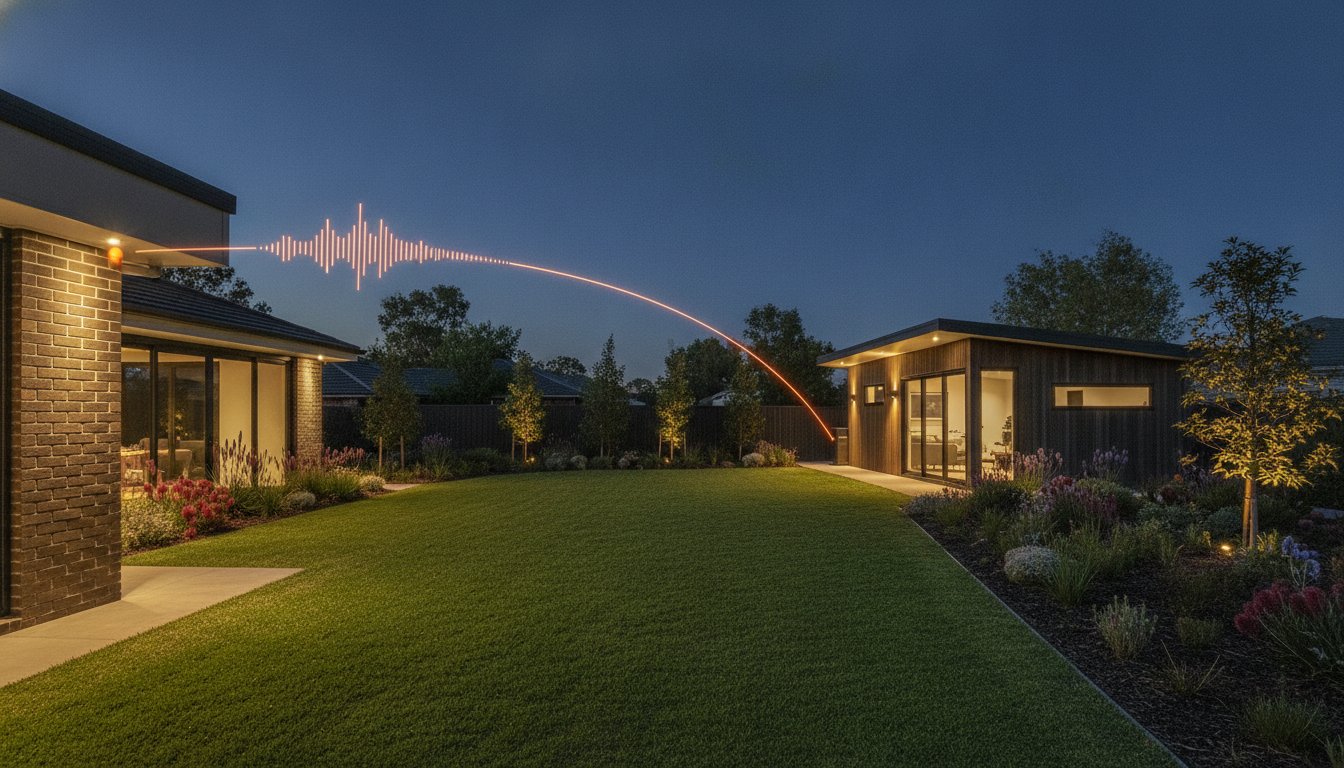
You’re standing at the back door, staring into a pitch-black yard, and realised the only way to turn on the shed light is to trek across the wet lawn in the dark. It’s a common frustration for Australian homeowners, but the thought of digging a 20-metre trench through your landscaped garden just to run a new cable is enough to make anyone stay inside. You aren’t alone in wanting a reliable wireless switch for outdoor security lights that actually works when you need it. Most people agree that traditional smart home hubs often struggle with thick brick walls or the distance to the back of the block, leaving you with tech that simply won’t connect.
This 2026 guide reveals how to bypass the complexity of modern hubs and the high cost of electrical trenching. We promise to show you how specialised long-range switching modules provide seamless remote control from your back door without the mess. While you’ll still need a licensed electrician to handle the 240V mains connection as per Australian safety standards, we’ll preview the most cost-effective way to organise a professional retrofit that secures your backyard without ruining your lawn.
Key Takeaways
- Learn how to avoid the backbreaking labour and high cost of trenching by choosing a wireless switch for outdoor security lights.
- Discover why long-range switching modules outperform standard WiFi when trying to reach outbuildings at the back of the block.
- Understand how to organise a seamless retrofit using no-rewire kits that protect your existing walls and landscaping.
- Explore the versatility of switching modules for controlling more than just lighting, including garden pumps and motorised gates.
- Identify the essential components needed for a reliable, mains-powered setup that works every time you press the button.
Why Shed Lighting Often Requires a Wireless Solution
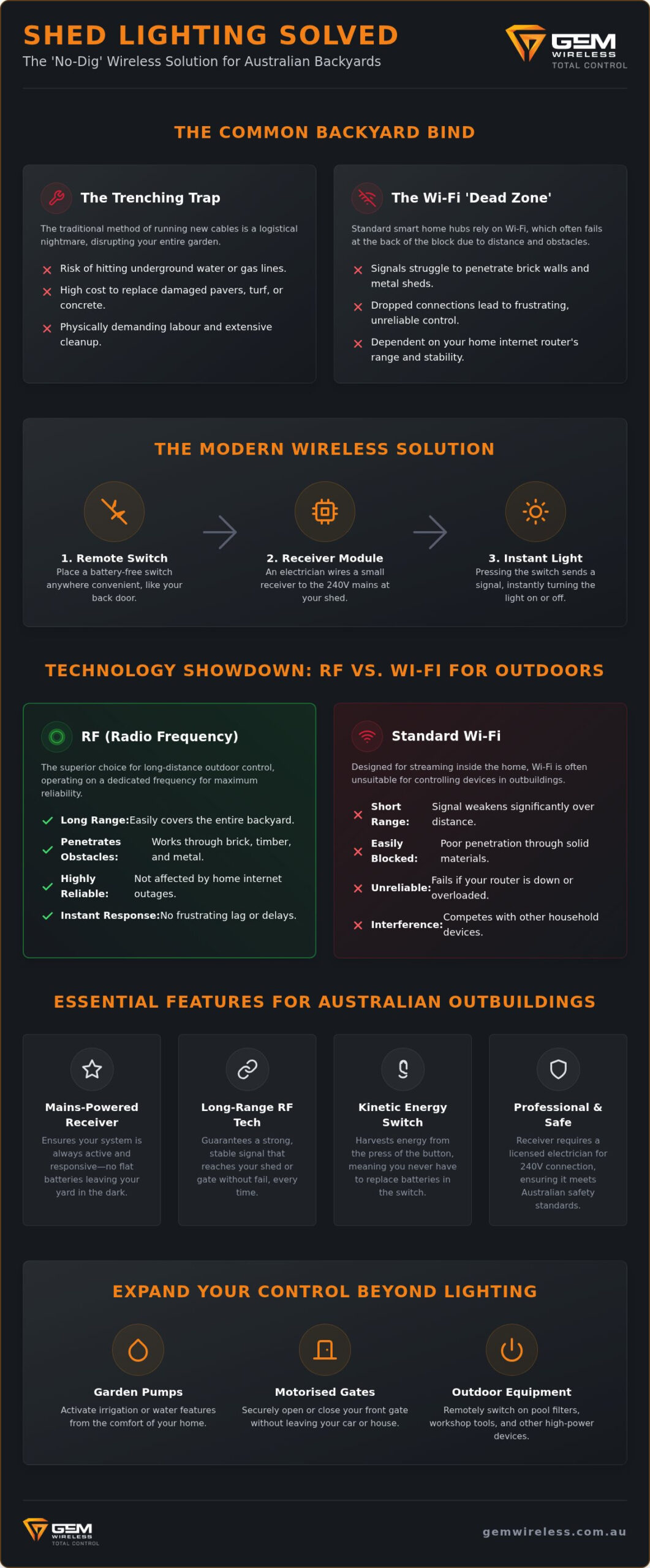
Adding functional lighting to a shed or backyard often stops at the planning stage because of the infrastructure required. A wireless light switch is a two-part system that solves this by using a receiver wired to the light fixture and a remote switch that communicates with it. This setup provides a reliable wireless switch for outdoor security lights without requiring you to run new copper cables through the ground. It’s a modern way to bridge the gap between your home and your outbuildings while keeping the installation process clean and efficient.
While the remote switch is battery-powered or kinetic, the receiver module connects directly to your 240V mains. This requires a licensed electrician to ensure everything meets Australian safety standards, but it eliminates the need for any new internal wiring between the house and the shed. It’s a pragmatic choice for homeowners who want to modernize their property without the disruption of a major renovation.
The Trenching Trap: Why Digging is the Last Resort
Digging a trench is a logistical nightmare that many homeowners underestimate. You have to navigate underground pipes, established garden beds, and expensive concrete paths. Hiring an excavator or spending a weekend on a shovel is physically demanding and often results in high restoration costs. Consider these common hurdles:
- The risk of hitting existing water or gas lines.
- The cost of replacing cracked pavers or damaged turf.
- The difficulty of cutting through reinforced concrete driveways.
Retrofitting is the process of adding new technology to an existing structure without major demolition. By choosing a wireless module, you preserve the integrity of finished walls or heritage buildings. It’s a “no-dig” alternative that keeps your landscaping intact while providing the same results as a full rewire.
Overcoming the ‘Dead Zone’ at the Back of the Block
Traditional smart home devices often rely on your home router, but Australian backyards present a unique challenge. The distance between the router and the back shed is usually too great for a stable connection. WiFi signals struggle to penetrate brick walls and metal shed cladding, leading to dropped connections and frustrating delays. If your wireless switch for outdoor security lights won’t respond because the signal is weak, the system is effectively useless.
RF (Radio Frequency) technology operates on a different frequency than standard WiFi. It offers much better range and penetrates obstacles like foliage and steel more effectively. Using a long-range RF module ensures your lights respond instantly from the back door, regardless of how many obstacles are in the way. This removes the need for expensive WiFi extenders and ensures your security system stays online 24/7.
Selecting the Best Wireless Switch for Your Outdoor Setup
Not all wireless switches are equal. For a reliable wireless switch for outdoor security lights, you need hardware that survives the Australian climate and the distance of a standard residential block. Standard-range modules work well inside a single room, but outbuildings require long-range technology to ensure the signal doesn’t drop out when you need it most. Choosing the wrong hardware often leads to “ghosting,” where the light flickers or fails to respond because of interference from other household devices.
Reliability starts with the power source. While some entry-level systems use battery-powered receivers, these are unsuitable for permanent security. A mains-powered switching module is the professional choice. It stays permanently active, ensuring your lights trigger instantly without the risk of a flat battery leaving your yard vulnerable. For the wall switch itself, kinetic energy models are becoming the standard. They harvest energy from the physical press of the button, meaning you never have to replace a battery in the switch unit again.
RF vs. WiFi: Which Signal Wins in a Shed?
WiFi is great for streaming, but it’s often a poor choice for outbuildings. Most smart switches use 2.4GHz WiFi, which has a short wavelength that struggles to penetrate brick, timber, or metal. If your shed is made of Colorbond cladding, it acts like a shield, blocking high-frequency signals entirely. Radio Frequency (RF) modules operate at a lower frequency, allowing the signal to “wrap” around obstacles and penetrate metal walls more effectively. This creates a robust connection that doesn’t rely on your home internet speed or router placement, providing a true line-of-sight range that WiFi simply can’t match.
Feature Checklist for Australian Outbuildings
When browsing for hardware, prioritise these technical specs to ensure your setup lasts in harsh conditions:
- High-Wattage Capacity: Heavy-duty security floodlights draw significant power. Ensure your receiver can handle the specific load of your LED or halogen lamps.
- Multi-Channel Control: Some modules allow you to control lights, fans, or garden pumps independently from a single switch plate.
- Weatherproof Housing: If the receiver is mounted externally, it must be housed in a UV-stabilised, waterproof enclosure to prevent corrosion.
Choosing the right technology upfront saves you from the frustration of a patchy signal. For a deeper look at hardware options, check out our Long Range Wireless Light Switches: 2026 Australian Guide. If you’re looking for a simple way to get started, exploring a Switch Module Kit is the easiest way to get everything you need in one package.
Step-by-Step: Installing Your Wireless Shed Light Switch
Installing a wireless switch for outdoor security lights is a logical upgrade that focuses on simplicity rather than demolition. The process involves two main components: a receiver module that handles the power and a transmitter switch that sends the command. By following a structured approach, you can modernise your backyard lighting without the stress of a major construction project. It’s about creating a reliable link that responds instantly the moment you step out onto the patio.
The hardware is designed for a clean retrofit. You won’t need to pull up floorboards or chase cables through finished plasterwork. Instead, the focus is on a digital connection that bridges the gap between your home and the shed. This method ensures your property stays looking its best while gaining the functional benefits of modern automation.
The Receiver: Converting Your Light to Wireless
The switching module is the brain of your new setup. It’s a compact unit that sits between the power source and the light fixture, tucked away inside the base of the light or a nearby junction box. While you can plan the layout and choose the mounting spots, a licensed electrician must handle the 240V mains wiring. This is a non-negotiable safety requirement in Australia that ensures your insurance remains valid and your home stays safe.
Once the module is wired in, you need to sync it with your remote. The pairing process involves a simple button sequence that creates a unique digital handshake between the module and the switch. This secure connection prevents interference from other devices, ensuring your neighbour’s remote doesn’t accidentally trigger your backyard floodlights at midnight.
The Switch: Placing Control Where You Need It
The greatest advantage of a wireless system is the freedom of placement. Traditional switches are restricted by where the internal wires can reach, but a wireless transmitter can be mounted virtually anywhere. You can fix the switch to a glass sliding door, a brick pillar, or even a timber fence post using adhesive strips or small screws. This flexibility is a key feature of No Rewire Lighting Control: Modernising Your Australian Home Without the Mess.
For maximum convenience, consider a multi-switch setup. Placing one switch by the back door and another inside the shed creates a highly functional two-way system. You can turn the wireless switch for outdoor security lights on as you leave the house and off again once you’re safely inside the shed. It’s a pragmatic solution that removes the need to walk back across a dark yard just to hit a switch.
Before you finalise the mounting positions, perform a thorough range test. Have someone stand at the shed while you operate the switch from various points inside the house. This confirms the signal reliably penetrates obstacles like Colorbond cladding or thick masonry walls. Once you’ve verified the response is instant and consistent, you can secure the hardware in place with confidence.
Maximising Your Setup: Security and Outdoor Equipment
A wireless switch for outdoor security lights provides more than just a way to see at night. It transforms your backyard into a controlled environment where you dictate the terms. By integrating these modules into your broader outdoor setup, you create a security perimeter that is both responsive and reliable. These systems operate on local radio frequencies, meaning your security remains fully functional even during a total internet outage. You don’t have to worry about your lights failing just because the home router is acting up or the NBN is down.
The real value of a professional switching module lies in its ability to centralise control. You can mount a switch by your bedside to act as a ‘Master Off’ for every piece of outdoor equipment. This allows you to shut down the shed lights, garden features, and workshop power with a single click before you go to sleep. It’s a simple, pragmatic way to manage your property without doing a final lap of the yard in the dark.
Security Synergy: Lights and Motion Sensors
Motion sensors are excellent for hands-free lighting, but they have limitations. They can be triggered by a stray cat or fail to pick up movement in specific blind spots. Wiring a wireless switch for outdoor security lights in parallel with your sensor allows for a manual override. This gives you the power to keep the lights on permanently when you’re entertaining or to “flash” the shed lights from the safety of your house if you hear a suspicious noise. This psychological deterrent is often more effective than a passive sensor alone, as it signals to any intruder that someone is awake and watching.
Expanding to Other Shed Equipment
The utility of a wireless system extends far beyond basic illumination. You can use these modules to control exhaust fans in a workshop, garden pumps, or motorised gates. If you have a pool, the same long-range RF technology that controls your shed lights can be applied to a wireless pool light switch, allowing you to manage your entire backyard from a single location without any additional trenching. This versatility is explored further in our Wireless Light Switch Kit Guide for Australian Homes 2026. When expanding your setup, always verify the amp rating of your switching module. Motorised equipment often has a high start-up current that requires a heavy-duty receiver to prevent internal damage and ensure long-term reliability.
If you’re looking to extend this approach across your entire garden, our guide to wireless garden lighting control covers how to automate your full outdoor space without digging a single centimetre of trenching. To start building your integrated backyard system, browse our range of Long Range Switches today. These modules are designed to handle the tough conditions of an Australian backyard while providing the seamless control you need for total peace of mind.
Why Gem Wireless is the Smart Choice for Australian Outbuildings
Selecting the right wireless switch for outdoor security lights often comes down to one thing: will it actually work when you press the button? Gem Wireless is built for the specific challenges of the Australian property. Standard smart switches designed for small overseas apartments frequently fail when faced with a 40-metre backyard and a Colorbond shed. We’ve focused on creating a pragmatic, industrial-grade solution that bypasses the limitations of consumer-grade WiFi. It’s about providing a reliable link that doesn’t require a degree in IT to maintain.
Our systems are completely independent of your home’s internet or NBN connection. This means your security lighting remains a closed, reliable circuit that won’t drop out during a storm or a router reboot. It’s a dedicated link that prioritises function over unnecessary complexity. Whether you’re a homeowner looking to secure your property or a trade professional seeking a reliable retrofit for a client, our hardware provides a consistent result every time. We offer the quiet confidence that comes from knowing your lights will trigger exactly when you need them.
Built for the Australian Backyard
Suburban environments are crowded with signals from garage doors, baby monitors, and neighbouring WiFi networks. Our RF switching modules use a robust frequency designed to cut through this digital noise. This ensures your wireless switch for outdoor security lights doesn’t suffer from interference or delayed response times. We’re committed to empowering you with technology that is sophisticated on the inside but incredibly simple to use on the outside. It’s the “no-dig” alternative that respects your time and your landscaping.
We also value our wholesale trade partners across Australia. We understand that electricians need reliable components that won’t result in costly callbacks. Our modules are designed for compatibility with existing Australian 240V systems, making them a favourite for professionals who want to offer their customers a high-quality solution without the mess of traditional trenching. It’s a win for the sparky and a win for the homeowner.
Getting Started with Your Shed Upgrade
Upgrading your outbuilding doesn’t have to be an all-or-nothing project. You can start small and expand as your needs change. Choosing the right hardware is straightforward. Consider these options for your block:
- Basic Switch Module Kits are perfect for standard suburban backyards where the distance is under 30 metres.
- Long Range Switches are the gold standard for larger rural blocks or properties with significant metal obstructions.
- Mains Powered Switches ensure your receivers are always active, providing permanent power for heavy-duty security floodlights.
You can order our hardware directly through our online store or find us at specialised electrical stockists nationwide. The goal is to get your project moving without the mess of a full rewire. Explore our range of wireless switching kits today and see how easy it is to modernise your backyard security.
Modernise Your Backyard Security Without the Mess
Modernising your shed or backyard lighting doesn’t have to involve a week of digging trenches or the headache of patchy WiFi signals. By choosing a wireless switch for outdoor security lights, you’re opting for a pragmatic solution that keeps your landscaping intact and your security system robust. You’ve learned that long-range RF technology provides a much more stable connection than standard home routers, ensuring your lights respond instantly from the back door every time.
Our systems are designed specifically for the unique layout of Australian properties. They offer a reliable, no-dig alternative that is compatible with any standard Australian light fixture. Because our hardware uses dedicated radio frequencies, there is no WiFi required for operation; your security stays online even when the internet doesn’t. It’s about empowering you to take control of your property with simple, effective tech that just works.
Ready to transform your outbuildings? Upgrade your shed lighting with a Gem Wireless kit today and enjoy the peace of mind that comes with a professional-grade retrofit. You’ll be surprised at how easy it is to add modern convenience to your backyard.
Frequently Asked Questions
Will a wireless switch work through a metal Colorbond shed wall?
Yes, our specialised RF switching modules are designed to penetrate metal structures like Colorbond sheds. Unlike standard 2.4GHz WiFi which often reflects off metal surfaces, the lower frequency radio signals used in our kits wrap around obstacles more effectively. This ensures your wireless switch for outdoor security lights remains responsive even when the receiver is mounted inside a steel workshop or behind thick external cladding.
Do I need a hub or WiFi for a Gem Wireless switch to work?
No, Gem Wireless switching modules do not require a hub, internet connection, or WiFi to function. The system uses a dedicated point-to-point radio frequency to communicate between the switch and the receiver. This makes it a highly reliable option for rural properties or backyards where your home network signal is weak. Your lights will continue to work perfectly even if your NBN connection drops out.
Can I add a wireless switch to my existing outdoor security lights?
Yes, you can easily add a wireless switch to your existing outdoor security lights without replacing the fixtures. The receiver module is installed between the power source and the light, essentially acting as the new control point. This is the ideal solution for retrofitting older homes where you want to add a remote switch by the back door without the mess of digging up your garden.
What is the maximum range for a wireless shed light switch?
The maximum range depends on the specific hardware you choose for your property. Our standard Switch Module Kits are perfect for typical suburban blocks, while our Long Range Switches are engineered for larger rural properties or environments with significant obstructions. These specialised modules are designed to maintain a stable signal through multiple brick walls and across distances that would cause standard smart home devices to fail entirely.
Is it legal to install a wireless light switch kit myself in Australia?
No, any component that connects to your home’s 240V mains wiring must be installed by a licensed electrician in Australia. This is mandated by the AS/NZS 3000 safety standards to prevent fire hazards and ensure your insurance remains valid. While you can mount the wireless wall switch yourself, the receiver module for your wireless switch for outdoor security lights requires professional installation to meet national regulations.
What happens to the wireless switch if there is a power outage?
If there is a total power outage, the receiver module will lose power and the lights will stay off. However, the system is designed to remember its pairing settings. Once the power is restored to your home, the receiver will automatically reconnect with your wireless switch. You won’t need to re-pair the devices or reset any software, allowing your backyard security to return to normal operation immediately.
Can one wireless switch control multiple lights in the shed?
Yes, a single wireless switching module can control multiple lights simultaneously as long as the total wattage doesn’t exceed the module’s rating. This is a common setup for large sheds where you might want several LED battens to turn on with one click. If you need independent control over different zones, you can simply install multiple modules and pair them to a multi-gang wireless switch plate.
Do the wireless switches require batteries that need frequent changing?
Our kinetic wireless switches don’t require batteries at all because they harvest energy from the physical press of the button. This no-battery design is a significant advantage for Australian homeowners who want a maintenance-free system for their outbuildings. For our battery-powered modules, the high-efficiency RF signal ensures the power cell lasts for years. You won’t be stuck climbing ladders to change batteries every few months.
electrical retrofitgarden electricshome improvementoutdoor lightingsecurity lightsshed lightingwireless switches