- Empty cart.
- Continue Shopping
Wireless Warehouse Lighting: 2026 Australian Retrofit Guide
- Posted on
 Strong Digital
- 0
- Categories: Uncategorized
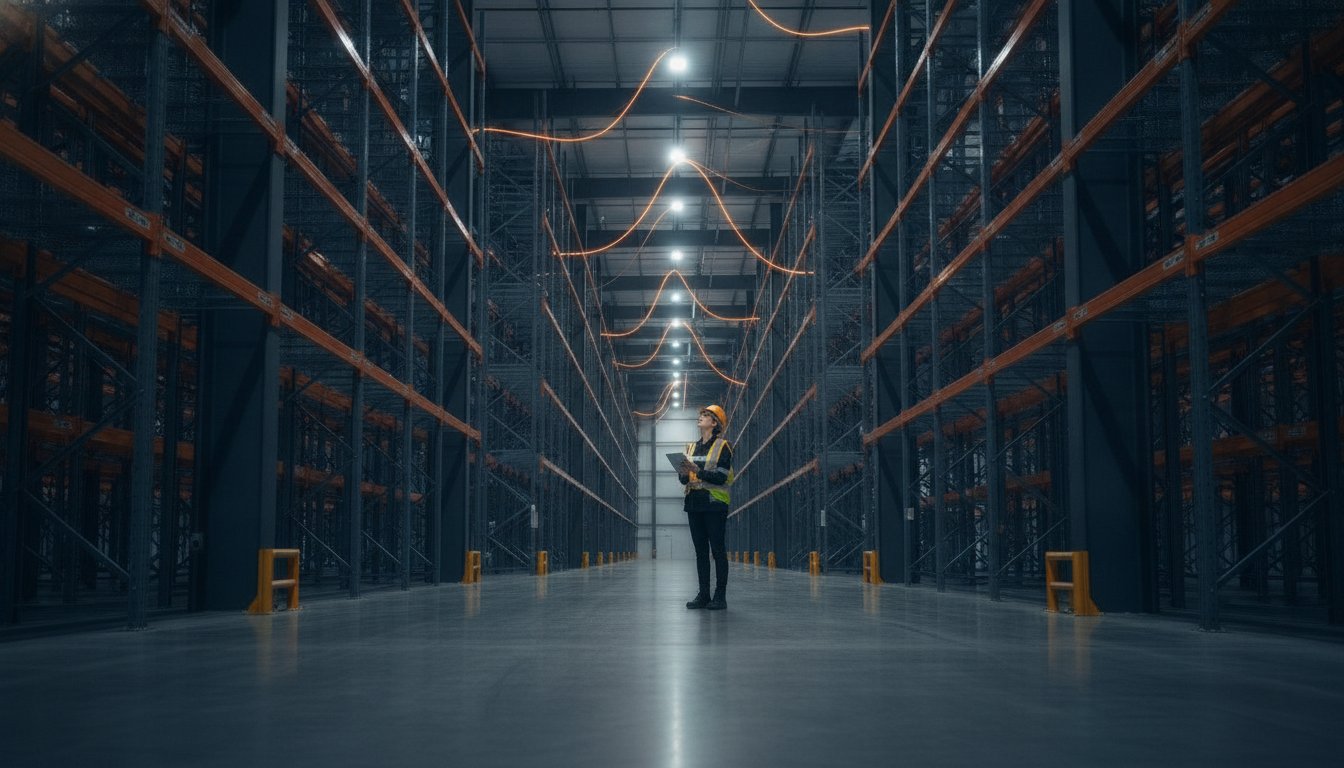
What if your warehouse floorplan could change overnight without a single sparky pulling a new cable? Most facility managers accept that updating wireless lighting for warehouses means weeks of disruption, expensive contractor bills, and a rigid system that’s outdated the moment the racking moves. It’s a frustrating bottleneck that keeps energy costs high and operations stagnant. You already know that your current hardwired setup is more than just inflexible. It’s actively costing you money every time your business evolves or your storage needs shift.
The good news is that modern efficiency is no longer about the globes; it’s about the control. You can modernise your facility without the cost and downtime of a total rewire. This 2026 Australian guide shows you how to use long-range switching modules and kits to create a system that scales with your business. We’ll explore how to achieve lower energy bills through better control and quick installations that keep your team working while the upgrade happens. It’s time to stop planning around your wiring and start making your lighting work for you.
Key Takeaways
- Modernise your facility by decoupling switches from fixtures to gain instant layout flexibility without the need for expensive and disruptive rewiring.
- Discover how modern RF technology provides reliable wireless lighting for warehouses, penetrating steel and concrete industrial environments with ease.
- Save on commercial contractor fees and avoid business downtime by choosing modular retrofits over full lighting overhauls.
- Follow a practical site audit checklist to identify high-traffic zones and plan a scalable lighting upgrade that perfectly matches your current floorplan.
Understanding Wireless Lighting for Warehouses and Industrial Spaces
Wireless lighting for warehouses is fundamentally about breaking the physical link between the power source and the user interface. In a standard industrial setup, your lighting zones are defined by the copper cables hidden in your ceiling or conduit. If the cable doesn’t go there, the switch can’t go there. Wireless control changes this by placing a compact receiver at the fixture. This receiver communicates with a switch that can be placed anywhere, regardless of where the mains power is located.
This shift represents a major move toward modular industrial hardware. By 2026, the industry has largely moved away from complex, software-heavy platforms that require a subscription or a degree in IT to manage. Instead, pragmatic Australian operators are choosing hardware-based switching modules that offer simplicity and reliability. This approach ensures that your lighting control systems remain functional for decades without needing a software patch or a constant internet connection.
The Problem with Traditional Industrial Wiring
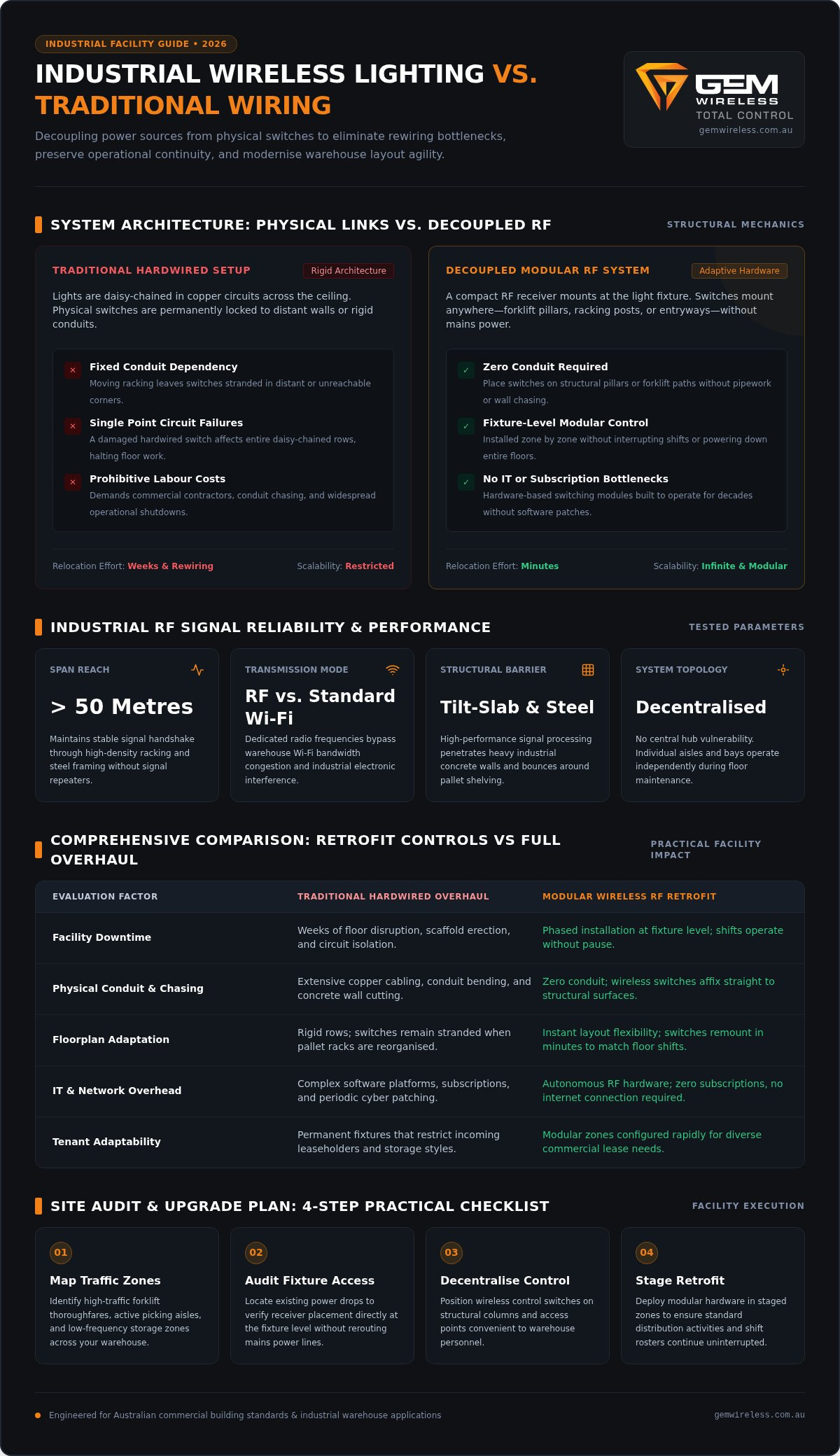
The cost of copper and specialised electrical labour has made traditional rewiring projects prohibitively expensive for many businesses. In older Australian warehouses, lights are often “daisy-chained” together in long, inflexible rows. This creates a functional bottleneck. When you reorganise your racking or change your floorplan, your light switches remain stuck on a distant wall or in an inaccessible corner. Hardwired zones are notoriously rigid; they don’t adapt to the way you actually use your space. If a hardwired switch fails, it often affects an entire circuit, leading to significant downtime while you wait for a contractor to attend the site.
Why Australian Industry is Choosing Wireless Retrofits
Pragmatism is driving the adoption of wireless lighting for warehouses across the country. These systems allow facility managers to meet modern energy efficiency standards without the massive capital expenditure of a full electrical overhaul. It’s about getting the control you need without the headache of a construction project.
- Zero conduit: You can add switches to forklift-accessible areas or structural pillars without running new pipes or chasing walls.
- Tenant flexibility: If you lease your space, you can adapt lighting zones to match new storage layouts in minutes, making the property more attractive to diverse businesses.
- Reduced downtime: Receivers are installed at the fixture level, meaning the work can often be done in stages without shutting down the entire floor.
Retrofitting ensures your facility stays competitive and compliant as Australian building standards continue to evolve. It’s a sensible, forward-thinking way to manage a large-scale industrial environment without being held back by the wiring of the past.
The Technology Behind Reliable Industrial Wireless Switching
Reliability in an industrial setting isn’t just a preference; it’s a safety requirement. Modern wireless lighting for warehouses relies on robust Radio Frequency (RF) technology rather than standard Wi-Fi. While Wi-Fi can struggle with interference and bandwidth congestion, dedicated RF modules operate on specific frequencies designed to cut through the electronic noise of a busy distribution centre. This technology ensures that when a picker hits a switch, the response is instantaneous and consistent.
Many facility managers worry that concrete tilt-slabs and heavy steel racking will block wireless signals. This is largely a myth in 2026. Modern high-performance receivers use advanced signal processing to penetrate industrial structures and bounce around obstacles. Instead of relying on a single central hub that creates a point of failure, these systems use decentralised control. Each row or zone operates independently. This means your facility remains functional even if one area undergoes maintenance, aligning with the latest energy-efficient commercial lighting guidance regarding system resilience and zoned control.
Signal Strength in Steel-Framed Warehouses
Connectivity across 50 metre spans is the baseline for a functional Australian warehouse. High-performance receivers are engineered to maintain a “handshake” with the switch even when buried behind rows of pallet racking. Reliable industrial wireless systems must maintain a stable connection through high-density racking and structural steel over distances exceeding 50 metres. This removes the need for signal repeaters in all but the most massive facilities. If your site has particularly challenging spans, choosing specialised long range switches can provide that extra layer of certainty.
Mains Powered vs. Battery-Free Switching
The industrial standard for receivers is a mains-powered module located at the light fixture. This ensures the receiver is always “listening” and ready to act. However, the switches themselves have seen a massive technological leap. Many modern warehouse switches now use kinetic energy harvesting. Every time you press the button, the physical force of the click generates enough electricity to send the RF signal. This battery-free approach is a game-changer for maintenance teams. It eliminates the need to track and replace batteries across hundreds of remote switches, reducing both your environmental footprint and your long-term labour costs. It’s a simple, set-and-forget solution that keeps your operations running without the friction of constant hardware upkeep.
Comparing Retrofit Wireless Controls vs. Full Lighting Overhauls
Many businesses are told that the only way to achieve modern control is to replace every high-bay in the building. This is often an unnecessary expense. If your current LED or fluorescent fixtures are functional, scrapping them is both a financial waste and an environmental burden. Retrofitting wireless lighting for warehouses allows you to keep your existing infrastructure while adding the sophisticated control you’re currently missing. It’s a pragmatic choice that respects your previous capital investments.
Implementation speed is where the retrofit truly shines. In a 24/7 logistics hub, closing an aisle for even half a day is a massive operational hit. A full overhaul requires extensive cable runs, new mounting hardware, and total fixture swaps. Retrofitting, by comparison, is a surgical strike. You add a module to the existing circuit and you’re done. This approach minimises the footprint of the upgrade and keeps your pickers moving.
The ROI of Retrofitting Existing High-Bays
The maths is simple. A standard module installation takes roughly 15 minutes per fixture. You aren’t paying for weeks of scissor lift hire or teams of contractors to pull new copper through the ceiling. By extending the life of your current LED investment, you’re redirecting capital toward other parts of the business. When making these upgrades, facility managers must ensure they still meet the Safe Work Australia model Code of Practice regarding illumination levels and safe transit. This ensures you maintain safety standards without the price tag of a total rebuild.
Flexibility for Evolving Warehouse Floorplans
Warehouse layouts are rarely static. As racking moves to accommodate new stock, your old hardwired switch zones quickly become a hindrance. Wireless switching gives you the power of instant re-zoning. You can mount switches directly onto steel columns or packing benches using industrial-grade adhesives. This means you can add task lighting controls exactly where they’re needed without a single centimetre of new conduit. It’s about creating a workspace that adapts to your team, rather than forcing your team to adapt to the building’s original wiring. If your storage needs shift next month, you simply move the switch.
Planning Your Warehouse Lighting Retrofit: A Practical Checklist
Success with wireless lighting for warehouses starts with a clear map of your existing electrical infrastructure. Begin by auditing your circuit breakers and identifying how your current lights are grouped. Often, lights are wired in massive blocks that don’t match your daily workflow. This is the moment to decide how you actually want the space to function. You might want the packing area to stay bright while the long-term storage aisles remain dimmed. Identifying these high-traffic zones early allows you to plan for independent switching control that actually saves on power bills.
Once you have your zones mapped, you need to select the right hardware. Consider the physical footprint of your shed to determine the required range for your remote switches. For larger facilities, you’ll need components that can handle significant distances without signal drop-off. You should select the most appropriate wireless switching modules based on your specific load types. Whether you’re running heavy-duty LED high-bays or smaller task lighting, matching the module to the wattage ensures long-term reliability and prevents premature component wear.
Identifying Control Zones and Sensor Placements
Grouping your fixtures by aisle or specific function is far more efficient than sticking to the original wiring plan. Think about where your team naturally enters and exits a zone. This is where you should place manual override switches for safety and convenience. You can also integrate basic occupancy sensors into these zones. This ensures lights only operate when a forklift or staff member is present, providing automated savings without any manual intervention. It’s a simple way to modernise your facility without overcomplicating the user experience.
The Installation Process: What to Expect
You’ll still need a local sparky to handle the mains power, but the job is significantly faster than a traditional rewire. The electrician simply installs the modules at the junction box or the fixture itself. Pairing the switches to the receivers takes seconds and doesn’t require any complex software or Wi-Fi configuration. This simplicity is what makes the 2026 retrofit model so effective for busy sites. Once installed, perform a thorough walk-through to test signal reliability through your racking and stock. High-density storage can sometimes create signal shadows, so testing with a full load of stock is a sensible final step. If you’re ready to start your own facility audit, you can browse our range of switching kits to see which setup fits your floorplan best.
Gem Wireless: Simple Industrial Lighting Control Without the Rewire
Gem Wireless is the pragmatic Australian choice for facilities that need results without the disruption of a construction site. We act as a helpful innovator, doing the hard work behind the scenes so you can focus on your logistics. Our approach to wireless lighting for warehouses is built on sophisticated technology that stays simple to use. For those managing massive distribution hubs, the availability of long range wireless light switches ensures that even the most expansive floorplans remain fully controllable. The core promise is clear: you can modernise your facility and gain total control over your energy bills without the cost, dust, and downtime of a total rewire.
Why Gem Wireless Suits the Australian Industrial Sector
Industrial environments in Australia are notoriously demanding. From high heat in corrugated iron sheds to the constant vibration of heavy machinery, your hardware needs to be hardy. Gem Wireless components are designed specifically for these conditions. Unlike international tech platforms that rely on fragile “smart hubs” or complex internet dependencies, our systems are decentralised and robust. We don’t believe in locking you into ongoing software subscriptions that drain your budget every month. Instead, we provide reliable, standalone hardware supported by local stockists across the country. If a component is needed, it’s available locally, ensuring your operations never skip a beat.
Getting Started with a Wireless Lighting Trial
The easiest way to see the benefits of wireless lighting for warehouses is to start with a small-scale trial. You don’t need to commit to a national rollout on day one. Instead, you can order a single wireless light switch kit to test in a specific high-traffic zone or a single aisle. This allows your team to experience the responsiveness and flexibility of the system first-hand. It is a low-risk way to prove the concept before expanding.
Once the ROI is proven in one area, scaling to a national distribution network is a matter of simple replication. For a broader look at how these systems work across different environments, you can explore our guide to no rewire lighting control. It’s about taking the stress out of modernisation and giving facility managers the tools to fix their own zone issues as they arise. You can start small, move fast, and build a lighting network that actually supports your business growth.
Future-Proof Your Facility with Flexible Control
Modernising your warehouse doesn’t have to be a multi-week construction project that halts your operations. By choosing a retrofit approach, you’re opting for a solution that respects your existing infrastructure while providing the flexibility your business needs to grow. You’ve seen how no-rewire technology can eliminate the mess of traditional electrical work, and how long-range industrial reliability ensures your signal stays strong across the largest spans. It is a sensible way to upgrade without the capital-heavy burden of a total electrical overhaul.
Implementing wireless lighting for warehouses is a pragmatic step toward lower energy bills and a more agile workspace. As an Australian-owned and supported business, we understand the specific demands of local industrial environments. You don’t need to overcomplicate your tech stack to get results; you just need a system that works as hard as your team does. Take the first step toward a more efficient floorplan by exploring our range of modular solutions. Browse our commercial wireless switching kits today and discover how simple it is to bring your facility into 2026. Your modernised warehouse is closer than you think.
Frequently Asked Questions
Will wireless switches work in a warehouse with heavy metal racking?
Yes, modern RF signals are designed to cut through industrial environments. Unlike Wi-Fi, these frequencies bounce off and penetrate steel structures rather than being absorbed. This ensures reliable wireless lighting for warehouses even in high-density storage facilities. If your layout is particularly dense, using specialised long-range modules provides an extra layer of signal security to prevent any dead zones between your racking aisles or heavy machinery zones.
Do I need a special electrician to install wireless lighting modules?
Any licensed local electrician can install these modules. You don’t need a specialist automation contractor or a software engineer to get started. The modules are installed at the junction box or light fixture like any other standard electrical component. This simplicity helps keep your labour costs low and ensures the installation process is as fast as a standard maintenance task without requiring any complex proprietary training or software configuration.
How many lights can a single wireless receiver module control?
A single switching module can control multiple lights provided the total wattage doesn’t exceed the module’s rated load. For large industrial high-bays, you might install one module per fixture for individual control, or one module for a whole row of smaller lights. It’s about matching the hardware to your specific circuit requirements to ensure long-term reliability and efficient power management across your entire warehouse facility.
What happens if the wireless signal is blocked by stock or machinery?
Radio Frequency signals are highly resilient and tend to bounce around machinery and stock rather than being completely blocked. Modern receivers are engineered to maintain a strong signal handshake even in busy logistics hubs. If you do encounter a specific signal shadow, relocating the receiver or switch by just a few centimetres usually resolves the issue. Performing a quick site test with a single kit is a great way to confirm coverage.
Can I integrate wireless switching with my existing motion sensors?
Yes, you can integrate wireless switching modules with your existing occupancy sensors and high-bay fixtures. The module acts as the control bridge, allowing the sensor to trigger the lights wirelessly. This is a smart way to add automated energy savings to zones that don’t need constant illumination. It ensures your wireless lighting for warehouses works in harmony with your current safety hardware without needing a total system replacement or expensive rewiring.
How long do the batteries last in industrial wireless switches?
Many of our industrial-grade switches are completely battery-free and use kinetic energy harvesting to power the signal. Every time you press the switch, the physical movement generates the electricity needed to communicate with the receiver. This eliminates the maintenance burden of tracking and replacing batteries across a large facility. For models that do use batteries, they are typically high-capacity cells designed to last several years under normal industrial use.
Is wireless lighting control compliant with Australian electrical standards?
Wireless lighting control is fully compliant with Australian electrical standards, provided the hardware is installed by a licensed electrician. Our modules are designed to meet the relevant AS/NZS standards for commercial and industrial buildings. Using these systems often makes it easier to comply with modern energy efficiency mandates because they allow for more granular control over your power consumption without requiring a full, capital-heavy rewire of the building.
What is the maximum range for a long-range wireless industrial switch?
Our long-range switches are designed to maintain a stable connection over distances exceeding 50 metres in typical industrial settings. In clear line-of-sight conditions, this range can be significantly further. This capability is essential for large-span distribution centres where switches need to communicate with receivers mounted high in the rafters. It ensures you have total control from the warehouse floor without needing to install expensive signal repeaters or additional cabling through the ceiling.
commercial lightingenergy efficiencyfacility managementretrofit guidesmart warehousingwarehouse lightingwireless controls