- Empty cart.
- Continue Shopping
7 Ways Builders Cut Electrical Labour Costs Without Cutting Corners
- Posted on
 Strong Digital
- 0
- Categories: Blog

Last Updated: October 26, 2026
Quick Summary
Builders can reduce electrical labour costs by planning before work starts, defining scope clearly in writing, and using installation methods like wireless lighting controls that eliminate expensive rewiring. These strategies cut costs without compromising quality or safety.
- A planning checklist covering site conditions, materials, access, and switchboard capacity prevents 20% cost overruns.
- Electrical contractor quotes vary by 30% or more due to scope differences, not labour rates alone.
- Wireless lighting controls eliminate in-wall rewiring, reducing installation time from a full day to one or two hours.
- Coordinating site access and material delivery 48 hours before work prevents costly electrician waiting time.
- A detailed scope of work template prevents scope creep and mid-project change order disputes.
Table of Contents
- Why Electrical Labour Costs Spiral on Building Projects
- Create an Electrical Project Planning Checklist Before Work Starts
- Compare Electrical Contractor Quotes With a Clear Scope
- Use an Electrical Scope of Work Template to Define Boundaries
- Wireless Lighting Controls Installation Cuts In-Wall Rewiring Time
- Coordinate Site Access and Material Delivery to Reduce Delays
- Getting Started With Cost-Effective Electrical Solutions
- Frequently Asked Questions
Why Electrical Labour Costs Spiral on Building Projects
Electrical labour costs are one of the biggest budget surprises on building projects. A job quoted at $50,000 can balloon to $70,000 before the first wall is closed. The culprit isn’t always poor estimating, it’s often poor planning. Establishing a more disciplined approach to site management is essential for reducing project budget overruns and ensuring that initial estimates remain accurate throughout the construction lifecycle.
Most projects suffer from the same mistakes. Site access gets delayed. Materials arrive late. Scope creeps because nobody wrote down what “finished” actually means. Electricians spend hours troubleshooting instead of installing. Each delay compounds. Each change order adds labour time. Before you know it, the margin is gone.
The good news: these cost spirals aren’t inevitable. Builders who reduce electrical labour costs do three things differently. They plan before work starts. They define scope clearly. They use technology to avoid expensive rewiring.
This guide covers practical strategies that actually work. Builders can cut electrical labour costs by changing how they approach planning, quoting, and installation methods. None of these require cutting corners or sacrificing quality.
Electrical projects commonly experience cost overruns through predictable mistakes that compound over time.
| Problem | Cause | Impact on Labour Costs |
|---|---|---|
| Site access delays | Poor coordination with other trades | Electricians bill for waiting time |
| Late material delivery | Inadequate ordering lead time | Schedule shifts, project delays |
| Unclear scope | No written definition of work | Scope creep, change orders, rework |
| Troubleshooting instead of installing | Poor planning before work starts | Hours spent on site diagnostics |
| Quote variations of 30%+ | Different scope interpretations | Difficult to compare contractor bids accurately |
Create an Electrical Project Planning Checklist Before Work Starts
Planning before the first electrician arrives saves thousands in labour. A simple checklist prevents the mistakes that eat up hours on site.
Your checklist should cover five areas: site conditions, material availability, access logistics, switchboard capacity, and timeline constraints. Document existing wiring, identify neutral wire availability, and confirm whether you’re working in a new build or retrofit. Check that all materials will arrive on schedule. Confirm site access dates with other trades. Verify the switchboard can handle the load. Set realistic start and completion dates.
The difference between a project that runs smoothly and one that doesn’t often comes down to whether these five things were confirmed before day one.
Many builders skip this step because it feels like admin work. It’s not. It’s the difference between a job that costs what you quoted and one that costs 20% more. When electricians show up to find no site access, no materials, or unclear requirements, they’re billing you for waiting time and rework.
A written checklist also protects you in disputes. When a client asks why labour costs rose, you can show exactly what changed and why. That clarity matters.
Compare Electrical Contractor Quotes With a Clear Scope
Getting three quotes is standard practice. What’s not standard is comparing them properly. Most builders compare price alone. That’s backwards.
When quotes vary by 30% or more, the difference usually isn’t labour rates, it’s scope interpretation. Learn how to justify and understand the margins in electrical contractor pricing so you can evaluate quotes with confidence. One contractor included site clean-up. Another didn’t. One assumed new conduit throughout. Another assumed existing conduit could be reused. One quoted a full day for switchboard work. Another quoted two hours.
This is where a detailed scope document becomes essential. Before you send quotes out, write down exactly what the job includes. List every circuit. Specify conduit runs. State whether existing wiring will be reused or replaced. Define what “finished” means for each area. Include site access, material delivery, and clean-up expectations.
When contractors quote from the same scope, their prices become genuinely comparable. You’re no longer comparing apples and oranges. You’re comparing actual labour rates and efficiency.
Standards Australia’s wiring guidelines set minimum requirements for electrical installations. Your scope should reference these standards so contractors know exactly what they’re installing to.
Another benefit: a clear scope prevents the “we’ll charge extra for that” conversations mid-project. The contractor knows what’s included. You know what you’re paying for. Changes get documented as change orders, not surprises.
Use an Electrical Scope of Work Template to Define Boundaries
A scope of work template saves time and prevents misunderstandings. It’s a document that lists every task, every material, and every deliverable.
Your template should include:
- Circuit schedule with load calculations
- Conduit routing and sizing
- Cable types and quantities
- Switchboard modifications (if any)
- Outlet and switch locations
- Testing and certification requirements
- Site access and material delivery dates
- Clean-up and site restoration
- Timeline and milestone dates
When you use the same template for every project, contractors get familiar with your format. They quote faster. They make fewer assumptions. They know what you expect.
A good template also prevents scope creep. When a client asks for an extra outlet mid-project, you can show them exactly what was included in the original scope and what the addition will cost. That conversation becomes straightforward instead of contentious.
The National Electrical Code guidelines outline what must be documented in electrical work. Your scope template should align with these requirements so there’s no confusion about compliance.
Many builders create a template once and use it for years. That template becomes your standard. Contractors know what to expect. Clients know what they’re getting. Labour costs stay predictable.
Wireless Lighting Controls Installation Cuts In-Wall Rewiring Time
In-wall rewiring is one of the most labour-intensive parts of electrical work. Running new conduit through walls, pulling cable, and installing switches takes time. That time costs money.
Wireless lighting controls eliminate this step entirely. Understanding the full cost comparison between wireless and traditional wiring helps you make the right choice for your project. Instead of running new wiring, electricians install wireless switch modules that communicate with existing circuits. No conduit. No cable pulling. No wall damage that needs patching.
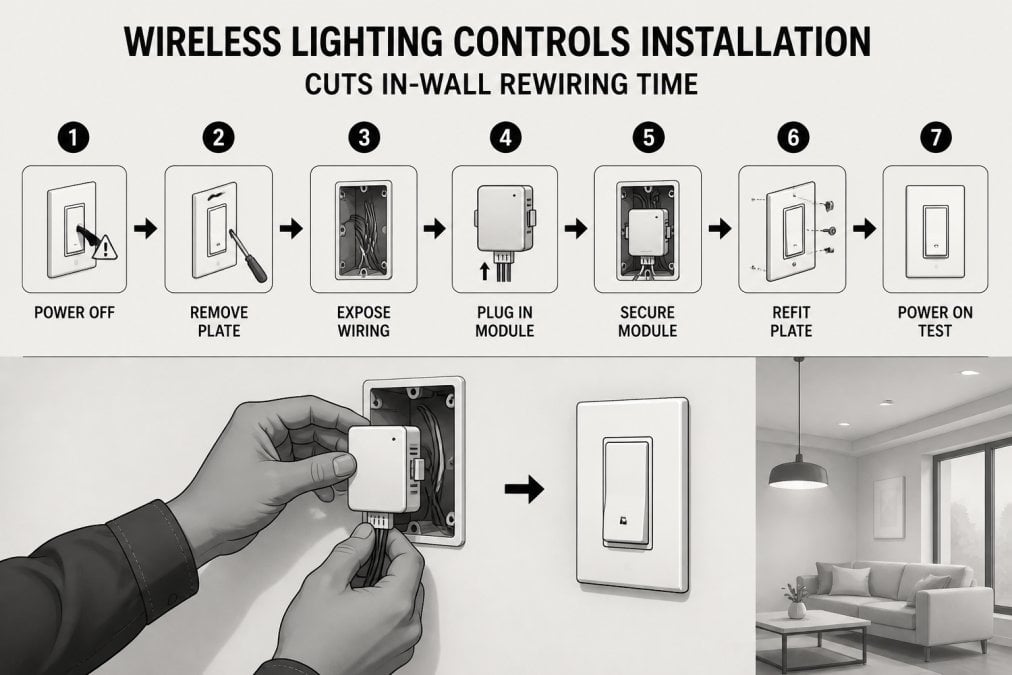
The labour saving is significant. What might take a full day of rewiring work takes an hour or two to install wireless controls. For builders managing multiple properties or large projects, this difference compounds quickly.
Gem Wireless wireless switch modules work with existing electrical infrastructure. No neutral wire requirement in many cases. No special wiring. Just install the module, connect it to your existing circuit, and control it from your phone or wall switch. This approach works for new builds and retrofits alike.
The cost advantage goes beyond labour. You avoid the cost of conduit, cable, and wall repairs. You avoid the disruption of opening walls. You avoid the timeline delays that come with rewiring work.
For builders looking to reduce electrical labour costs without compromising functionality, wireless controls are one of the fastest wins available. You get modern lighting control with a fraction of the installation effort.
Coordinate Site Access and Material Delivery to Reduce Delays
Delays are labour cost killers. When an electrician arrives to find the site locked or materials haven’t arrived, you’re paying for waiting time. That waiting time is pure waste.
Coordination prevents this. Confirm site access 48 hours before work starts. Verify that materials have been delivered and are stored safely on site. Check that other trades won’t block electrical work. Confirm parking and unloading access for delivery vehicles.
This sounds like basic logistics. It is. But many projects skip it because nobody owns the coordination task. It falls through the cracks. Then the electrician shows up and finds the site isn’t ready.
A simple coordination schedule prevents this. List every date when electrical work is scheduled. For each date, confirm site access, material availability, and trade coordination. Send this schedule to the site manager, the contractor, and anyone else who needs to know.
When everyone knows the schedule and knows their role in making it work, delays drop dramatically. Labour stays productive instead of wasted on waiting.
Material delivery deserves its own attention. Order materials early enough that they arrive before work starts. Confirm delivery dates with your supplier. Have a plan for storage on site. When materials arrive late, the entire schedule shifts. The electrician either sits idle or moves to another job. Either way, your project gets delayed and costs rise.
Getting Started With Cost-Effective Electrical Solutions
Reducing electrical labour costs doesn’t mean cutting quality or taking shortcuts. It means working smarter.
Start with a planning checklist before your next project. Confirm site conditions, material availability, and access logistics. Write a detailed scope of work so contractors can quote accurately. Use that scope to compare quotes properly instead of just comparing prices.
For new builds and retrofits, consider wireless lighting controls where they make sense. The labour savings are real. The installation is straightforward. The functionality is modern.
Coordinate site access and material delivery so electricians stay productive. Every hour of waiting time is labour cost that doesn’t add value.
Gem Wireless helps builders reduce electrical labour costs through wireless automation solutions that eliminate expensive rewiring. Our wireless switch modules integrate with existing electrical systems, cutting installation time and material costs significantly. No neutral wire required in most cases. Plug-and-play integration. Mobile app control. The same functionality as traditional wiring at a fraction of the labour cost.
If your projects are struggling with electrical labour costs, the issue is usually planning, scope clarity, or installation method, not the electricians themselves. Fix those three things and your costs will follow.
Frequently Asked Questions
How much can builders realistically reduce electrical labour costs on a typical project?
Labour savings depend on project scope, existing infrastructure, and installation method. Builders who adopt wireless lighting controls and improved planning can reduce electrical labour hours compared to traditional in-wall rewiring. Early planning and clear scope documents also eliminate costly rework and site delays. Results vary by project type and complexity, so obtain quotes from contractors familiar with your specific requirements.
Will wireless lighting controls work in older properties with no neutral wire in the walls?
Many older properties lack neutral wires at switch locations, which complicates traditional smart installations. Wireless lighting control systems bypass this problem entirely because they don’t require in-wall rewiring or neutral connections. They operate independently and integrate with existing light fittings and switches. This makes them ideal for retrofits and renovations where rewiring would be prohibitively expensive or disruptive.
What should an electrical scope of work template include to prevent cost overruns?
A comprehensive scope should specify circuit locations, switch types, load calculations, existing infrastructure assessment, material supply responsibility, site access requirements, and completion timelines. Include details about whether rewiring is needed, what compatibility issues exist, and which party provides materials. A clear scope prevents misunderstandings between builder and contractor, reduces change orders, and allows accurate quoting. Templates should be specific to your project type, residential, commercial, or retrofit.
How do I justify my labour quote if wireless controls cut installation time in half?
Your quote reflects the value delivered, not just hours worked. Wireless solutions provide benefits beyond speed: no wall damage, easier future modifications, superior functionality, and faster project completion that benefits your schedule and reputation. You’re charging for expertise, reliability, and the ability to deliver high-tech control without disruption. Clients value finishing on time and within budget more than your internal labour efficiency. Position wireless controls as a premium solution that justifies your rate.
Get in touch with Gem Wireless today to discuss how wireless lighting controls can reduce electrical labour costs on your next project. We’ll show you exactly how the installation works and what you can expect to save.

compare electrical contractor quoteselectrical project planning checklistelectrical scope of work templatereduce electrical labor costs for buildersreduce electrical labour costs