- Empty cart.
- Continue Shopping
Mains Powered Wireless Switch vs Battery Options: Australian Guide
- Posted on
 Strong Digital
- 0
- Categories: Uncategorized
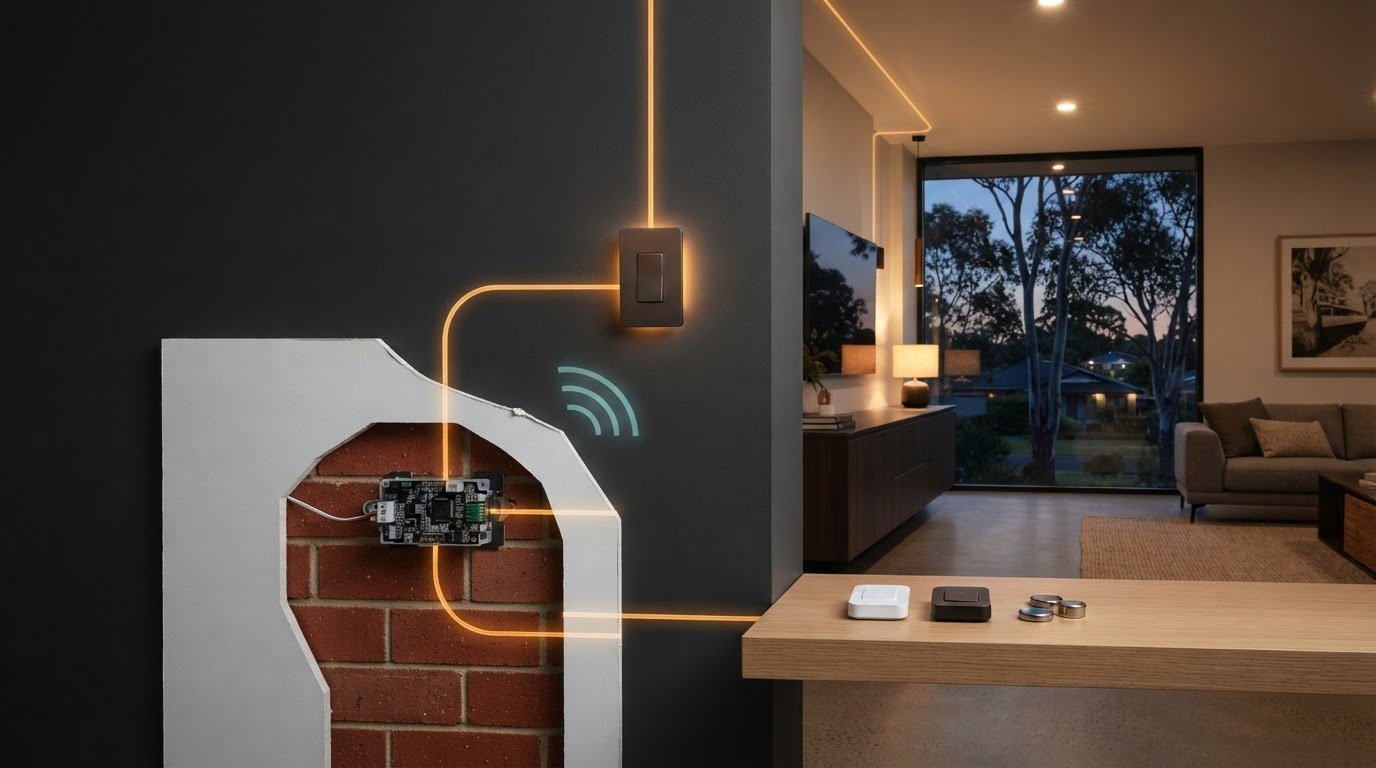
The simplest wireless lighting setup isn’t always the one running on disposable batteries. While sticking a battery-operated button on the wall seems effortless, dealing with dead coin cells in the dark or wrestling with child-resistant safety latches quickly wears thin. On the other hand, cutting into pristine plasterboard or chasing solid brick to run switch drops creates unnecessary mess, repainting expenses, and disruption. Installing a mains powered wireless switch bridges that gap, giving you the rock-solid reliability of continuous electricity without running physical switch-leg cables down your walls.
You shouldn’t have to choose between permanent power and an easy installation. In this guide, you’ll discover how a mains powered wireless switch works, how it compares to battery and kinetic alternatives, and how it simplifies Australian retrofit projects. We’ll explore the mechanical differences between each setup, clear up the rules surrounding Australian wiring standards, and help you pinpoint the most dependable wireless architecture for your property without ongoing maintenance headaches.
Key Takeaways
- Understand how a mains powered wireless switch combines continuous 240V operation with RF control to eliminate dead battery replacements permanently.
- Compare the distinct maintenance cycles, child-safety regulations, and operational reliability of mains-fed, battery, and kinetic switching systems.
- Protect heritage plaster, tiles, and solid double-brick walls by bypassing invasive switch-leg cabling and messy wall chasing.
- Identify the right switching modules to safely manage different lighting circuits, LED drivers, and inductive ceiling fan loads.
- Learn how wireless receivers integrate behind standard Australian architectural switch plates for a clean, modern finish.
What Is a Mains Powered Wireless Switch in Modern Installations?
Traditional domestic lighting relies on continuous copper cable running from the switchboard, through the ceiling cavity, and down into a wall switch-drop. A mains powered wireless switch re-engineers this architecture. It operates as a hybrid control solution, drawing direct 240V electrical power while transmitting switching commands across dedicated radio frequencies (RF). By decoupling the physical switch interface from the light fitting, it eliminates the need to run vertical cabling down finished walls.
The evolution of modern electronic and wireless light switches has made complex multiway traveler wiring obsolete. Instead of cutting channels into masonry or plasterboard, property owners achieve permanent, set-and-forget control without ever scheduling another battery replacement.
The Anatomy of a Mains Powered Wireless System
A mains-fed wireless installation divides switching tasks between two distinct hardware elements:
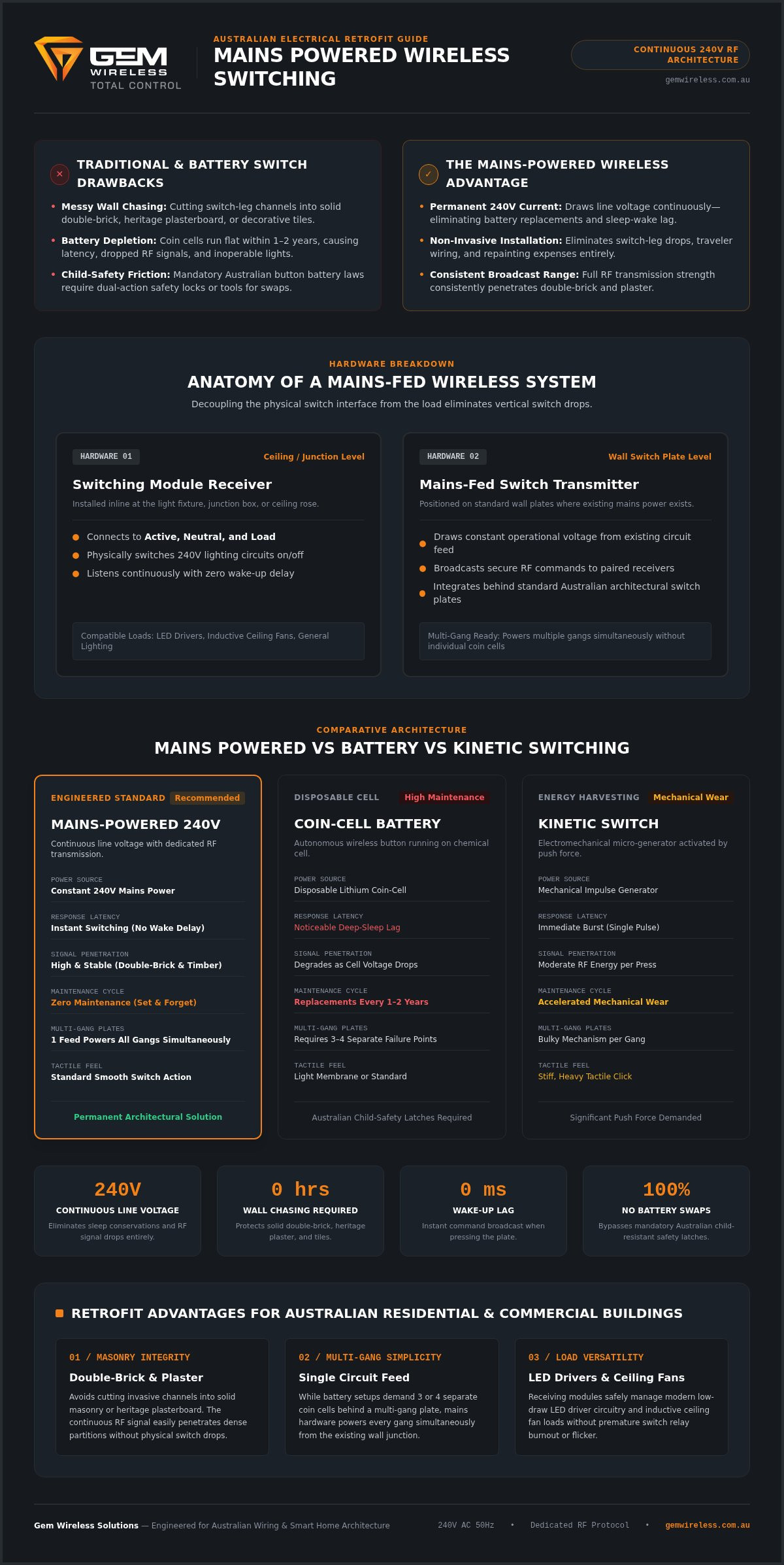
- The Switching Module Receiver: Installed inline at the light fixture, junction box, or ceiling rose. This compact unit connects directly to the 240V circuit (active, neutral, and load) to switch the lights physically on and off.
- The Mains-Fed Switch Transmitter: Positioned on the wall or ceiling junction where existing mains power is readily accessible. It draws constant operational voltage to broadcast secure RF signals to the paired receiver module without any switch-leg cabling between them.
This layout integrates neatly with standard Australian lighting circuits, making it exceptionally fast to modernise established homes and commercial spaces.
Why Constant 240V Power Matters for Wireless Reliability
Battery-powered alternatives inevitably rely on deep-sleep modes to preserve energy. That conservation cycle often causes noticeable switching lag, and over time, weakening coin cells lead to dropped signals. A mains powered wireless switch solves this issue through steady electrical current.
Because the internal receiver maintains constant line voltage, switching commands trigger instantly. There is no wake-up delay when you press the plate. Continuous power also preserves consistent transmission strength, easily penetrating dense plaster, double-brick, and timber partitions across residential and commercial layouts.
Mains Powered vs Battery and Kinetic Wireless Switches
Choosing between wireless control architectures comes down to balancing installation effort against long-term maintenance. While coin-cell battery switches offer stick-anywhere convenience and kinetic options harvest physical energy, a mains powered wireless switch provides an uninterrupted 240V power baseline. Aligning your lighting strategy with official Australian Government smart home guidance means looking beyond quick fixes to build a genuinely resilient electrical layout.
Multi-gang plates highlight these technical differences immediately. Fitting three or four separate battery cells behind an architectural switch plate creates multiple failure points. In contrast, running mains-fed hardware behind the plate powers every gang simultaneously from the existing circuit feed. For multi-room renovations or commercial spaces, sourcing engineered hardware from Gem Wireless Solutions ensures multi-gang configurations communicate without dropped commands.
Maintenance and Lifespan Realities
Coin-cell batteries inevitably run flat. In busy households, high-use switches run out of juice within one to two years, leaving lights inoperable at the worst times. Australia’s mandatory button battery safety laws also mean opening these compartments requires child-resistant tools or dual manual actions, turning a quick battery swap into a frustrating chore.
Kinetic switches bypass chemical cells by using electromechanical micro-generators. Every press generates a tiny burst of electricity. However, harvesting that physical energy requires substantial mechanical force, creating a stiff, heavy tactile click that accelerates mechanical wear over time. Mains powered alternatives eliminate both issues, delivering standard switch feel with permanent, zero-maintenance operation.
Signal Range and Signal Consistency
Radio frequency performance drops as battery voltage declines. When a coin cell steadily discharges, its effective RF broadcast strength shrinks. Signals that easily passed through stud walls when the battery was new begin failing to penetrate double-brick, masonry, or double-stud acoustic partitions as the cell weakens.
Direct mains connection solves this by supplying full transmission wattage on every press. The broadcast range remains identical on day 1,000 as it was on day one. For large domestic layouts, outbuildings, or workshops where structural distance pushes standard frequencies to their limits, pairing your setup with dedicated long range wireless light switches keeps distant fixtures instantly responsive.
Key Architectural and Retrofit Advantages for Australian Buildings
Retrofitting lighting controls into established Australian properties often uncovers major structural hurdles. Solid masonry, double-brick walls, and fragile lath-and-plaster ceilings make running new copper wiring a logistical nightmare. Traditional methods require cutting vertical channels into brickwork, tearing open finished plasterboard, or pulling off decorative timber architraves. These invasive techniques create dust, extend project timelines, and rack up substantial plastering and repainting bills.
Adopting modern control hardware bypasses these structural bottlenecks entirely. By referring to the Your Home lighting controls and design guide, property owners can plan efficient zoning layouts that reduce standby power while respecting architectural integrity. Wireless switching decouples the switch position from the physical load, keeping renovation schedules intact.
Eliminating the Switch-Drop in Challenging Walls
Pulling cables down external double-brick cavity walls or heavily insulated internal partitions routinely stalls renovation schedules. In older Australian homes built before 1990, cutting into wall linings also introduces serious risks around disturbing hidden asbestos fibro sheeting. A mains powered wireless switch avoids these hazards completely.
Electricians simply place the receiving module at the ceiling light point or existing junction box. The switch itself mounts exactly where daily traffic needs it, integrating cleanly over finished surfaces without invasive channel cuts. Exploring proven strategies for no rewire lighting control ensures you protect expensive finishes like splashback tiles, delicate heritage cornices, and bespoke timber panelling from accidental construction damage.
Versatile Two-Way and Multi-Point Switching
Creating multi-way switching in long hallways, stairwells, or open-plan living areas used to require complex three-core traveler cables and specialized mechanical intermediate switches. If the original cabling was not roughed in during the initial framing stage, adding an extra switch point later was rarely practical.
Wireless receivers simplify multi-point control into a fast pairing process. A single receiving module inside the ceiling can link to multiple switch transmitters across the room. You can place one switch at the front entrance, another at the far end of the hallway, and a third right beside a master bed. Each unit commands the same lighting group reliably, cutting hours of rough-in labour while giving occupants total control over their living spaces. For properties where adding a new control point without cutting into walls is the priority, a wireless relay for lights offers a practical retrofit solution that pairs with compatible switches to send lighting commands without new switch cabling.
Selection and Installation Criteria for Property Owners
Selecting the right wireless setup requires evaluating your electrical loads, building structure, and interior styling. A mains powered wireless switch integrates directly with standard Australian architectural switch plates, allowing you to upgrade circuit controls without altering your designer faceplates. However, matching hardware specifications to your actual lighting circuits prevents unexpected failures and ensures safe, compliant operation.
Matching Electrical Loads and Switch Ratings
Calculating overall circuit wattage is essential before finalising your hardware. Modern LED downlights and strip lighting draw very low continuous power, but their internal drivers produce brief, intense inrush currents upon start-up. In addition, circuits powering bathroom exhaust fans or ceiling sweeps create inductive motor loads that place unique stress on switching mechanisms. Understanding how a wireless switch for exhaust fans handles these inductive loads — and what compatibility checks are required before installation — helps you select modules that won’t fail under real-world operating conditions.
Selecting robust wireless switching modules rated for both resistive lighting and inductive loads ensures your relays won’t weld shut during daily operation. Verifying these electrical ratings guarantees long-term durability across high-output pendants, multi-downlight arrays, and ventilation fixtures.
Receiver Placement and Professional Installation
Physical placement influences both signal performance and ease of access. Receiving modules commonly fit within ceiling cavities directly beside the light fixture, inside standard electrical junction boxes, or recessed behind existing switch plates. While radio signals pass through timber and standard drywall easily, installers should avoid placing modules inside fully sealed metal enclosures or beneath heavy foil insulation batts, which act as shields against RF signals.
Fixed 240V wiring must always be handled correctly. Under Australian AS/NZS 3000 wiring standards, hardwiring a mains powered wireless switch or receiver module legally requires a licensed electrical contractor. Your electrician ensures proper 30mA RCD subcircuit protection, checks loop impedance, and issues an official compliance certificate once work wraps up.
Ready to upgrade your property? Explore the certified hardware lineup at Gem Wireless Solutions to select the ideal switching modules and kits for your upcoming project.
Modernising Lighting Control with Gem Wireless Solutions
Upgrading lighting circuits across Australian buildings shouldn’t mean compromising on aesthetics or tearing into finished walls. Gem Wireless Solutions engineers practical hardware designed specifically for seamless architectural retrofits. By replacing complex switch-leg wiring with smart RF communication, these systems deliver reliable control across home renovations, multi-storey residential builds, and commercial office fit-outs nationwide.
Instead of sourcing mismatched components from various suppliers, trade professionals and property owners can turn to complete Switch Module Kits. These packages pair pre-configured modules with transmitters right out of the box, drastically cutting down installation time and removing guesswork on site.
Engineered for Invisible, High-Performance Control
Maintaining the visual flow of a space is just as important as the switching technology behind it. Gem Wireless Switching Modules tuck neatly out of sight inside ceiling spaces, luminaire canopies, or wall cavities. Because the hardware operates behind the scenes, you don’t need to replace your architectural switch plates with bulky third-party touchpads.
Occupants enjoy the exact tactile response of standard mechanical wall switches, backed by the continuous reliability of modern wireless communication. For a comprehensive walkthrough on mapping out your installation and selecting matching modules, review our detailed wireless light switch kit guide.
Getting Started with Your Switching Upgrade
Executing a clean lighting retrofit across your property involves three simple steps:
- Map Your Requirements: Walk through your living spaces or commercial floor plates to identify switch positions, light circuits, and inductive loads like exhaust fans.
- Source Proven Hardware: Choose dedicated Switch Module Kits or individual Mains Powered Switches directly online or through verified regional trade stockists across Australia.
- Engage a Licensed Electrician: Hand the hardware to your electrical contractor, who can wire the modules into your 240V subcircuits quickly and safely without chasing a single groove into your walls.
Adopting a mains powered wireless switch gives you an enduring, set-and-forget lighting layout that protects your walls, streamlines project timelines, and eliminates maintenance cycles for good.
Streamline Your Lighting Controls with Permanent Wireless Power
Modernising your property’s lighting doesn’t require tearing into double-brick walls, patching plasterboard, or settling for recurring coin-cell battery replacements. Installing a mains powered wireless switch delivers the uninterrupted reliability of 240V electricity alongside the effortless flexibility of RF control. You skip the mess of chasing masonry while keeping the familiar tactile feel of your favourite wall plates. Zero invasive wall cabling or plaster repair is required, and the hardware is engineered to integrate seamlessly with existing Australian switch plates.
Take command of your next residential renovation or commercial fit-out without compromising on building aesthetics or project deadlines. Backed by reliable nationwide delivery and trade stockist support across Australia, creating a clean, modern electrical layout is fast and hassle-free. Explore Gem Wireless Switch Module Kits today to equip your property with durable, set-and-forget lighting control built for the long haul.
Frequently Asked Questions
How does a mains powered wireless switch receive power if there is no switch-drop?
A mains powered wireless switch draws electricity directly from existing 240V active and neutral conductors already present at a wall box, power outlet, or junction point. Meanwhile, a paired switching module sits at the ceiling fixture to handle the load. Because the switch communicates with the lighting fixture via radio frequency signals, your electrician doesn’t need to pull a physical switch-leg cable between the wall plate and the ceiling.
Do I need a licensed electrician to install a mains powered wireless switch in Australia?
Yes, Australian law requires a licensed electrical contractor to install any fixed 240V equipment. Under AS/NZS 3000 wiring rules, hardwiring a mains powered wireless switch or connecting an in-line receiver module into your electrical subcircuits is classified as prescribed electrical work. Licensed electricians ensure your lighting circuits meet mandatory 30mA RCD safety requirements and issue an official certificate of electrical safety upon completion. DIY installation on mains voltage is illegal and voids property insurance.
Can a mains powered wireless switch control dimmable LED lights and exhaust fans?
Yes, provided you select modules rated for those specific electrical loads. Switching modules easily handle inductive motor loads like ceiling sweeps and bathroom exhaust fans, along with standard resistive lighting circuits. For dimming LED lights, you need a compatible dimming module paired with phase-dimmable LED drivers. Verifying the module’s total wattage and inrush capacity beforehand ensures smooth motor start-ups and flicker-free lighting control across all connected fixtures. Before committing to a module, review what a wireless switch for exhaust fans requires in terms of compatibility checks and receiver specifications to avoid mismatched hardware.
What happens to a mains powered wireless switch during a household power outage?
The system temporarily powers down during a blackout, just like any standard wired light switch. Because the modules and transmitters rely on household mains electricity, they cannot operate fixtures without grid power. However, modern switching modules feature non-volatile internal memory. Once power is restored, the hardware instantly reconnects, retains all stored RF pairing codes, and returns to its pre-programmed state without requiring manual re-pairing or system reboots.
How far can a mains powered wireless switch transmit through interior walls?
Standard RF wireless switches reliably transmit through 20 to 30 metres of typical indoor building materials, including timber studs, plasterboard, and masonry. Solid double-brick or concrete partitions can absorb some signal strength, but continuous 240V power ensures full transmission output on every click. If you need to span long distances between separate structures or across expansive commercial floor plates, dedicated Long Range Switches provide enhanced coverage without signal dropouts.
Can I keep my home’s existing decorative wall plates with a wireless switching module?
Yes, you can retain your original architectural and decorative wall plates. Compact switching modules are designed to mount cleanly behind standard Australian switch plates or inside the ceiling cavity beside the luminaire. This means you don’t have to swap your designer finishes or matching faceplates for mismatched smart panels. Occupants continue using the standard mechanical rocker switches while the wireless module handles the electrical switching behind the scenes.
Why choose a mains powered wireless switch over a battery-operated alternative?
Mains-powered units provide permanent reliability without recurring maintenance cycles. Battery-operated switches eventually run flat, causing sudden control loss and requiring fiddly replacements with child-resistant safety latches. A mains powered wireless switch also avoids the signal lag common in battery units that drop into deep-sleep modes. You get instantaneous switching response, consistent transmission strength through heavy walls, and total peace of mind knowing the switch will never run out of juice.
Australian electricalelectrical retrofithome renovationlighting automationmains powered wireless switchRF switchsmart lightingwireless light switch